
Paid online consultations are available by appointment. For booking, please contact us via Whatsapp.

In short
What Is Microvascular Decompression Surgery?
Microvascular decompression (MVD) is an operation for trigeminal neuralgia. It moves an artery or vein off the trigeminal nerve and cushions the nerve with a small Teflon pad. As a result, the nerve stops sending pain signals, often right after surgery.
Surgeons also call it the Jannetta procedure. It takes about 2-3 hours under general anesthesia, through a coin-sized opening behind the ear.
In contrast to needle procedures and radiosurgery, MVD does not damage the nerve on purpose. Therefore, European guidelines recommend it as the first-choice surgery for classical trigeminal neuralgia.
MVD at a glance
In short, six facts sum up the operation.
- Treats the causeRemoves the vessel's pressure instead of injuring the nerve
- Keyhole openingA coin-sized opening behind the ear on the painful side
- 2-3 hoursTypical operating time under general anesthesia
- Fast reliefMany patients wake up without their typical attacks
- Long-lasting7 in 10 are pain-free without medicine at 10 years
- Short hospital stayUsually a few days, then about a month to full routine
However, MVD works only on a cranial nerve inside the skull. For surgery on nerves in the arms or legs, such as carpal tunnel release, see peripheral nerve entrapment treatment.
Where Are You in Your Decision?
First, pick the line that matches you. Then, each link explains what it means for surgery.
- 01Medicines no longer control the painWhy surgery comes after medicine, and when
- 02Your MRI shows a vessel on the nerveWhat the scan tells the surgeon
- 03Worried about age or other illnessesWho can safely have MVD
- 04Pain returned after another procedureMVD after radiosurgery or a needle procedure
- 05Planning surgery from abroadLength of stay, flights and what to bring
Who Is a Good Candidate for Microvascular Decompression?
The best candidates have classical trigeminal neuralgia and a vessel pressing on the nerve on MRI. They also need health that allows general anesthesia. In addition, surgery makes most sense once medicine fails.
Pain that medicine no longer controls
Guidelines advise offering surgery when medicine fails or its side effects become hard to bear. For example, rising doses, drowsiness or unsteadiness at work are common reasons.
Waiting for years brings no benefit. In fact, in a large study, pain that had lasted over 8 years made later recurrence more likely.
A vessel pressing on the nerve
First, a high-resolution MRI shows the nerve root and the vessels around it. When an artery clearly presses on or displaces the nerve, MVD targets exactly that problem.
Veins can also press on the nerve, although venous compression carries a higher risk of the pain returning. Conversely, if the scan shows no contact at all, guidelines favor a needle procedure or radiosurgery.
Age and general health
Age alone does not rule out MVD. For example, in a 2026 study, patients aged 80 and over did as well as younger ones. The only difference was more heart rhythm problems.
What matters most is fitness for general anesthesia. Therefore, the team checks the heart, lungs and blood tests before surgery.
Pain after an earlier procedure
MVD remains an option after radiosurgery or a needle procedure. In fact, a study of 1,185 patients found that earlier procedures did not lower the chance of relief.
However, burning or aching pain was more common afterward in patients with an earlier radiofrequency lesion.
Does the type of pain matter?
Yes. Sudden, shock-like attacks respond best. In contrast, constant burning pain is harder to treat with any method, including MVD.
What about multiple sclerosis?
When an MS plaque causes the pain, however, MVD helps less, because no vessel drives it. For this reason, doctors usually prefer medicines, a needle procedure or radiosurgery.
Questions at this stage
Is microvascular decompression brain surgery?
Yes. The surgeon opens a small window in the skull behind the ear and works beside the brainstem. However, the surgeon does not cut the brain, but gently moves it aside to reach the nerve.
Does MVD leave the face numb?
Usually not. MVD aims to keep normal feeling, although about 9 in 100 patients notice some numbness afterward.
Is MVD Right for You?
MVD suits people who want long-lasting relief and can safely have an operation. However, a few situations call for another plan.
MVD is worth discussing if you:
- Have classical trigeminal neuralgia with shock-like attacks
- Have a vessel pressing on the nerve on MRI
- No longer get enough relief from medicine
- Want to avoid the numbness that other procedures cause
Tell your surgeon before planning if you:
- Take blood thinners or have a bleeding problem
- Have hearing loss in the other ear
- Have heart or lung disease
- Had an earlier procedure on the nerve
If MVD is not the best fit, other options still work well. Also, for a side-by-side view, compare all trigeminal neuralgia treatments.
What Is the Success Rate of Microvascular Decompression?
MVD has the highest long-term success of any trigeminal neuralgia procedure. In large studies, for example, about 8 in 10 patients become pain-free. Moreover, 7 in 10 remain pain-free without medicine 10 years later.
Prof. Albayrak's professional profile also reports a 97% success rate for MVD in his own practice. Because studies define success in different ways, ask each surgeon what the figure means.
MVD outcomes in numbers
| Outcome | Figure | Source |
|---|---|---|
| Complete pain relief | 83.5% in a review of 6,847 patients | Xia 2014 |
| Pain-free without medicine at 10 years | 70%, plus 4% with occasional mild pain | Barker 1996 |
| Pain returned during follow-up | 30% over a median of 6.2 years, mostly in the first 2 years | Barker 1996 |
| Yearly relapse after 10 years | Under 1% | Barker 1996 |
| Recurrence versus radiofrequency | 18.3% after MVD, 46% after radiofrequency | Tatli 2008 |
| Prof. Albayrak's reported MVD success | 97% | Professional profile, 2026 |
Will the pain stop right after MVD?
Often, yes: many patients wake up without their typical attacks. In others, the pain fades over days to weeks as the irritated nerve settles.
What Are the Risks of MVD?
Serious complications are rare, but MVD is still brain surgery. A review of 6,847 patients gives a realistic picture:
- Facial numbness: 9.1%
- Facial weakness: 2.9%
- Hearing loss on the operated side: 1.9%
- Cerebrospinal fluid leak: 1.6%
- Wound infection: 1.3%
- Death: 0.1%, about 1 in 1,000
Strokes happen rarely: the largest single-center series found one in 0.1% of patients. Headache, nausea and tiredness often follow in the first days and then settle.
To lower these risks, surgeons also close the brain's covering watertight. In addition, many teams monitor the hearing nerve during the operation.
MVD Recovery Time: What to Expect
Most people feel relief quickly, but the head needs about a month to heal. This timeline shows a typical course; your surgeon then adjusts it to you.
Week by week
| When | What usually happens |
|---|---|
| Day of surgery | A 2-3 hour operation, then close monitoring overnight, often in intensive care |
| Day 1 | Sitting up and walking; medicine controls headache and nausea |
| Days 2-4 | Discharge once you are stable and eating well |
| Weeks 1-2 | Soreness around the wound, gentle walks, no heavy lifting |
| Weeks 4-6 | Return to strenuous exercise and heavy lifting, if your surgeon agrees |
| Months 1-3 | Anticonvulsants tapered slowly, then stopped under medical advice |
How long does it take to recover from MVD surgery?
Most people return to their normal routine in about a month. However, strenuous exercise and heavy lifting usually wait until 4-6 weeks after surgery.
What Affects the Cost of MVD in Turkey?
The cost of MVD depends on the hospital, the length of stay and the tests you need. Therefore, the clinical team prepares a personal estimate when you request an appointment.
- Hospital choice and room type
- Nights in hospital, including any intensive care
- Tests before surgery, such as a new MRI
- Surgeon and anesthesia fees
- Hotel nights, airport transfers and an interpreter if needed
- Travel and stay for a companion
Also, ask what the estimate covers, such as follow-up visits and the care of any complication.
Your surgery in Istanbul
From Your First Message to Flying Home
The journey follows four steps. In turn, each step then answers one practical question.
STEP 01
Before you travel: plan about 10-14 days
For MVD, plan roughly 10-14 days in Istanbul. This covers the consultation, tests, operation and hospital stay. It also leaves about a week of recovery before the flight home.
First, bring a list of every medicine you have tried and its side effects. Also bring earlier MRI discs and reports, and ideally a companion.
Should someone come with me?
Yes, if possible. A companion helps with the hospital days, the hotel stay and the journey home.
STEP 02
Evaluation: confirm that MVD fits
First, Prof. Albayrak confirms that the pain fits classical trigeminal neuralgia. Then, a high-resolution MRI, blood tests, a heart check and an anesthesia assessment complete the picture.
You may also need to pause certain medicines, such as blood thinners, when your doctors advise it.
Do I need a new MRI before surgery?
Often, yes. Surgeons plan MVD on thin-slice sequences that show the nerve and vessels, so an older scan may need updating.
STEP 03
Surgery: step by step
The operation usually takes 2-3 hours under general anesthesia. It follows these steps:
- The team positions you on your side and holds your head steady
- The surgeon makes a curved cut behind the ear and opens a coin-sized window in the skull
- Under the microscope, the surgeon opens the brain's covering and reaches the nerve at the brainstem
- The surgeon frees the artery or vein from the nerve and lifts it away
- A small Teflon pad goes between the vessel and the nerve to keep them apart
- Finally, the surgeon closes the covering watertight and repairs the opening, often with a small titanium plate
Is MVD done with a microscope or an endoscope?
Most surgeons use an operating microscope, and some add an endoscope for a wider view. Either way, the goal is to free the nerve completely.
STEP 04
Recovery and the flight home
You spend the first night under close watch and usually walk the next day. Afterward, most people leave hospital within a few days and rest at a nearby hotel.
UK aviation guidance advises no flights for about 7 days after brain surgery. Trapped air inside the skull can expand at altitude. Therefore, fly only once your neurosurgeon confirms it is safe.
Will I still need medicine after MVD?
Most patients stop their anticonvulsant gradually over the following weeks. However, never stop it suddenly, because that can cause withdrawal problems.
When can I go back to work after MVD?
Many people return to desk work within a month. In contrast, heavy physical work usually waits until 4-6 weeks after surgery.
Your MVD Surgeon in Istanbul
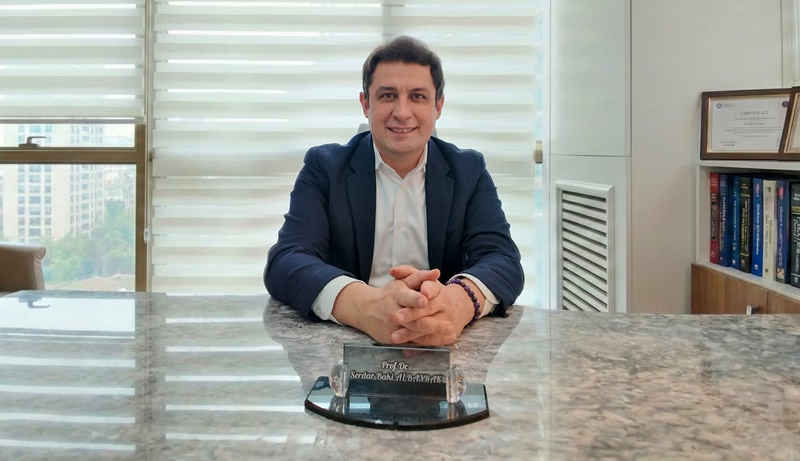
Prof. Dr. Serdar Baki Albayrak
Neurosurgeon · Microvascular Decompression and Cranial Nerve Surgery
MVD is delicate work beside the brainstem, so the surgeon's experience shapes both relief and safety. Prof. Albayrak trained in advanced surgery at Harvard Medical School (Brigham and Women's Hospital). He also completed a clinical fellowship at the University of Helsinki.
27+Years
5,000+Operations
64Countries
Figures from Prof. Albayrak's professional profile, September 2026.
Request an AppointmentFrequently Asked Questions
How much does trigeminal neuralgia surgery cost in Turkey?
Costs depend on the hospital, the length of stay and the tests you need, so they vary between patients. The clinical team then shares a personal estimate after your appointment request.
How long does microvascular decompression take?
Usually 2-3 hours under general anesthesia. However, complex anatomy can take longer, and your surgeon gives a personal estimate.
Will I have a visible scar after MVD?
The cut sits behind the ear, usually within the hairline. So, once the hair grows back, the scar is hard to see.
Can trigeminal neuralgia come back after MVD?
Yes, in some patients, usually within the first two years. If it returns, however, medicine, a needle procedure or a second operation can help again.
Prof. Albayrak's Published Research
Peer-reviewed articles and book chapters written or co-written by Prof. Dr. Serdar Baki Albayrak on trigeminal neuralgia surgery. Each link opens the record on PubMed or at the publisher. The full list of his 33 publications is on his profile.
Public health information
- NHS. Trigeminal neuralgia: treatment.
- UK Civil Aviation Authority. Surgical conditions: guidance for health professionals.
This page gives general medical information and does not replace a consultation. Diagnosis and treatment decisions need an examination by your own doctor.
Plan Your MVD Surgery in Istanbul
Request an appointment with Prof. Dr. Serdar Baki Albayrak. The clinical team then guides international patients through every step of the visit.
Request an Appointment