Epilepsy Surgery: Who Qualifies, Types and Success Rates
When two suitable medicines fail, surgery gives many patients the best chance of seizure freedom. Prof. Dr. Serdar Baki Albayrak performs epilepsy surgery in Istanbul for international patients.
Career figures from Prof. Albayrak's professional profile, updated September 2026.
Request an Appointment
Prof. Albayrak's team will contact you to plan your visit.
Your details are used only to arrange your appointment.
In short
What Is Epilepsy Surgery?
Epilepsy surgery is an operation that removes, disconnects or calms the brain area where seizures start. Doctors offer it when two suitable anti-seizure medicines fail to stop seizures. For many of these patients, surgery offers the best chance of seizure freedom.
Doctors call this situation drug-resistant epilepsy. In fact, it affects more than one in three people with epilepsy.
In a 30-year study, the first medicine stopped seizures in about half of patients. However, a third medicine added only 4.4% more seizure-free patients.
Surgery, however, changes these odds. In a landmark trial, 58% of patients had no seizures that impair awareness a year after temporal lobe surgery. In contrast, medicines alone achieved only 8%.
A seizure is a sudden burst of abnormal electrical activity. Surgery targets the area where it starts or the pathways it uses to spread.
What can epilepsy surgery do?
Surgeons use six approaches, alone or together. The choice depends on where seizures start and how they spread.
Find the focusSEEG electrodes record seizures from inside the brain
Remove itResection takes out the tissue that starts seizures
Ablate itA laser fiber heats a small, deep focus through a tiny opening
Disconnect itCallosotomy or hemispherotomy stops seizures from spreading
Stimulate itVNS, RNS and DBS devices calm seizure networks
Protect functionBrain mapping keeps speech, memory and movement safe
Start where you are
Where Are You in Your Decision?
First, pick the situation closest to yours. Then, each link opens the part of this guide that answers it.
Generally, you are a candidate when medicines fail and tests trace your seizures to one treatable area. However, people who cannot have a resection often qualify for another procedure.
Seizures despite two medicines
Two unsuccessful medicine trials justify a surgical evaluation. Each trial must use a suitable medicine at a proper dose. After that point, waiting for another drug rarely pays off.
Yet delays are common. For example, adults in a large European study had lived with epilepsy for about 20 years before surgery.
Meanwhile, uncontrolled seizures carry real risks. People with hard-to-control seizures, for instance, face a higher risk of SUDEP, which means sudden unexpected death in epilepsy.
A visible lesion on MRI
A lesion on MRI is the strongest sign that surgery can help. When tests also confirm that it starts the seizures, removing it often ends them.
Hippocampal sclerosis: scarring deep in the temporal lobe, the most common finding in adults who need surgery
Cortical dysplasia: a patch of brain that formed abnormally before birth, the most common finding in children
A normal MRI
However, a normal MRI does not rule surgery out. Instead, the team looks for the focus with PET, SPECT, MEG and, when needed, SEEG electrodes.
Success rates generally run lower than with a clear lesion. Still, many patients benefit, especially when all tests point to the same area.
When surgeons cannot remove the focus
Some seizures start in several places, in both hemispheres, or inside areas that control speech or movement. In these cases, the goal therefore shifts from cure to control.
Disconnection surgery and stimulation devices reduce the number and severity of seizures. For example, vagus nerve stimulation cuts seizures by half or more in about half of patients.
Children with uncontrolled seizures
Children gain the most from early surgery, because frequent seizures disrupt learning and development. For example, in a randomized trial of 116 children, 77% had no seizures a year after surgery. In contrast, only 7% of children on medicines alone did.
Hemispherotomy and corpus callosotomy also play a bigger role in children, as our pediatric neurosurgery guide explains. Moreover, a young brain can move functions such as language to healthy areas.
Questions at this stage
How many medicines should I try before epilepsy surgery?
Two. If two suitable medicines at proper doses have not stopped your seizures, ask for a surgical evaluation. In fact, additional drugs rarely bring full control after this point.
Is it too late for surgery after many years of seizures?
No. Indeed, adults with decades of epilepsy still benefit from surgery. However, earlier surgery protects memory, work and social life better, so experts advise against waiting.
Can you have epilepsy surgery with a normal MRI?
Yes. The team first searches for the focus with PET, SPECT and SEEG. If all results point to one area, surgery remains possible, although success rates run lower than with a visible lesion.
Act early
When to Ask for a Surgical Evaluation
Most people with epilepsy never need surgery. However, certain patterns call for a referral to an epilepsy surgery team.
Ask for an epilepsy surgery evaluation if:
Two suitable medicines have not controlled your seizures
Side effects stop you from taking useful doses
Your seizures always start the same way
Your MRI shows a possible cause, such as a lesion or scar
Seizures keep you from driving, working or studying
Seek emergency care for:
A seizure that lasts longer than 5 minutes
A second seizure before the person wakes up
Breathing problems or blue lips after a seizure
A head injury during a seizure
After surgery: fever, wound leakage, a worsening headache or new weakness
In most cases, the first step is a few days of video-EEG monitoring in hospital. The results then show whether surgery is realistic and which type fits.
Compare the options
Types of Epilepsy Surgery Compared
Resection and ablation aim to stop seizures. In contrast, disconnection and stimulation usually reduce them, although hemispherotomy often stops them in children.
Operations that aim to stop seizures
Procedure
Best suited for
Seizure freedom in studies
Hospital stay and recovery
Temporal lobe resection (anterior temporal lobectomy or selective amygdalohippocampectomy)
Seizures from the inner temporal lobe, often with hippocampal sclerosis
About two in three long term (66-69%); 58% vs 8% with medicines in a trial
3 to 5 days; daily life in 4 to 6 weeks
Lesionectomy and extratemporal resection
A tumor, cavernoma or dysplasia outside the temporal lobe
Lower and more variable: 27% (frontal) to 46% (parietal, occipital) long term
3 to 5 days; daily life in 4 to 6 weeks
Laser ablation (LITT)
A small or deep focus, such as hippocampal sclerosis or a cavernoma
About 57% for inner temporal lobe epilepsy
Usually one night; routine in 1 to 2 weeks
Hemispherotomy
Children with widespread damage in one hemisphere
About 73% in a review of 1,528 patients
Several days; rehabilitation for one-sided weakness
Procedures that reduce seizures
Procedure
Best suited for
Typical result in studies
Hospital stay
Corpus callosotomy
Drop attacks and fast-spreading seizures
35% free of the most disabling seizures long term
3 to 5 days
Vagus nerve stimulation (VNS)
Seizures that surgery cannot remove
45% fewer seizures on average; half of patients halve their seizures
Same day or one night
Responsive neurostimulation (RNS)
One or two foci in areas unsafe to remove
Median 75% fewer seizures at 9 years; 18% seizure-free for a year or more
Usually one night
Deep brain stimulation (DBS) of the anterior thalamus
Focal seizures from several areas
Median 41% fewer seizures at 1 year and 69% at 5 years
Usually one night
These figures come from the trials and reviews listed under Sources. However, your own chances depend on the cause, the location and your test results.
Which type of epilepsy surgery has the highest success rate?
Removing a single, well-defined focus gives the best results. For example, about two in three patients become seizure-free after temporal lobe resection. Stimulation devices, in contrast, usually reduce seizures rather than stop them.
The procedures
How Each Operation Works
Each operation tackles the seizure network in a different way. Therefore, the evaluation results, not personal preference, decide the method.
Resection: removing the seizure focus
Resection removes the small area of brain that starts the seizures. In temporal lobe epilepsy, for example, the surgeon takes out the front of the temporal lobe with the hippocampus. Alternatively, a selective amygdalohippocampectomy removes only the inner structures and so spares the outer cortex.
Outside the temporal lobe, the surgeon removes the lesion. When tests show it, the surgeon also removes the irritable tissue around it. Meanwhile, brain mapping and recordings from the brain surface guide how far to go.
Laser ablation: heating a deep focus
Laser interstitial thermal therapy (LITT) treats the focus without a large opening. First, the surgeon passes a thin laser fiber into the target through a hole a few millimeters wide. Real-time MRI then shows the heat as it destroys the focus.
As a result, recovery is faster and the hospital stay is shorter. In addition, one review found major complications in 3.8% after laser ablation and 10.9% after temporal lobectomy. However, seizure freedom rates run somewhat lower.
Disconnection: stopping the spread
Some seizures start across a wide area or spread quickly between the two hemispheres. The surgeon then cuts the pathways instead of removing tissue.
A corpus callosotomy divides the main bridge between the hemispheres, which reduces sudden drop attacks. In contrast, a hemispherotomy disconnects one damaged hemisphere from the rest of the brain. Children often recover well afterward, because the healthy side takes over many functions.
Stimulation devices: VNS, RNS and DBS
Stimulation devices send mild electrical pulses that make seizures less frequent and less severe. They rarely stop seizures completely, but their effect grows over the years.
VNS: a wire on the vagus nerve in the neck connects to a small generator below the collarbone, with no brain surgery
RNS: a device in the skull detects seizure activity and answers with a brief pulse
DBS: electrodes in the anterior thalamus calm a key seizure network; read our guide to deep brain stimulation
Similar implanted stimulators also treat chronic nerve pain, for example with spinal cord stimulation.
Prof. Albayrak briefly explains vagus nerve stimulation for drug-resistant epilepsy.Risks
What Are the Risks of Epilepsy Surgery?
Epilepsy surgery carries risks, but serious permanent problems are uncommon. Your team also weighs them against the risks of ongoing seizures.
Risks of the operation
Vision: a small gap in upper side vision after temporal surgery, which many people never notice
Memory: verbal memory can decline after surgery on the language side; tests predict this risk
Major complications: bleeding, infection or stroke, reported in about 4-11% depending on the method
Mood: temporary low mood or anxiety in the first months
Devices: infection, lead problems or later battery changes after VNS, RNS or DBS
Risks of ongoing seizures
Injuries, burns and drowning during seizures
Gradual problems with memory and thinking
New or worsening depression and anxiety
A higher risk of SUDEP with frequent seizures
Limits on driving, work and independence
Can epilepsy surgery cause memory loss?
It can, particularly after temporal lobe surgery on the language-dominant side. However, tests before surgery estimate this risk, and a more selective operation can lower it. Meanwhile, attention and thinking often improve once seizures stop.
Your treatment path
From Evaluation to Recovery
Epilepsy surgery follows four steps. First, tests show where seizures start, and then the team chooses the operation. Finally, surgery and recovery complete the path.
First, non-invasive tests locate the seizure focus and the functions around it. The team then selects the tests you need.
Video-EEG monitoring records seizures on camera and EEG together during a hospital stay of several days.
Epilepsy-protocol MRI uses thin, detailed slices to find small lesions.
PET and SPECT show low sugar use between seizures or high blood flow during one.
Neuropsychological tests measure memory and language as a baseline.
Functional MRI or a Wada test identifies the side of language and memory.
How long does the pre-surgical evaluation take?
Video-EEG generally takes several days in hospital. Overall, the evaluation often spans a few weeks, and longer if SEEG becomes necessary.
PlanningSTEP 02
Planning: the epilepsy conference
Next, neurologists, neurosurgeons, neuroradiologists and neuropsychologists review all results together. When every test points to the same area, the team can then plan surgery directly.
If results disagree or the MRI looks normal, stereo-EEG (SEEG) comes next. The surgeon places thin electrodes through small holes, and seizures then get recorded for one to two weeks. As a result, the focus and nearby functions become clear before surgery.
Is SEEG a major operation?
No. SEEG needs no large opening in the skull. Instead, the surgeon inserts the electrodes through small holes and then removes them after the recording.
SurgerySTEP 03
Surgery: precise and protective
Resective surgery takes place under general anesthesia and lasts several hours. During surgery, neuronavigation guides the surgeon, and neuromonitoring also warns the team when a vital pathway comes close.
When the focus lies next to speech areas, the surgeon may wake the patient for a short mapping phase. In contrast, VNS implantation uses two small incisions in the neck and chest and involves no brain surgery.
Surgical footage: Prof. Albayrak implants a vagus nerve stimulator in a patient with drug-resistant epilepsy.
Is epilepsy surgery painful?
Not during the operation. In fact, anesthesia prevents pain, and the brain itself has no pain sensors. Afterward, headache and jaw soreness usually settle within days to weeks with simple medicines.
RecoverySTEP 04
Recovery: hospital, home and medicines
After open surgery, most patients spend one night in intensive care and three to five days in hospital. Daily activities then resume in about four to six weeks, and work or school in one to three months.
You also keep taking anti-seizure medicines for at least two years after successful surgery. After that, your neurologist may lower the doses slowly if you stay seizure-free.
International patients usually fly home after a good wound check. Your surgeon then confirms the timing.
Does one seizure after surgery mean it failed?
Not necessarily. An early seizure can come from swelling and healing in the first weeks. Therefore, doctors judge the final result over one to two years.
When can I drive after epilepsy surgery?
Driving rules depend on your country. Most set a legal seizure-free period and ask for a doctor's report, so check the local rules first.
Your surgeon
Epilepsy Surgery in Istanbul
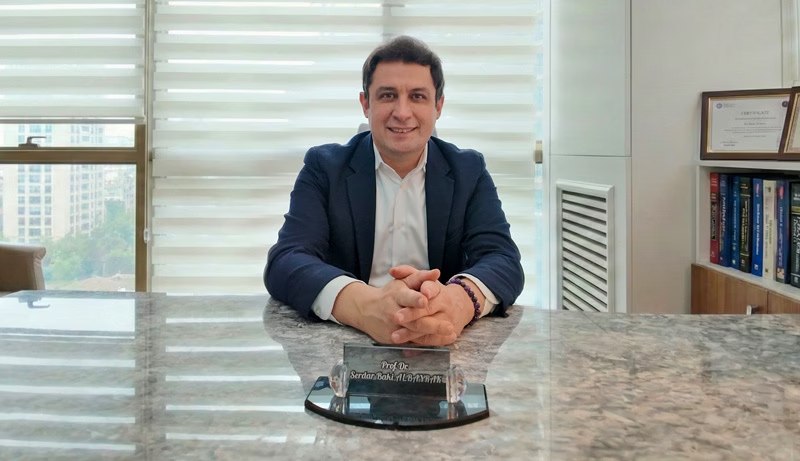
Prof. Dr. Serdar Baki Albayrak
Neurosurgeon · Epilepsy Surgery and Neuromodulation
Good epilepsy surgery starts with the right patient and the right target. Therefore, Prof. Albayrak plans each operation with the epilepsy team, from resection and disconnection to VNS implantation.
27+Years
5,000+Operations
64Countries
Figures from Prof. Albayrak's professional profile, September 2026.
It depends on the operation and the cause of seizures. For example, about two in three patients stay seizure-free in the long term after temporal lobe resection. Stimulation devices, by comparison, usually halve seizures rather than stop them.
Is epilepsy surgery safe?
For carefully chosen patients, yes. Serious permanent problems are uncommon, and ongoing seizures often carry greater risks. Your team explains your personal risks after the evaluation.
Can epilepsy come back after surgery?
Sometimes. Seizures can return months or years later, for instance when the network extends beyond the treated area. In that case, medicine changes or a second procedure often help.
How long does epilepsy surgery take?
Open resective surgery generally takes several hours. Laser ablation and device implants take less time, and most patients also go home sooner.
Which doctor performs epilepsy surgery?
A neurosurgeon who specializes in epilepsy operates, together with an epileptologist, a neurologist trained in epilepsy. Prof. Dr. Serdar Baki Albayrak is one such surgeon in Istanbul.
Prof. Albayrak's Published Research
Peer-reviewed articles and book chapters written or co-written by Prof. Dr. Serdar Baki Albayrak on image-guided neurosurgery, including epilepsy surgery. Each link opens the record on PubMed or at the publisher. The full list of his 33 publications is on his profile.
This page gives general medical information and does not replace a consultation. Diagnosis and treatment decisions need an examination by your own doctor.
Plan Your Epilepsy Surgery Evaluation in Istanbul
Request an appointment with Prof. Dr. Serdar Baki Albayrak. The clinical team then guides international patients through every step of the visit.