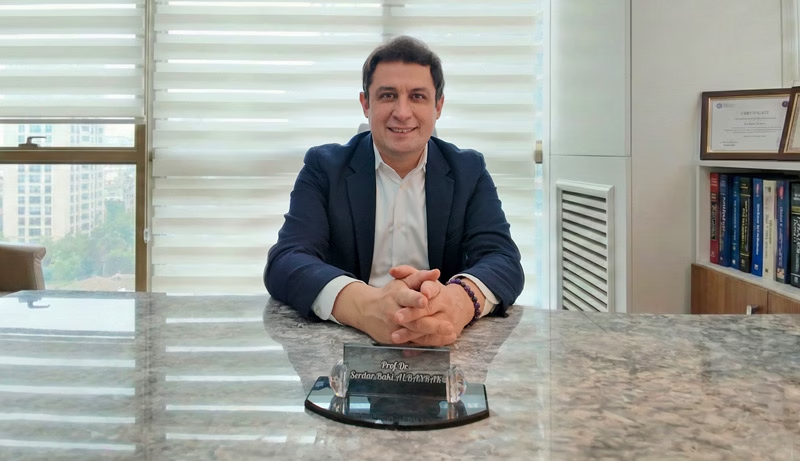
Deep Brain Stimulation (DBS): Surgery, Candidates and Results
Deep brain stimulation uses a pacemaker-like device to ease Parkinson's symptoms, tremor and dystonia. Prof. Dr. Serdar Baki Albayrak performs DBS surgery in Istanbul for international patients.
Career figures from Prof. Albayrak's professional profile, updated September 2026.
Request an Appointment
Prof. Albayrak's team will contact you to plan your visit.
Your details are used only to arrange your appointment.
In short
What Is Deep Brain Stimulation?
Deep brain stimulation (DBS) is a surgery that places thin electrodes deep in the brain and connects them to a chest battery. The device then sends mild electrical pulses that ease tremor, stiffness and slowness. Doctors generally offer it when medicines no longer control symptoms well.
Unlike older lesioning operations, DBS destroys no brain tissue. Moreover, the team can adjust the settings as your condition changes.
However, DBS does not cure the underlying disease or slow its progression. Instead, it controls symptoms, so many patients can lower their medicine doses.
In the United States, the FDA first approved DBS for Parkinson's tremor in 1997. In 2025, it also approved adaptive DBS, which adjusts stimulation to live brain signals.
Prof. Albayrak explains how DBS works, with footage from a Parkinson's DBS operation and the patient's recovery.
What are the parts of a DBS system?
A DBS system has three implanted parts and one handheld controller. In addition, newer devices add steering and sensing features.
LeadsThin wires with 4 to 16 contacts sit in the brain target
Extension wiresRun under the skin from the scalp to the chest
NeurostimulatorA pacemaker-like battery below the collarbone
Patient controllerA handheld device or app to check the battery and switch programs
Directional steeringAims the current at the target and away from side-effect areas
Adaptive modeSome systems adjust stimulation to brain signals in real time
Start where you are
Where Are You in Your Decision?
First, choose the statement closest to your situation. Then, each link opens the part of this guide that answers it.
Good candidates have a movement disorder that medicines no longer control, and good general health. A specialist team then confirms this with detailed tests.
Parkinson's disease
DBS helps most when levodopa still works, but its effect wears off or causes extra movements. Generally, symptoms that respond to levodopa also respond to DBS. Tremor, however, is the exception, because it often improves even when levodopa helps little.
A confirmed diagnosis, usually for four years or more
Troublesome off periods or dyskinesia despite medicine changes
No serious memory, mood or thinking problems
Health that allows surgery, and family support during recovery
Essential tremor
DBS of the thalamus suits disabling hand tremor that medicines no longer control. The benefit also lasts: one study followed patients for more than ten years and found stable tremor control.
Focused ultrasound offers an incisionless option, but it permanently destroys a small target, usually on one side. In contrast, DBS can treat both sides and stays adjustable.
Dystonia
In dystonia, the surgeon usually targets the globus pallidus internus (GPi). Improvement then builds over weeks to months, rather than overnight.
For example, in a controlled study of generalized dystonia, movement scores fell by about half within a year. Children with primary dystonia can also qualify, as our pediatric neurosurgery overview explains.
In contrast, spasticity is stiffness after brain or spinal cord injury, and spasticity surgery treats it differently.
Epilepsy, OCD and research uses
For drug-resistant focal epilepsy, DBS of the anterior thalamus reduces seizures over several years. Our epilepsy surgery guide also compares it with other options.
For severe OCD that resists medicines and therapy, specialized centers also use DBS under strict rules. Meanwhile, depression, Tourette syndrome and other conditions remain research uses.
Questions at this stage
Is there an age limit for deep brain stimulation?
There is no strict age limit. However, surgical risks rise after 70, so general health counts more than age alone.
Is it too early for DBS if I was diagnosed recently?
Usually, yes. DBS for Parkinson's generally follows at least four years of disease, once motor fluctuations appear. Even so, a large trial showed benefit for patients with early motor complications.
Can DBS help if levodopa no longer works?
For most Parkinson's symptoms, no. DBS mainly improves symptoms that still respond to levodopa. However, tremor is the main exception, since it often improves even without a levodopa response.
Timing
When to Consider DBS, and When to Call Your Team
DBS works best before disability becomes severe. Therefore, ask about it when medicines start to fail, not as a last resort.
A sudden, severe return of symptoms, which may mean the device has stopped
In most cases, a movement disorder neurologist makes the first assessment. The team then decides whether DBS is realistic and which target fits.
Compare the targets
DBS Targets Compared: STN, GPi and VIM
The target is the small brain area where the electrode tip sits. Each target suits different symptoms, so the team matches it to your main problem.
Target
Main conditions
Main strengths
Trade-offs
Subthalamic nucleus (STN)
Parkinson's disease
Improves slowness, stiffness and tremor; allows the largest medicine reduction
Mood and thinking speed can worsen in some patients
Globus pallidus internus (GPi)
Parkinson's disease, dystonia
Reduces dyskinesia directly; mood tends to hold up better; main target for dystonia
Medicine doses usually stay higher than with STN
Ventral intermediate thalamus (VIM)
Essential tremor, tremor-dominant Parkinson's
Strong, long-lasting tremor control
Treats tremor only; speech and balance problems can follow stimulation on both sides
Anterior thalamus (ANT)
Drug-resistant focal epilepsy
Fewer seizures, with benefit that grows over years
Rarely stops seizures completely
Which is better for Parkinson's disease, STN or GPi?
Neither target suits everyone. In a large randomized trial, both improved movement equally, but STN allowed lower medicine doses. Depression scores, however, worsened after STN and improved after GPi, so the team also weighs your mood.
Expected results
Which Parkinson's Symptoms Improve With DBS?
DBS improves many movement symptoms, but not all of them. The table shows, for example, which symptoms usually improve and which rarely do.
Symptom
Typical effect of DBS
Tremor
Usually improves, even when levodopa helps little
Stiffness and slowness
Improve if they respond to levodopa
Dyskinesia (extra movements)
Improves, directly or through lower medicine doses
Off periods
Shorter and milder, with more good hours each day
Sleep, pain, bladder urgency
May improve in some patients
Mood, energy and walking
Usually do not improve if levodopa did not help them
Balance, speech and swallowing
Rarely improve and can worsen
In a randomized trial, DBS gave patients about 4.6 extra hours a day of good movement without troublesome dyskinesia. In contrast, patients on best medical therapy alone gained no extra time. Moreover, 71% of DBS patients improved meaningfully in motor function, compared with 32%.
Risks
Risks and Side Effects of DBS
For most well-chosen patients, DBS carries a low risk, but surgical, hardware and stimulation problems can occur. Moreover, most stimulation side effects improve with new settings.
Surgery and hardware
Brain bleeding with symptoms: about 1%
Wound infection that needs another operation: about 2%
Lead movement or misplacement: about 2%
Broken wire or device failure: about 1-2%
Temporary confusion after surgery, especially in older adults
Stimulation
Tingling, muscle pulling or dizziness when settings change
Slurred speech or balance problems
Changes in mood, memory or thinking
Most of these ease when the team adjusts the settings
These surgical figures come from a series of 728 patients and a national neurosurgical society. However, your own risk depends on age, general health and the target.
Can deep brain stimulation change your personality?
Rarely in a lasting way. Stimulation can affect mood or behavior, but new settings usually reverse these effects. Therefore, families should report any change early.
The battery
Rechargeable or Non-Rechargeable Battery?
The battery type decides how often you need a replacement operation. Your team then recommends one based on your settings and daily routine.
Non-rechargeable: no charging at all, but a standard battery usually lasts about three to five years.
Rechargeable: lasts about nine years or longer, but you charge it regularly with a small wireless unit.
Replacing the battery is a short operation, and patients usually go home the same day. The brain leads stay in place, so no brain surgery is necessary.
Your treatment path
From Evaluation to Programming
DBS follows four steps. First, the team confirms that DBS can help, and then it plans a precise route. Finally, surgery and programming visits bring the benefit.
First, a movement disorder neurologist confirms the diagnosis and reviews your medicines. Next, the team films and scores your movements with and without levodopa.
Levodopa challenge: shows how much of your disability can improve
Memory and mood tests: check for problems that DBS could worsen
Brain MRI: rules out other causes and maps the target
Team conference: neurology, neurosurgery and neuropsychology decide together
Why do I have to stop my medicine before the evaluation?
Stopping medicine overnight shows your symptoms at their worst. The team then compares this with your best response, and the difference predicts the benefit of DBS.
PlanningSTEP 02
Planning: mapping a safe route
First, the surgeon combines MRI and CT images to locate the target precisely. Then, planning software draws a path that avoids blood vessels and fluid spaces.
During surgery, a stereotactic frame or a frameless system holds this plan. As a result, the electrode can reach a target only a few millimeters wide.
SurgerySTEP 03
Surgery: awake or asleep
In awake DBS, you stay awake while the surgeon records brain cell activity with a fine microelectrode. Then, test stimulation shows whether tremor or stiffness eases before the final lead goes in.
In contrast, asleep DBS uses general anesthesia, and imaging during surgery confirms the lead position. Overall, a large review found similar movement results with both methods.
Next, the surgeon places the battery under the collarbone, on the same day or a little later. Most patients stay in hospital one to three days after lead placement.
Is deep brain stimulation painful?
No. In fact, local anesthesia numbs the scalp, and the brain itself feels no pain. You may feel pressure or hear the drill, and the incisions ache for a few days afterward.
Are you awake during DBS surgery?
It depends on the center and your needs. Awake surgery keeps you awake only for testing; asleep surgery uses general anesthesia throughout. Overall, both give similar movement results.
ProgrammingSTEP 04
Programming and recovery
Before switch-on, some patients notice a brief improvement, called the microlesion effect, from swelling around the new lead. The team then switches the device on a few weeks after surgery. Next, it tests settings to balance benefit and side effects and adjusts your medicines.
Visits run frequently in the first six months and then drop to once or twice a year. Meanwhile, most people return to light activities within a few weeks. However, they avoid heavy lifting for four to six weeks.
Carry your device ID card when you travel
Tell every doctor about your device, especially before an MRI
Avoid diathermy, a deep-heat treatment
Use household electronics as usual
A patient regains control of daily movements after DBS surgery by Prof. Albayrak in Istanbul.
When can international patients fly home after DBS?
Your surgeon decides this after the post-operative check. Generally, patients fly once the incisions heal well and their condition is stable.
Your surgeon
Deep Brain Stimulation in Istanbul
Prof. Dr. Serdar Baki Albayrak
Neurosurgeon · Deep Brain Stimulation and Functional Neurosurgery
DBS results depend on careful selection, precise electrode placement and patient programming. Prof. Albayrak completed advanced surgical training at Harvard Medical School (Brigham and Women's Hospital). He also completed a clinical fellowship at the University of Helsinki.
27+Years
5,000+Operations
64Countries
Figures from Prof. Albayrak's professional profile, September 2026.
Lead placement takes several hours, and awake procedures can fill most of the day. Battery placement, in contrast, is a shorter operation under general anesthesia.
How long does DBS last?
The brain leads can stay in place for many years. A standard battery lasts about three to five years, but a rechargeable one lasts about nine years or longer. Meanwhile, the benefit continues, although the underlying disease keeps progressing.
Can DBS be turned off or removed?
Yes. You can switch stimulation off with your controller, and a surgeon can remove the system if needed. However, symptoms return quickly when stimulation stops.
Does DBS cure Parkinson's disease?
No. DBS controls symptoms but does not stop the disease from progressing. Many patients, however, gain years of better movement and quality of life.
Which doctor performs deep brain stimulation?
A neurosurgeon trained in functional neurosurgery performs DBS, together with a movement disorder neurologist who programs the device. Prof. Dr. Serdar Baki Albayrak is one such surgeon in Istanbul.
Prof. Albayrak's Published Research
Peer-reviewed articles and book chapters written or co-written by Prof. Dr. Serdar Baki Albayrak on image-guided neurosurgery. Each link opens the record on PubMed or at the publisher. The full list of his 33 publications is on his profile.
This page gives general medical information and does not replace a consultation. Diagnosis and treatment decisions need an examination by your own doctor.
Plan Your DBS Evaluation in Istanbul
Request an appointment with Prof. Dr. Serdar Baki Albayrak. The clinical team then guides international patients through every step of the visit.