
Paid online consultations are available by appointment. For booking, please contact us via Whatsapp.

What Is Brachial Plexus Surgery?
Brachial plexus surgery repairs the network of nerves that runs from the neck into the arm. The surgeon frees, bridges or reroutes torn nerves. Then signals can reach the arm muscles again.
A mild stretch injury often heals on its own. However, a torn nerve or a root pulled out of the spinal cord does not repair itself. In those cases, only surgery can bring a new nerve supply to the muscles.
Timing matters more here than in most nerve problems, because a paralyzed muscle slowly wastes. After about 12 to 18 months, it can no longer accept a new nerve.
So the most useful window for nerve surgery is usually the first six months.
At a Glance
- What it treatsTorn or stretched nerves between the neck and the arm
- Common causesMotorcycle and road accidents, falls, difficult births
- Typical signsA weak or limp arm, numbness, burning pain
- Key testsExamination, EMG at 3 to 4 weeks, MRI or CT myelography
- Main operationsNeurolysis, nerve graft, nerve transfer, muscle transfer
- RecoveryFirst movement in months, strength over one to two years
Where Are You in Your Decision?
Pick the line that sounds most like you. Each one then opens the matching part of this guide.
- 01My arm went weak or numb after an accidentWhat kind of nerve injury this may be
- 02I need to know if and when I need surgeryThe time window and the test schedule
- 03Nerve graft, nerve transfer or muscle transfer?All operations side by side
- 04My baby cannot move one arm after birthErb's palsy and when surgery helps
- 05More than a year has passed since my injuryOptions that still work later
- 06I am planning surgery from abroadLength of stay, flights and physiotherapy at home
Brachial Plexus Injury Symptoms, Root by Root
The brachial plexus starts as five nerve roots, C5 to T1, in the lower neck. They join, split again under the collarbone and end as the main nerves of the arm.
So each root has its own job. The pattern of weakness then shows where the damage lies.
| Root | Main movement | Area of feeling | First thing you notice |
|---|---|---|---|
| C5 | Lifting the arm out to the side | Outer shoulder | You cannot raise the arm |
| C6 | Bending the elbow, lifting the wrist | Thumb and outer forearm | You cannot bring a cup to your mouth |
| C7 | Straightening the elbow | Middle finger | Weak pushing |
| C8 | Bending the fingers, gripping | Ring and little fingers | You cannot hold things firmly |
| T1 | Small hand muscles, fine movement | Inner arm | Trouble with buttons or writing |
Upper plexus injury (Erb's palsy)
Here only the upper roots, C5 and C6, take the damage. As a result, the shoulder and the elbow stop working, while the hand still moves.
Lower plexus injury (Klumpke's palsy)
In contrast, damage to C8 and T1 weakens the hand and the fingers. A drooping eyelid and a small pupil on the same side form Horner's sign. This sign suggests that a root has torn from the spinal cord.
Total plexus injury
In the most severe form, the whole arm hangs without movement or feeling. Burning or electric pain in the numb arm is common too. For this reason, surgical planning starts earliest in this group.
Questions at this stage
Can a brachial plexus injury heal on its own?
Yes, if the nerve has only stretched, and then signals often return within weeks or months. A torn nerve or a torn-out root, however, does not heal by itself. So if nothing recovers by three months, see a surgeon.
Why does my arm hurt so much when I cannot feel it?
This pattern points to a root avulsion. Nerve cells in the spinal cord lose their input, then fire pain signals on their own. So ordinary painkillers often fail, and doctors first try medicines for nerve pain.
When to See a Doctor About Arm Weakness After an Injury
Any weakness that lasts more than a few days after an accident needs a specialist visit. A few signs, however, point to damage to the spinal cord or a main artery. They call for emergency care.
Book a specialist visit if you notice:
- Arm weakness or numbness that does not improve within days
- A "stinger", a burning shock down the arm, that keeps coming back
- Shoulder or arm muscles that slowly waste
- A baby who still cannot bend the elbow at three months
Go to the nearest emergency department (911, 999 or 112) for:
- A completely limp arm after a crash or a fall
- Arm weakness together with neck pain or numb legs
- A cold, pale or bluish arm
- Fast-growing swelling above or below the collarbone
- A stab or gunshot wound near the shoulder or armpit
If Your Legs Feel Numb Too
Numb legs suggest damage to the spinal cord as well. So the team first protects the neck and checks the cord. Our spinal cord injury guide explains this step.
A cold arm, by contrast, means that the artery comes first.
Brachial Plexus Injury Types and What Each One Needs
Most injuries happen when a force pushes the head and the shoulder apart. For example, a rider lands on the shoulder.
The nerves then stretch like a spring, and a strong pull tears them. The type of damage then sets both the treatment and the outlook.
| Type | What happens to the nerve | Recovery on its own | Usual treatment |
|---|---|---|---|
| Neurapraxia (stretch) | The nerve stays whole; signals stop for a while | Full recovery within weeks | Follow-up and physiotherapy |
| Axonotmesis (inner damage) | Fibers break; the outer sheath holds | Partial or full, over months | Close watch; surgery if no recovery |
| Neuroma | The nerve heals with scar that blocks signals | Limited | Neurolysis or a nerve graft |
| Rupture | The nerve tears outside the spinal cord | Not expected | Repair with a nerve graft |
| Avulsion | The root tears away from the spinal cord | None | Nerve transfer, then muscle transfer if needed |
Avulsion is the most severe type. Today no surgeon can sew a torn root back onto the spinal cord. Instead, the surgeon borrows a working nerve and uses it to restore the lost function.
Other Causes
Besides road accidents, work injuries and falls from height cause similar damage. Also, a dislocated shoulder or a broken collarbone can bruise nearby branches. Over years, chest radiotherapy and tumors there can harm the plexus too.
How Doctors Diagnose a Brachial Plexus Injury
Diagnosis starts with a careful muscle and sensation check, and then it unfolds over weeks. That is because some tests cannot show the true damage in the first days.
| When | Test | What it adds |
|---|---|---|
| First day | Detailed muscle and sensation exam; neck and shoulder X-rays | Which roots are involved; fractures or dislocation |
| First days | Vascular ultrasound or angiography | Whether the main artery is injured |
| Weeks 3 to 4 | EMG and nerve conduction study | How severe the damage is; clues to avulsion |
| Weeks 3 to 6 | Plexus MRI or CT myelography | Torn roots, fluid pouches, nerve thickening |
| Month 3 | Repeat exam and EMG | Has recovery started? Is surgery needed? |
Why the EMG Should Wait
An EMG in the first two weeks can mislead, since muscle fibers have not changed yet. From the third week on, however, the changes become clear. Also, a numb arm with normal sensory signals hints at a root tear near the cord.
On imaging, the strongest clue is a pseudomeningocele. This small fluid pouch marks a torn-out root. So the surgeon knows in advance which roots need repair or a transfer.
Plexus Injury, Neck Disc or Trapped Nerve?
Arm weakness and numbness have other causes too. For example, a cervical disc herniation usually weakens one muscle group. Neck pain then grows when you turn your head.
Numbness only in the hand, by contrast, often comes from a trapped nerve at the wrist or elbow.
When Do You Need Brachial Plexus Surgery?
The basic rule is simple: if the nerve cannot repair itself, the wait should not drag on. Otherwise, a paralyzed muscle wastes and stops accepting a nerve, usually within 12 to 18 months.
- Surgery at once: a knife or glass wound, an open wound or an artery injury; the team looks at the nerves in the same session
- Early surgery, within three months: imaging clearly shows root avulsion, so waiting brings no gain
- Planned surgery, at three to six months: a closed injury with no sign of recovery by the third month
After six months, however, results of nerve repair drop clearly. Even so, later options exist, and the section on late presentation covers them. In any case, an early specialist assessment keeps every option open.
Brachial Plexus Surgery Options Compared
The surgeon chooses the method by the type and the place of the damage. In most people, one operation combines two or more methods. It takes several hours under a microscope.
| Operation | What the surgeon does | Who it suits | Limit |
|---|---|---|---|
| Neurolysis | Frees the nerve from the scar around it | An intact nerve trapped in scar | Not enough alone for a torn nerve |
| Nerve graft | Bridges the gap with a thin sensory nerve from the leg | A rupture outside the spinal cord | Long grafts give weaker results |
| Nerve transfer | Links a working nerve branch to the nerve of a paralyzed muscle | Root avulsion; early cases | A small loss at the donor site |
| Free muscle transfer | Moves a thigh muscle with its artery and nerve | Late cases; wasted muscles | Joint planning with plastic surgery |
| Tendon transfer, joint fusion | Gives a healthy muscle's tendon a new job, or steadies a joint | Lasting partial paralysis | A joint decision with orthopedics |
| Pain surgery | Targets the spinal cord area that makes the pain signal | Avulsion pain that resists medicine | Does not bring back movement |
For severe avulsion pain, see our guide to pain surgery and spinal cord stimulation.
Can physiotherapy replace surgery?
In mild stretch injuries, physiotherapy supports recovery and is often enough. A torn nerve, however, cannot join again with exercise. So in rupture and avulsion, physiotherapy works alongside surgery, not instead of it.
How long does brachial plexus surgery take?
It usually takes several hours under general anesthesia. The length depends on the number of nerves and any grafts from the leg. In some people, the team splits the plan into two stages.
How Nerve Transfer Surgery Works
A nerve transfer gives a working nerve branch a new, more important job. For example, to bend the elbow, the surgeon can borrow a small fiber bundle from a forearm nerve. In this way, new nerve supply reaches the muscle close by, away from the scarred injury zone.
Distance is the key advantage. Nerve fibers regrow about one millimeter a day, so a link close to the muscle saves months.
For this reason, nerve transfer is often the first choice after root avulsion.
Which Movement Comes First?
In a total injury, no surgeon can restore every function at once. So the team sets priorities.
The first aim is usually elbow bending, since it brings the hand to the mouth. Shoulder stability then comes second.
Hand function, by contrast, is the hardest to regain in adults. Even so, protective feeling and a simple grip make a real difference in daily life. During surgery, nerve monitoring also shows the surgeon in real time which nerve still works.
The same idea helps in other nerve injuries too. In facial palsy, for instance, a nerve transfer can bring signals back to the face. Our facial paralysis guide describes it.
Will another movement get weaker after a nerve transfer?
The surgeon picks a donor branch with a spare or minor job. As a result, most people do not notice the loss, although slight weakness is possible. Before surgery, your surgeon explains which nerve he plans to use and what that means.
Brachial Plexus Birth Palsy and Erb's Palsy Surgery
Birth palsy happens when a baby's shoulder gets stuck during delivery. The pull then stretches the plexus.
Most babies recover on their own. MedlinePlus notes full recovery within three to four months in most.
Some babies, however, still cannot move the arm well. So show your doctor at three months whether your baby can bend the elbow. If that movement is still missing, the doctor brings the surgical assessment forward.
Besides, a drooping eyelid or a fully limp arm calls for an early review. Meanwhile, daily physiotherapy keeps the joints supple. For broader care of children, see our pediatric neurosurgery page.
Can adults with old Erb's palsy have surgery?
Yes, although nerve repair no longer helps after so many years. Instead, tendon transfers, muscle transfers or bone procedures can improve shoulder and elbow use. So an examination shows which of these fits your arm.
Options When More Than a Year Has Passed
After a long wait, the paralyzed muscles may no longer accept a nerve. Even then, muscle and tendon transfers can restore useful movement years after the injury.
- Free muscle transfer: a thigh muscle moves to the arm with its own artery and nerve, and a nerve transfer drives it
- Tendon transfer: a working muscle's tendon takes over a lost movement
- Joint fusion: a steady wrist or shoulder can make the rest of the arm more useful
Each of these needs a joint plan with plastic and orthopedic surgeons. Still, the best results come from early assessment. So try not to wait a year.
Brachial Plexus Surgery Risks
Brachial plexus surgery is long and delicate, so it carries real risks. Therefore, your surgeon should explain each one for your own injury.
- Limited recovery: some nerves recover less than hoped, mainly after late or severe injuries
- Donor site effects: mild weakness after a transfer, or a small numb patch on the leg after a graft
- Lung and chest effects: rare, when the surgeon uses nerves from the chest wall
- Vessel injury and bleeding: the plexus lies next to the main artery of the arm
- Infection, scarring and blood clots: as with any long operation
What is the success rate of brachial plexus surgery?
No single figure fits everyone, because every injury has its own map. Results depend on the damage type, the time to surgery, age and the roots involved. Generally, surgery at the right time restores elbow bending and shoulder stability in most people.
Will I have a large scar?
The main cut usually runs above the collarbone, sometimes toward the armpit. Grafts add a small cut on the back of the lower leg. Most scars fade over a year or two.
Brachial Plexus Surgery Recovery Time
Recovery is a marathon, not a sprint. Nerve fibers regrow slowly. So the first muscle flicker often appears after three to six months, and useful strength takes one to two years.
| Stage | What happens | Your part |
|---|---|---|
| First days | Hospital stay of a few days; pain control | Keep the arm in the sling |
| First weeks | The sling protects the repaired nerves from tension | Gentle exercises for the free joints |
| After the sling | A physiotherapist starts a full program | Daily home exercises keep joints supple |
| Months 3 to 6 | The first muscle flicker often appears | Practice the new movement pattern |
| Years 1 to 2 | Strength keeps building | Regular checks and EMG |
Your Brain Learns a New Route
After a nerve transfer, the brain must learn the new wiring. At first, for example, you may bend the elbow by thinking of another movement. Then, with practice, the new movement becomes automatic.
Joints must also stay supple even while the muscle cannot move. Otherwise, a frozen shoulder or stiff fingers block progress when the nerve returns. So your home program is the most important homework of all.
Coming to Istanbul from the US, Canada, the UK or Europe
After the first days, this surgery is rarely urgent, so it suits a trip you plan ahead. Still, the time window is short. So plan the visit early, ideally once the three to six week tests are done.
How Long to Stay in Istanbul
First, count the consultation, any new tests and the operation. After that, add a few days in hospital.
Then stay about a week nearby for the wound check. Overall, many people plan for about two weeks.
When You Can Fly Home
The UK CAA sets no single waiting time for this operation. So your surgeon decides, based on the wound and your health.
However, the CAA notes that older or anemic patients may need several days more. The US CDC also warns that flying soon after surgery raises the risk of blood clots.
Physiotherapy and Follow-Up at Home
Most of the recovery happens at home, over many months. So before you leave, ask for the operation report, an exercise plan and your scans. Then share them with your local doctor and physiotherapist, and plan EMG checks with them.
For insurance and Medicare, see planning surgery in Turkey from the US. For NHS rules and travel insurance, see planning from the UK. From Canada, check with your provincial health plan and private insurer before you book.
Your treatment in Istanbul
From Your First Message to Flying Home
Treatment in Istanbul follows four clear steps. Each one answers a practical question about your trip.
STEP 01
Request an appointment
Use the form on this page, WhatsApp or call +90 532 308 97 72. Then share the date of the injury, your country and your travel dates. You can write in English or Turkish.
STEP 02
Consultation and tests in Istanbul
First, Prof. Albayrak examines your arm at his clinic in Teşvikiye. Next, he goes through the EMG and scans with you. New tests can follow in Istanbul.
He then explains which nerves need repair or a transfer, and in what order. Questions worth asking include:
- Which movements can surgery aim to restore?
- Which donor nerves will you use?
- How long until I can expect the first movement?
What should I bring to the consultation?
First, bring all MRI and CT images on a disc or USB drive, with the written reports. Also bring every EMG report, the emergency notes from the accident and a list of medicines.
STEP 03
Surgery and hospital stay
If you choose surgery, the operation takes place in a hospital in Istanbul. Prof. Albayrak names the hospital at the consultation, along with the likely stay. In addition, a relative or companion can usually stay with you.
STEP 04
Recovery, fitness to fly and follow-up
After discharge, you rest at a nearby hotel and start the first exercises. Then, before the flight, your surgeon checks the wound and confirms that you can fly.
Back home, seek urgent help for fever, a leaking wound, breathlessness or a swollen leg.
When can I go back to work?
Many people with desk jobs return within a few weeks, once the sling comes off. Manual work, however, depends on how much strength returns. That can take a year or more.
Your Brachial Plexus Surgeon in Istanbul
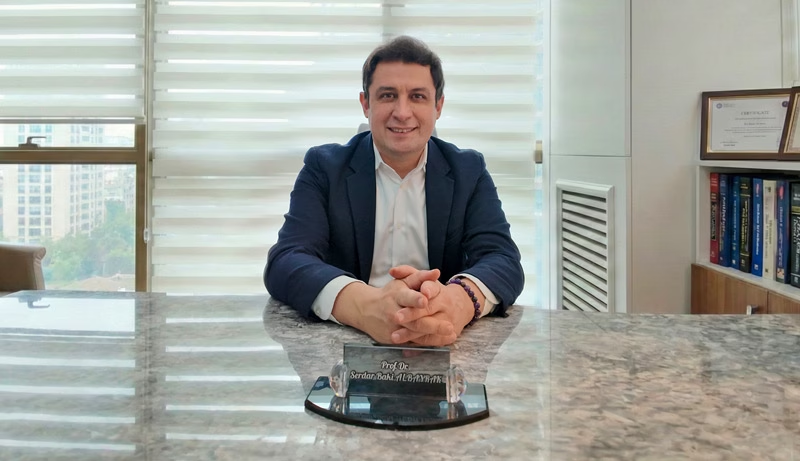
Prof. Dr. Serdar Baki Albayrak
Neurosurgeon · Full Professor of Neurosurgery
Prof. Albayrak treats peripheral nerve injuries alongside brain and spine surgery. So his plan puts the test schedule and the timing of surgery first. During the operation, he uses nerve monitoring.
After medical school at Marmara University, he trained in neurosurgery at Istanbul University. Clinical fellowships at the University of Helsinki and Harvard Medical School followed.
27+Years
5,000+Operations
64Countries
33Publications
Figures from Prof. Albayrak's professional profile, September 2026. See his full publication list.
Request an AppointmentFrequently Asked Questions
Which doctor treats a brachial plexus injury?
Neurosurgeons who perform peripheral nerve surgery treat these injuries. In some centers, hand and plastic surgeons join them, and the teams decide together on muscle transfers. A rehabilitation specialist then guides the physiotherapy.
My arm is numb after a motorcycle crash. What should I do?
First, let the emergency team rule out neck, spinal cord and artery injury. After that, note how the numbness and weakness change. If they do not settle within days, see a neurosurgeon, so the tests happen on time.
Do steroids help a brachial plexus injury?
Not for a torn nerve. Doctors sometimes use them for inflammatory plexus problems, such as brachial neuritis, which is a different condition. So for an injury after an accident, the plan rests on tests, timing and, if needed, surgery.
How much does brachial plexus surgery cost in Turkey?
The cost depends on the number of nerves, any grafts or muscle transfers, and the hospital stay. A single nerve transfer, for example, usually costs less than a staged operation with a free muscle transfer. So ask for the cost of your plan at the consultation, and see our guide to costs.
Prof. Albayrak's Published Research
Prof. Albayrak has no paper on the brachial plexus itself. These papers cover surgery for a stretch injury to a leg nerve.
They also study the scar that forms around a nerve after surgery. Each link opens PubMed; his profile lists all 33 publications.
- Management outcome of peroneal nerve injury at knee level: experience of a single military institution
- Doxorubicin for prevention of epineurial fibrosis in a rat sciatic nerve model: outcome based on gross postsurgical, histopathological, and ultrastructural findings
- Topical Application of Cyclosporine Reduces Epineurial Fibrosis: Gross Postsurgical, Histopathological and Ultrastructural Analysis in a Rat Sciatic Nerve Model
Public health information
- National Institute of Neurological Disorders and Stroke. Brachial Plexus Injury.
- MedlinePlus, US National Library of Medicine. Brachial plexus injury in newborns.
- MedlinePlus. Electromyography.
- MedlinePlus. Nerve conduction velocity.
- NHS. Dislocated shoulder.
- NHS. Broken collarbone.
- NHS. DVT (deep vein thrombosis).
- UK Civil Aviation Authority. Surgical conditions: guidance for health professionals.
- US Centers for Disease Control and Prevention. Medical tourism.
This guide gives general medical information and does not replace a consultation. So diagnosis and treatment decisions need an examination by your own doctor.
Last updated: 16 October 2026. Website editor: Prof. Dr. Serdar Baki Albayrak's clinic, [email protected].
Plan Your Brachial Plexus Consultation in Istanbul
Request an appointment with Prof. Dr. Serdar Baki Albayrak. The team then helps you plan your visit within the time window that matters.
Request an Appointment