
Paid online consultations are available by appointment. For booking, please contact us via Whatsapp.

In short
What Is Brain Cancer?
Brain cancer is a malignant tumor in the brain. Its cells multiply quickly and invade nearby tissue, so surgery rarely removes every cell. It can start in the brain or, more often, spread there from cancer elsewhere.
Doctors call a cancer that starts in the brain a primary brain cancer. For example, glioblastoma is the most common one in adults. In fact, it makes up about half of primary malignant brain tumors in adults.
Cancer that spreads to the brain from another organ is a brain metastasis. These secondary tumors are also more common than primary ones. However, primary brain cancer rarely spreads outside the brain and spinal cord.
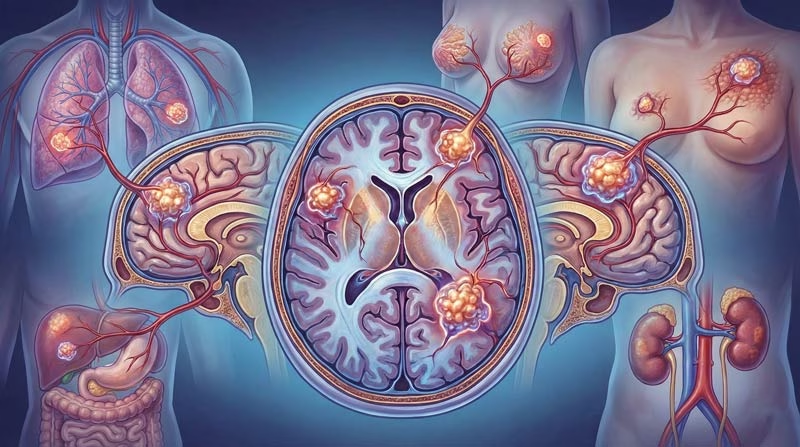
Brain cancer vs brain tumor: what is the difference?
Every brain cancer is a brain tumor, but not every brain tumor is cancer. For example, most meningiomas are benign and grow slowly. Our guide to brain tumor treatment therefore covers benign tumors as well.
- PrimaryStarts in the brain, such as glioblastoma
- SecondarySpreads from cancer elsewhere, such as the lung
- High gradeWHO grades 3 and 4 grow fastest
- Gene markersIDH, MGMT and 1p/19q guide treatment
- Rarely spreadsStays within the brain and spinal cord
- CauseUsually unknown; radiation is the only known outside risk
Which Type of Brain Cancer Were You Told You Have?
First, find the name on your MRI report or pathology result. Then, each link explains how that cancer behaves and how surgeons treat it.
- 01GlioblastomaGrade 4, the most common malignant brain tumor in adults
- 02Astrocytoma or oligodendroglioma, grade 3 or 4IDH-mutant gliomas that usually grow more slowly
- 03Brain metastasisCancer that spread from the lung, breast, skin or kidney
- 04MedulloblastomaA fast-growing cerebellum tumor, mostly in children
- 05Primary CNS lymphomaA lymphoma of the brain, treated mainly with chemotherapy
No diagnosis yet? Then start with the brain cancer symptoms below.
Main Types of Brain Cancer
Five types account for most malignant brain tumors. Each one behaves differently, so the type shapes the whole treatment plan.
Glioblastoma
Glioblastoma is a grade 4 glioma without an IDH gene change. It grows fast and also sends cells deep into the brain around it.
For this reason, surgeons almost never remove every cell. Treatment therefore combines surgery with radiotherapy and temozolomide chemotherapy. Some patients also wear a tumor treating fields device.
Astrocytoma and oligodendroglioma, grade 3-4
These gliomas carry an IDH gene change, and many patients are younger adults. They also grow more slowly than glioblastoma and usually respond better to treatment.
An oligodendroglioma also has a 1p/19q codeletion, which predicts a better response to chemotherapy. When such a glioma lies deep in the brain, as an insular glioma does, awake surgery often helps.
Brain metastasis
Cancer cells from another organ can travel to the brain through the blood. For example, lung cancer, breast cancer, melanoma and kidney cancer often spread there.
Generally, surgery suits a large single tumor, and radiosurgery treats small ones. Our guide to metastatic brain tumors also explains each option.
Medulloblastoma
Medulloblastoma starts in the cerebellum and occurs mostly in children. It can also spread through the brain fluid to the spine.
Treatment therefore combines surgery, radiotherapy to the brain and spine, and chemotherapy. Many children respond well; our pediatric neurosurgery page also explains their care.
Primary CNS lymphoma
This lymphoma starts in the brain, often deep inside it. However, surgery does not treat it, so a stereotactic biopsy only confirms the diagnosis.
Chemotherapy, usually with methotrexate, forms the main treatment, sometimes with radiotherapy. People with a weak immune system, such as those with HIV, face a higher risk.
Grade 3 or grade 4: what changes?
A grade 4 tumor grows faster than a grade 3 one, so treatment starts sooner and scans come more often.
Why gene markers matter
- IDH change: slower growth and a better outlook.
- MGMT methylation: a better response to temozolomide.
- 1p/19q codeletion: defines oligodendroglioma and predicts a good response to chemotherapy.
Questions at this stage
Is glioblastoma always grade 4?
Yes. Under the 2021 WHO system, glioblastoma is always grade 4 and IDH-wildtype. Doctors now call a similar IDH-mutant tumor astrocytoma, grade 4.
Can a benign brain tumor turn into cancer?
Most benign tumors, such as grade 1 meningiomas, stay benign. However, some low-grade gliomas progress over years, so they need regular MRI scans.
Does brain cancer spread to other parts of the body?
Very rarely. Primary brain cancers almost always stay within the brain and spinal cord. In contrast, a brain metastasis comes from a cancer that already spread from elsewhere.
Brain Cancer Symptoms
Brain cancer causes the same symptoms as other brain tumors, but they often build up faster. For example, new symptoms can appear within weeks rather than months.
Common signs include worsening headaches, seizures, nausea and weakness on one side. Our full guide to brain tumour symptoms also explains each sign and its pattern.
See a doctor soon if you notice:
- Headaches that worsen over days or weeks
- Weakness, numbness or clumsiness on one side
- Changes in speech, memory or behavior
- Any new neurological symptom after an earlier cancer
Seek emergency care for:
- A first seizure
- A sudden, severe headache
- Rapidly worsening confusion or drowsiness
- Sudden loss of speech or movement
Brain Cancer Grades Explained
Brain tumors have grades rather than stages. The WHO grade runs from 1 to 4, so higher numbers mean faster growth.
| Grade | How it behaves | Examples | Usual approach |
|---|---|---|---|
| Grade 1 | Slow growth and a clear border; often curable by removal | Most meningiomas, pilocytic astrocytoma | Surgery or observation |
| Grade 2 | Slow growth but spreads into nearby tissue; can progress over years | Grade 2 astrocytoma and oligodendroglioma | Surgery, then scans, radiotherapy or targeted drugs |
| Grade 3 | Malignant; faster growth and very active cells | Grade 3 astrocytoma and oligodendroglioma | Surgery, then radiotherapy and chemotherapy |
| Grade 4 | Most aggressive; dead tissue and new blood vessels inside the tumor | Glioblastoma, astrocytoma grade 4, medulloblastoma | Surgery, then radiotherapy and chemotherapy |
Is there a stage 4 brain cancer?
Not in the usual sense, because primary brain cancer seldom spreads outside the brain. Therefore, doctors use the WHO grade instead. When people say stage 4, they usually mean a grade 4 tumor such as glioblastoma.
Surgery for Brain Cancer
Surgery is the first treatment for most brain cancers. It relieves pressure and provides tissue for the exact diagnosis. It also removes as much tumor as is safe.
For gliomas, research links a more complete removal with longer survival. Therefore, surgeons remove as much tumor as they can without harming speech, movement or vision.
Craniotomy
The surgeon first opens a small window in the skull. Then, the tumor comes out under the microscope, and the bone goes back. Meanwhile, neuronavigation guides the route, much like GPS.
Awake craniotomy
When cancer lies near speech or movement areas, the patient wakes during the mapping phase. The team then tests speech and movement while the surgeon removes tumor tissue. Meanwhile, the brain itself feels no pain.
This approach suits many frontal lobe tumors close to the speech area, for example.
Fluorescence-guided surgery
Before surgery, the patient drinks a special dye. Under blue light, high-grade glioma tissue then glows red. As a result, the surgeon can see tumor that looks normal under white light.
Stereotactic biopsy
Through a small hole in the skull, a thin needle takes a tissue sample. For example, surgeons choose it when the tumor lies deep or when lymphoma is likely. It also suits patients who cannot undergo open surgery.
Laser ablation (LITT)
A thin laser probe enters the tumor through a small hole, guided by MRI. The laser then heats and destroys the tumor while nearby tissue stays safe.
Doctors mainly use it for deep or recurring tumors. However, the technique is fairly new, so research continues.
| Option | Best suited for | Main advantage | Recovery |
|---|---|---|---|
| Craniotomy with maximal safe resection | Most accessible gliomas and large metastases | Removes the most tumor and relieves pressure | Usually 4-6 days in hospital |
| Awake craniotomy | Tumors near speech or movement areas | Protects function while removing more tumor | Similar to a standard craniotomy |
| Fluorescence guidance | High-grade gliomas such as glioblastoma | Reveals tumor that looks normal | Adds no extra recovery time |
| Stereotactic biopsy | Deep tumors and suspected lymphoma | Confirms the diagnosis through a small opening | Usually a short stay |
| Laser ablation (LITT) | Deep or recurring tumors | Small opening and a quick recovery | Usually a short stay |
Can brain cancer be removed completely?
Sometimes, but rarely in glioblastoma. Its cells spread beyond the edge that MRI shows, so radiation and chemotherapy target the rest. In contrast, a single metastasis often comes out completely.
Treatment After Brain Cancer Surgery
Most brain cancers need more treatment after surgery. The pathology result, including gene markers, then decides the plan.
- Radiotherapy usually starts a few weeks after surgery, once the wound heals. Patients attend daily sessions, Monday to Friday, over several weeks.
- Chemotherapy with temozolomide tablets runs alongside radiotherapy for glioblastoma and continues afterwards.
- Tumor treating fields use a wearable device on the scalp. With chemotherapy, they can help some glioblastoma patients live longer.
- Radiosurgery treats small brain metastases or the space left after removing one.
- Targeted drugs and immunotherapy help some metastases, such as those from lung cancer or melanoma, and some gliomas with specific gene changes.
- Clinical trials offer new treatments, especially for glioblastoma.
In addition, steroids reduce swelling around the tumor, and anti-seizure medicines prevent seizures during treatment.
Brain Cancer Survival and Prognosis
Outlook varies widely between brain cancers. For example, many people with oligodendroglioma live for years, but glioblastoma remains hard to control.
US SEER data put five-year relative survival for brain and nervous system cancer at 32.9%. However, glioblastoma figures are lower. The American Cancer Society reports about 28% for ages 15-39 and about 6% from age 40.
These numbers reflect people treated years ago, so they cannot predict one person's result. Newer treatments and gene testing also continue to improve care.
| Factor | Linked with a better outlook | Linked with a harder course |
|---|---|---|
| Tumor type and grade | Lower grade, oligodendroglioma | Glioblastoma, grade 4 |
| Gene markers | IDH change, MGMT methylation, 1p/19q codeletion | IDH-wildtype, unmethylated MGMT |
| Age | Younger age | Older age |
| Daily function | Independent in daily activities | Needs help with daily care |
| Extent of removal | Most or all visible tumor removed | Biopsy only or a small removal |
| Response to treatment | Stable scans after radiotherapy | Early regrowth |
How long can you live with brain cancer?
It depends mostly on the tumor type, gene markers, age and general health. For example, many people with slower-growing gliomas live for years. In contrast, survival with glioblastoma often ranges from months to a few years.
Your treatment path
From Diagnosis to Recovery
Brain cancer care moves through four steps. Each step then shapes the next, from the first MRI to follow-up scans.
STEP 01
Diagnosis: is it cancer?
First, an MRI with contrast shows the tumor. Perfusion and spectroscopy scans then estimate how aggressive it is.
After surgery, the pathologist confirms the type and tests gene markers such as IDH, MGMT and 1p/19q.
Can an MRI tell if a brain tumor is cancer?
An MRI can strongly suggest cancer, for example through an irregular ring and swelling. However, only tissue from surgery or a biopsy confirms the diagnosis.
STEP 02
Planning: how much can come out safely?
Next, functional MRI and tractography map the speech and movement pathways near the tumor. A tumor board of neurosurgeons, oncologists and radiologists then agrees on the order of treatments.
STEP 03
Surgery: maximal safe resection
On the day of surgery, the team uses navigation, neuromonitoring and, when needed, awake mapping or fluorescence. Within a few days, an MRI then measures how much tumor remains.
What are the risks of brain cancer surgery?
Possible risks include bleeding, infection, brain swelling, seizures and new weakness or speech problems. However, most are uncommon or temporary, and the team works to prevent them.
STEP 04
Recovery and follow-up
Most patients walk within a day or two and go home after 4 to 6 days. Radiotherapy and chemotherapy then usually start a few weeks later.
Afterwards, follow-up MRI scans check the result every few months.
Can radiotherapy continue in my home country?
Often, yes. Many patients return home after surgery and complete radiotherapy and chemotherapy with their local team. Prof. Albayrak's team then shares the surgical and pathology reports for this.
Brain Cancer Surgery in Istanbul

Prof. Dr. Serdar Baki Albayrak
Neurosurgeon · Brain Tumor and Skull Base Surgery
Brain cancer surgery must remove as much tumor as possible while protecting who the patient is. For this reason, Prof. Albayrak combines careful planning, brain mapping and a team approach for each patient.
27+Years
5,000+Operations
64Countries
Figures from Prof. Albayrak's professional profile, September 2026.
Request an AppointmentFrequently Asked Questions
Is brain cancer curable?
Treatment can cure or control some brain cancers for many years, especially lower-grade tumors and childhood medulloblastoma. Glioblastoma, however, is rarely curable today. Even so, treatment can extend life and relieve symptoms.
What causes brain cancer?
In most people, doctors find no clear cause. Known risks include earlier radiation to the head, for example during childhood cancer treatment. However, large studies have not shown that mobile phones cause brain cancer.
Is brain cancer hereditary?
Rarely. Most brain cancers come from gene changes that happen during life, not from inherited genes. However, a few family syndromes, such as Li-Fraumeni syndrome and neurofibromatosis, raise the risk.
Prof. Albayrak's Published Research
Peer-reviewed articles and book chapters written or co-written by Prof. Dr. Serdar Baki Albayrak on malignant brain tumors and their treatment. Each link opens the record on PubMed or at the publisher. The full list of his 33 publications is on his profile.
- Intra-operative magnetic resonance imaging in neurosurgery
- The effects of tibolone on the human primary glioblastoma multiforme cell culture and the rat C6 glioma model
- Tumor Immunized Autologous Natural Killer Cell (NK) Therapy/Compassionate Use
- Cerebral metastasis of small-cell lung carcinoma mimicking a supratentorial cystic astrocytoma
- Sudden cessation of respiration in a patient with a solitary metastatic focus of renal cell carcinoma in medulla oblongata
Public health information
- National Cancer Institute, SEER. Cancer Stat Facts: Brain and Other Nervous System Cancer.
- National Cancer Institute. Primary CNS Lymphoma Treatment (PDQ), patient version.
This page gives general medical information and does not replace a consultation. Diagnosis and treatment decisions need an examination by your own doctor.
Plan Your Brain Cancer Treatment in Istanbul
Request an appointment with Prof. Dr. Serdar Baki Albayrak. The clinical team then helps international patients with every step of the visit.
Request an Appointment