
Paid online consultations are available by appointment. For booking, please contact us via Whatsapp.

What Is Vagus Nerve Stimulation?
Vagus nerve stimulation (VNS) is a treatment for epilepsy that does not respond to medicines. A chest generator sends mild electrical pulses along the left vagus nerve in the neck. These pulses then reach the brain and can make seizures fewer and milder.
People often call it an "epilepsy pacemaker". Yet it does not touch the brain or the heart. Instead, the surgeon uses two small cuts: one in the neck, one below the collarbone.
VNS adds to your seizure medicines and rarely replaces them. It also works slowly, so the full effect can take a year or longer (MedlinePlus).
At a Glance
- What it treatsSeizures that continue despite medicines, when surgery cannot remove their source
- How it worksA chest implant sends mild pulses along the left vagus nerve to the brain
- SurgeryAbout an hour under general anesthesia in Prof. Albayrak's practice
- Going homeUsually the same day or the next morning
- ResultsFewer, shorter or milder seizures over months; full seizure freedom is rare
- Flying homeAfter a wound check; VNS does not open the skull
Where Are You in Your Decision?
Choose the line that fits you. Each one then leads to the matching part of this guide.
- 01Seizures continue despite two or more medicinesWhen epilepsy counts as drug-resistant
- 02Told that surgery cannot remove the seizure sourceWhere VNS fits after an epilepsy evaluation
- 03Looking into VNS for a childAge, the decision and family life
- 04Wondering what the operation involvesTwo small cuts and about an hour
- 05Already living with VNSMRI scans, battery change and airport security
- 06Planning the surgery from abroadStay, flights and settings back home
Who Is a Candidate for Vagus Nerve Stimulation?
VNS suits people whose seizures continue despite medicines. It also fits when surgery cannot remove the seizure source. First, however, the team checks your heart, breathing and general health.
Seizures despite two medicines
Medicines control seizures for most people with epilepsy (WHO). Sometimes, however, two suitable medicines, taken correctly, fail to stop the seizures. Doctors then call the epilepsy drug-resistant (NICE).
At that point, further changes to medicines rarely bring lasting seizure freedom, according to NICE. So it makes sense to ask for a referral to an epilepsy center.
When surgery cannot remove the seizure source
Surgery that removes the area where seizures start can stop them altogether. So the epilepsy team first looks for that area with EEG, MRI and other tests. Our guide to epilepsy surgery and who qualifies explains that evaluation.
Sometimes, however, seizures start in several areas or on both sides of the brain. The source may also lie in an area that controls speech or movement. In these cases, UK guidance (NICE) suggests VNS as an add-on to medicines.
VNS also remains an option when earlier epilepsy surgery has not stopped the seizures (NICE).
Which seizure types can VNS help?
According to UK guidance (NICE), VNS can help both focal and generalized seizures. MedlinePlus, a US government source, describes it as an option from age 4. It suits people who cannot have brain surgery.
Results, however, vary from person to person, and no test can predict them beforehand.
When VNS may not suit you
VNS does not suit everyone. For example, MedlinePlus lists these reasons to avoid it:
- A slow heart rate or an abnormal heart rhythm
- Breathing problems, such as untreated sleep apnea, asthma or COPD
- Active stomach ulcers
- Earlier surgery on the vagus nerve, or only one vagus nerve
Before surgery, Prof. Albayrak also reviews your ECG, clotting test and other blood tests.
Questions at this stage
Is VNS better than epilepsy surgery?
Not when surgery can remove the seizure source. Removal then offers a better chance of seizure freedom. VNS, in contrast, aims to reduce seizures when that surgery does not suit you.
When to Ask About VNS, and When to Call for Help
Uncontrolled seizures deserve a fresh look, even after many years. Some seizures, however, need emergency care at once.
Ask your neurologist about VNS or epilepsy surgery if:
- Seizures continue after two medicines at proper doses
- Side effects of medicines outweigh their benefit
- Seizures cause falls, injuries or hospital visits
- A child's seizures hold back learning or development
- You heard that surgery is not possible, but no one discussed devices
Call emergency services if:
- A seizure lasts longer than 5 minutes, or longer than usual for that person
- Another seizure starts before the person recovers
- Three or more seizures happen within 24 hours
- It is the person's first seizure
- The person does not recover as usual afterward
These emergency rules follow NHS advice. So call 911 (US, Canada), 999 (UK) or 112 (rest of Europe).
How Does Vagus Nerve Stimulation Work?
The vagus nerve runs from the brainstem through the neck to the chest and belly. It carries signals both ways, so pulses sent up the nerve reach the brain (MedlinePlus).
Doctors do not fully know how this works. Still, the steady pulses seem to calm the electrical storms behind seizures.
The Parts of the Device
It has two parts: a generator and a thin lead. The generator measures about 4 cm (1.5 inches) across (MedlinePlus). The lead ends in small coils that wrap around the left vagus nerve.
Surgeons use the left nerve, which affects the heart rate less than the right. A typical setting sends pulses for 30 seconds every 5 minutes (NICE). This cycle then runs day and night.
Some newer models also sense a sudden jump in heart rate, a possible seizure sign. They then send an extra burst on their own.
Using the Magnet
You also receive a hand-held magnet. A swipe over the generator triggers an extra burst of stimulation (MedlinePlus).
So swipe it when you feel a seizure coming. A carer can also swipe it when a seizure starts. The extra burst may then stop the seizure or shorten it.
Holding the magnet over the device, in contrast, pauses the stimulation for a while. Removing it then restarts the normal cycle (NICE, MedlinePlus).
Does vagus nerve stimulation hurt?
No, not in the usual sense. During each pulse, however, you may notice neck tingling or a hoarse voice. These effects often fade as your body gets used to them.
VNS Compared With Other Epilepsy Treatments
VNS sits between medicines and brain surgery. The table compares it with the main options. Our comparison of epilepsy operations then covers each one in depth.
| Option | Main aim | Brain surgery? | Best suited for |
|---|---|---|---|
| Seizure medicines | Seizure control | No | Everyone at first; most people respond (WHO) |
| Resective surgery | Seizure freedom | Yes, it removes the seizure source | One source that surgery can safely remove |
| Vagus nerve stimulation | Fewer, shorter or milder seizures | No; neck and chest only | Drug-resistant seizures when removal does not suit |
| Responsive neurostimulation | Fewer seizures | Yes, a device in the skull | One or two known sources that surgery cannot remove |
| Deep brain stimulation | Fewer seizures | Yes, thin electrodes deep in the brain | Selected focal epilepsy at specialist centers |
| Ketogenic diet | Fewer seizures | No | Mainly children, with a specialist diet team (NINDS) |
The right option depends on where your seizures start. For deep brain targets in epilepsy, see our guide to deep brain stimulation.
Not the Same as Vagus Nerve Exercises or Ear Devices
Online, "vagus nerve stimulation" often means breathing exercises or clip-on gadgets. These differ from the implant on this page.
Non-invasive devices that rest on the neck or ear do exist. However, MedlinePlus lists their approved use as cluster headache and migraine. Ear devices for epilepsy remain under study, so ask your neurologist before you buy one.
Spinal cord stimulation, another implanted stimulator, treats chronic pain rather than seizures. For that, see spinal cord stimulation for chronic pain.
VNS Surgery Step by Step
VNS surgery takes about an hour in Prof. Albayrak's practice, under general anesthesia. It does not open the skull. Most people also go home the same day or the next (MedlinePlus).
Before the Operation
First, you have blood tests, a clotting test and an ECG. On the morning of surgery, keep taking your seizure medicines unless the team says otherwise.
Blood thinners, however, may need a pause days before. Never stop them on your own. Most people also stop eating and drinking about 8 hours before surgery.
During the Operation
- You lie on your back, with your head turned slightly to the right.
- The surgeon makes a small cut on the left side of the lower neck.
- Next, the surgeon finds the vagus nerve beside the large neck vein and gently wraps the coils around it.
- A second small cut below the left collarbone makes a pocket for the generator under the skin.
- The lead then runs under the skin from the neck to the chest and connects to the generator.
- Finally, a test checks that the lead and generator work together, and dissolving stitches close both cuts.
MedlinePlus puts the operation at 45 to 90 minutes. The stitches dissolve on their own, so you need no visit to remove them.
The First Days After Surgery
Expect some soreness at both cuts for a few days. You may also feel a small bump under the collarbone. Keep the wounds dry, and avoid baths and swimming until your surgeon agrees (MedlinePlus).
In Prof. Albayrak's experience, many people return to light daily activity the next day. Your voice may sound hoarse at first, since the vagus nerve serves the voice box.
Is VNS a major surgery?
No. It needs general anesthesia, but it does not open the skull or touch the brain. Two small cuts, in the neck and chest, carry the whole operation.
Switching On and Adjusting the Device
The device starts at a low setting. Its strength then rises step by step over weeks to months. This slow pace lets your body get used to the pulses.
Some teams switch it on before discharge, while others wait 2 to 4 weeks (MedlinePlus). Either way, a doctor programs it painlessly, with a wand or tablet over the skin.
At each visit, the doctor checks your seizure diary and side effects. The settings then go up only as far as you tolerate them.
A Typical First Year With VNS
| When | What usually happens |
|---|---|
| Surgery day | Implant; home the same day or the next |
| Weeks 1-2 | Wound healing; the device stays off or at a low setting |
| Weeks 2-4 | First programming visit, if not done before discharge |
| Months 1-6 | Visits every few weeks to raise the strength; side effects usually ease |
| Months 6-12 | The effect on seizures becomes clearer; your neurologist reviews your medicines |
| After year 1 | Regular check-ups, including the battery level |
Timing varies from person to person, so your team gives you your own schedule.
How long does VNS take to work?
Some people notice a change within months. For many, however, the full effect takes a year or longer (MedlinePlus). So judge it after the settings reach their target level, not after the first visit.
What Results Can You Expect From VNS?
VNS does not cure epilepsy, and it does not work for everyone (MedlinePlus). Its aim is fewer, shorter and milder seizures, with faster recovery afterward.
One study in NICE's review followed 50 children. Of these, 23 (46%) had their seizures cut by more than half. Results vary widely, however.
UK guidance also notes that long-term evidence remains limited (NICE). So weigh the expected benefit and the risks with your team before you decide.
Will I Still Need My Seizure Medicines?
Yes, almost always, because VNS works alongside medicines. In Prof. Albayrak's practice, the usual aim is a lower dose or fewer medicines. Only your neurologist should change them, and then step by step.
Does VNS stop seizures completely?
Rarely. A small number of people become seizure-free, but most have fewer or milder seizures instead. So plan on VNS as one part of your treatment, together with medicines.
Side Effects and Risks of VNS
Most side effects come from the stimulation itself. So they appear only while the device sends a pulse. They also tend to fade over time or after a change in settings (MedlinePlus).
Side Effects During Stimulation
- Hoarseness or a change in your voice
- Coughing or a tickle in the throat
- Shortness of breath
- Pain in the neck or throat
- Trouble swallowing
- Tingling in the skin
- Worse sleep apnea
In practice, a change in settings often eases these effects. If they stay unbearable, your doctor can also switch the device off.
Risks of the Operation
Every operation carries some risk. For VNS, these include infection, bleeding, and pain or swelling at the cuts (MedlinePlus).
An infection sometimes means the device must come out. In children, NICE's review found this in 3 to 6 of every 100 patients.
Harm to a nearby nerve can also occur (MedlinePlus). For example, it can leave a lasting voice change, though this stays uncommon.
Can VNS cause heart problems?
Rarely. Doctors avoid VNS in people with a slow heart rate or an abnormal rhythm (MedlinePlus). The team also watches your heart rate when it first tests the device during surgery.
Living With a Vagus Nerve Stimulator
Daily life with VNS stays mostly normal. However, three topics need planning: MRI scans, the battery and airport security.
Can I Have an MRI With VNS?
Often, yes, but only under the conditions set for your exact device. The FDA calls such implants "MR Conditional". They suit only scanner settings within their limits.
So always tell the MRI team about your VNS, and bring your device card. Before many scans, a doctor also switches the stimulation off, then back on afterward.
How Long Does the Battery Last?
Usually for several years, but stronger settings drain it faster. UK guidance from NICE quotes 8 to 10 years. In Prof. Albayrak's practice, it lasts about 6 to 15 years.
Replacing it takes a short operation through the old chest scar. In Prof. Albayrak's practice, local anesthesia usually suffices. You then go home the same day.
The lead in the neck usually stays in place. So a battery change in Istanbul often needs only a short stay.
Airport Security and Other Devices
Carry your device ID card and show it at airport security. Walk-through scanners may detect the generator, so tell the staff before you pass through.
Also tell every doctor, dentist and physiotherapist about the implant. Some heat treatments and strong magnets can affect it, so ask before any new treatment.
How do I know when the VNS battery runs low?
Your doctor checks the battery level at each programming visit (MedlinePlus). The replacement can then happen before the battery runs out. So keep your check-ups, even when seizures stay calm.
Vagus Nerve Stimulation for Children
VNS can also help children whose seizures continue despite medicines. MedlinePlus describes it as an option from age 4. UK guidance also asks for a specialist pediatric epilepsy team (NICE).
For a child, the decision weighs seizures against development, school and sleep. Child neurologists usually raise VNS first, and Prof. Albayrak then plans the operation with them.
NICE also asks teams to tell families clearly that no one can predict the benefit. On the other hand, its advisers noted possible gains in mood and quality of life.
Everyday Life for the Family
Parents, teachers and carers all learn to use the magnet. That way, anyone nearby can respond to a seizure. A short written seizure plan for school also helps.
VNS can also worsen sleep apnea (MedlinePlus). So mention any snoring or breathing pauses at night. For other operations in children, see pediatric neurosurgery for epilepsy and other conditions.
At what age can a child have VNS?
MedlinePlus describes VNS as an option from age 4. The decision also depends on the type of epilepsy and earlier treatment. So a pediatric epilepsy team assesses each child.
Other Uses: Depression and Stroke Recovery
VNS has other approved uses too, such as hard-to-treat depression and stroke recovery (MedlinePlus). This page, however, focuses on epilepsy.
For depression, VNS serves adults whose symptoms persist despite other treatment. UK guidance finds the evidence on benefit limited (NICE). So NHS teams offer it only under special arrangements.
Psychiatrists lead that decision, so discuss it with your own mental health team first.
Coming to Istanbul from the US, Canada, the UK or Europe
VNS surgery itself takes little time, but the device needs care for years. So the real planning question concerns who adjusts it after you fly home.
How Long to Stay in Istanbul
First, plan the consultation and any tests, such as an ECG and blood work. Surgery then follows, and most people go home the same day or the next.
Next, allow a few days nearby for a wound check. Altogether, that often adds up to about a week, so keep your return date flexible.
Flying Home After VNS
UK aviation guidance (CAA) advises about 7 days before flying after neurosurgery. The concern there: gas can stay inside the skull and expand at altitude. VNS, however, does not open the skull, so that concern does not apply.
Flying soon after surgery can still raise the risk of blood clots (CDC). So your surgeon confirms the flight date after a wound check. Our guide also explains when to fly home after surgery in Turkey.
Handing Over to Your Neurologist at Home
This step matters most. The settings keep rising for months. So a neurologist near home must take over.
Programming also needs equipment from the device's maker. Before you book, ask an epilepsy center near home if it can program your device.
Before you leave Istanbul, ask for your implant report and current settings. Also note the device model and serial number. Your discharge summary and scan copies help, too.
For insurance and Medicare, see planning from the US. For NHS rules and travel insurance, see planning from the UK. From Canada, check with your provincial health plan and private insurer before you book.
Who adjusts my VNS after I return home?
A neurologist or epilepsy center near you, ideally one you contact before surgery. Prof. Albayrak's team gives you the device details and settings they need. You can also message the clinic team with questions.
Your visit to Istanbul
From Your First Message to Flying Home
VNS surgery in Istanbul follows four steps. Each step then answers one practical question.
STEP 01
Request an appointment
Use the form on this page, WhatsApp or call +90 532 308 97 72. A short message is enough: your seizure type, your country and your travel dates.
You can write in English or Turkish. The team then arranges the consultation date with you.
STEP 02
Consultation in Istanbul
First, Prof. Albayrak examines you at his clinic in Teşvikiye. He then goes through your epilepsy history with you. He also asks whether an epilepsy team has assessed you for resective surgery.
If not, he may suggest that step first, because removal can sometimes stop seizures altogether.
What should I bring to my VNS consultation?
Bring your EEG and MRI reports, plus the images on a disc or USB drive. Add a list of your medicines and a seizure diary. Phone videos of typical seizures help, too.
STEP 03
Surgery day and going home
The operation takes place in a hospital in Istanbul. Prof. Albayrak names the hospital at the consultation, along with the anesthesia plan.
Also tell the team early if you take blood thinners. Keep taking your seizure medicines as usual unless the team advises otherwise.
STEP 04
Recovery, fitness to fly and handover
After discharge, rest at a nearby hotel, ideally with a companion. Your surgeon then checks the wounds and confirms that you can fly.
Back home, your own neurologist continues the settings. Get urgent help for any of these signs:
- Fever, or redness, swelling or discharge at either cut
- Trouble breathing or swallowing
- A seizure that lasts longer than 5 minutes, or a sudden change in your seizures
- Severe pain in the neck or chest
- A voice change that does not improve
Your VNS Surgeon in Istanbul
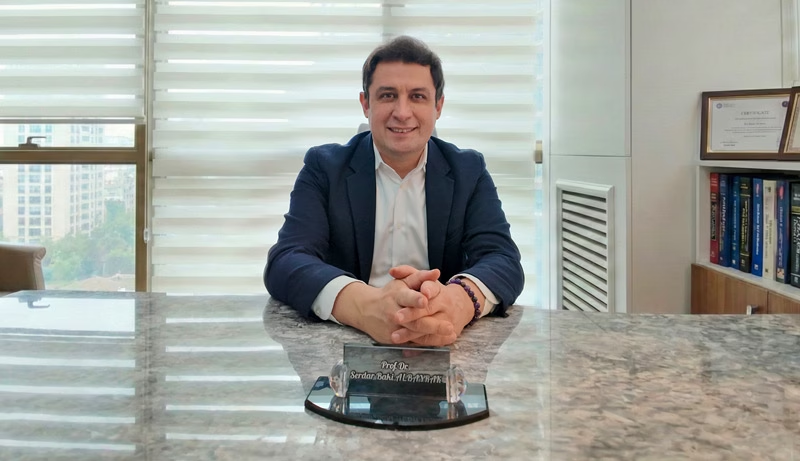
Prof. Dr. Serdar Baki Albayrak
Neurosurgeon · Full Professor of Neurosurgery
Prof. Albayrak implants vagus nerve stimulators for adults and children with drug-resistant epilepsy. Before any implant, he asks the epilepsy team whether surgery could remove the seizure source. Consultations take place in English or Turkish.
He completed his neurosurgery training at Istanbul University in 2004. Clinical fellowships then followed at the University of Helsinki and Harvard Medical School. At Harvard, he trained at Brigham and Women's Hospital.
27+Years
5,000+Operations
64Countries
33Publications
Figures from Prof. Albayrak's professional profile, September 2026. See his full publication list.
Request an AppointmentFrequently Asked Questions
Is VNS the same as deep brain stimulation?
No. VNS works on a nerve in the neck, while DBS places electrodes inside the brain. So VNS needs no brain surgery.
Can a vagus nerve stimulator be removed?
Yes. The surgeon can take out the generator through the chest scar. The coils on the nerve, however, gather scar tissue over the years. So surgeons sometimes leave part of the lead in place.
Is vagus nerve stimulation available on the NHS?
Yes, for some people. NICE suggests VNS for drug-resistant epilepsy when removal surgery does not suit. A specialist epilepsy center then makes the decision.
How much does VNS surgery cost in Turkey?
The device makes up much of the cost, along with the hospital stay and tests. A later battery change usually costs less. So ask for the cost of your own plan at the consultation.
Prof. Albayrak's Published Research
None of Prof. Albayrak's papers studies VNS or epilepsy. The closest study scar tissue around operated nerves, a factor in later VNS lead revision. His full list of 33 publications appears on his profile.
- Doxorubicin for prevention of epineurial fibrosis in a rat sciatic nerve model: outcome based on gross postsurgical, histopathological, and ultrastructural findings
- Topical application of cyclosporine reduces epineurial fibrosis: gross postsurgical, histopathological and ultrastructural analysis in a rat sciatic nerve model
- Management outcome of peroneal nerve injury at knee level: experience of a single military institution
Public health information
- MedlinePlus, US National Library of Medicine. Vagus nerve stimulation.
- National Institute for Health and Care Excellence (NICE). Epilepsies in children, young people and adults (NG217): non-pharmacological treatments.
- NICE. Epilepsies (NG217): terms used in this guideline, including drug-resistant epilepsy.
- NICE. Vagus nerve stimulation for refractory epilepsy in children (HTG25).
- NICE. Implanted vagus nerve stimulation for treatment-resistant depression (HTG551).
- National Institute of Neurological Disorders and Stroke (NINDS). Epilepsy and seizures.
- NHS. Epilepsy.
- World Health Organization. Epilepsy fact sheet.
- US Food and Drug Administration. MRI: benefits and risks.
- UK Civil Aviation Authority. Surgical conditions: guidance for health professionals.
- US Centers for Disease Control and Prevention. Medical tourism.
This page gives general medical information and does not replace a consultation. So diagnosis and treatment decisions need an examination by your own doctor.
Last updated: 1 October 2026. Website editor: Prof. Dr. Serdar Baki Albayrak's clinic, [email protected].
Plan Your VNS Consultation in Istanbul
Request an appointment with Prof. Dr. Serdar Baki Albayrak. The team then helps you plan the dates of your visit.
Request an Appointment