
Paid online consultations are available by appointment. For booking, please contact us via Whatsapp.

What Is Dystonia Surgery?
Dystonia surgery treats dystonia that injections and medicines no longer control. The main operation is deep brain stimulation (DBS) of the globus pallidus internus (GPi). Thin electrodes there connect to a small battery under the collarbone.
Unlike in Parkinson's disease, the benefit in dystonia builds slowly over weeks to months. Surgery also does not cure dystonia. Instead, it eases the pulling, the abnormal postures and often the pain.
Dystonia itself starts in the brain's movement circuits, not in the muscles. In fact, the brain tells opposing muscles to tighten at the same time.
At a Glance
- What it isSurgery for dystonia that injections and medicines no longer control
- Main operationDeep brain stimulation (DBS) of the GPi, usually on both sides
- Best candidatesInherited or unexplained dystonia, generalized or in the neck
- When it worksGradually, over weeks to months, not overnight
- Hospital stayUsually 3-5 days, then regular programming visits
- Flying homeUK guidance advises about 7 days after brain surgery
What Brought You Here?
Pick the line that sounds most like you. Each one then jumps to the part of this guide that answers it.
- 01My head turns or tilts and I cannot stop itCervical dystonia (torticollis) in adults
- 02My child's twisting spreads to other limbsGeneralized dystonia that starts in childhood
- 03Injections help less than they used toMedicines, injections and when to consider surgery
- 04I am considering deep brain stimulationWho is a good candidate and how surgery works
- 05I want to know how fast DBS worksResults month by month, then the risks
- 06I am planning surgery from abroadLength of stay, flights and programming at home
Types of Dystonia and Their Symptoms
Dystonia makes muscles contract and twist part of the body into an unusual posture. Doctors name each type by how much of the body it affects. The type then guides treatment.
Cervical dystonia (torticollis)
Cervical dystonia is the most common type in adults. The neck muscles turn the head, tilt it, or pull it forward or back. It usually starts in midlife and often brings neck pain and a head tremor.
For many people, a light touch on the chin briefly eases the pull. Doctors call this a sensory trick, and it points strongly to dystonia. The pain can also mimic a herniated disc in the neck.
Generalized dystonia
Generalized dystonia, in contrast, affects the trunk and at least two limbs. It usually starts in childhood or the teenage years, often in one foot or arm. Over time, it can spread to the rest of the body.
Many early cases come from a gene change, such as DYT1 (TOR1A). Others follow a lack of oxygen at birth, often with cerebral palsy. Children with inherited forms usually respond best to DBS.
Other focal and segmental types
- Blepharospasm: both eyelids squeeze shut, sometimes blocking vision
- Writer's cramp: the hand cramps only during one task
- Laryngeal dystonia: a strained or broken voice
- Oromandibular dystonia: the jaw, lips or tongue pull
- Segmental dystonia: two neighboring areas, such as eyelids and jaw
These types usually stay in one area, so injections remain the main treatment.
Questions at this stage
Is dystonia painful?
It can be. Cervical dystonia often causes neck pain that disturbs sleep. Easing the pull usually eases the pain too.
Is dystonia hereditary?
Some types do, including many childhood cases with a DYT1 gene change. Still, not every gene carrier develops symptoms. Adult focal dystonia rarely runs in families.
Can dystonia go away on its own?
Rarely. About 1 in 10 people with cervical dystonia get a symptom-free spell that usually ends. Dystonia from a medicine, in contrast, often settles once the medicine stops.
When to See a Doctor About Dystonia
See your doctor if a twisting or pulling movement keeps coming back. Most dystonia develops slowly, but a few situations need emergency care within hours.
Book a doctor's visit if you notice:
- Your head keeps turning or tilting to one side
- A hand cramps only when you write or play an instrument
- A child's foot or arm twists during walking or reaching
Call 911, 999 or 112 at once for:
- Spasms across the body that do not ease for hours
- Trouble breathing or swallowing during spasms
- Spasms with a high fever or a racing heart
- Sudden neck, jaw or eye spasms after a new medicine
- A sudden, severe return of spasms if you have DBS
Doctors call a severe, nonstop attack status dystonicus. It needs intensive care, so get help where you are. A sudden reaction to a medicine, in contrast, usually settles quickly with treatment.
What Causes Dystonia, and How Doctors Diagnose It
Dystonia comes from faulty signals in the brain circuits that control movement. In many adults, doctors find no clear cause and call it idiopathic dystonia.
Main Causes
- Genetic: gene changes such as DYT1, usually with onset in childhood
- Brain injury: lack of oxygen at birth, stroke, head injury or infection
- Medicines: some anti-sickness and antipsychotic medicines; late-onset cases go by the name tardive dystonia
- Other conditions: Parkinson's disease, multiple sclerosis, or Wilson disease, which lets copper build up
Tests Before Treatment
No single test proves dystonia, so the diagnosis rests on a careful examination. Tests then look for a cause that needs its own treatment.
- Examination: the posture, its triggers and any sensory trick
- Brain MRI: rules out a stroke, a tumor or other damage
- Blood and urine tests: including copper levels for Wilson disease in younger people
- Genetic tests: when dystonia starts early or runs in the family
- Levodopa trial: in childhood-onset dystonia, because one rare form responds almost completely
- EMG: shows which muscles pull and guides injections
First, a movement disorder neurologist usually makes the diagnosis. Prof. Albayrak then joins the decision once surgery becomes an option.
Is dystonia a psychological illness?
No. Dystonia is a neurological disorder of the brain's movement circuits. Stress can make spasms worse, but it does not cause them.
Dystonia vs Tremor, Spasticity and Facial Spasm
Several conditions look like dystonia at first. However, each one has a different cause and a different operation.
| Condition | Movement | Main trigger | Surgical option |
|---|---|---|---|
| Dystonia | Sustained pulling, twisting or an unusual posture | A specific action, stress or tiredness; eases in sleep | DBS of the GPi; for the neck, sometimes nerve-cutting surgery |
| Essential tremor | Regular, rhythmic shaking | Reaching or holding a posture | DBS of the thalamus (VIM) or focused ultrasound |
| Spasticity | Stiffness that resists fast movement, often with weakness | Quick stretching of a limb | Baclofen pump or selective nerve surgery |
| Hemifacial spasm | Twitching on one side of the face | Stress, talking or eating | Microvascular decompression (MVD) |
| Torticollis in babies | A tight neck muscle, present from birth | None; the tilt stays | Stretching first; rarely, surgery on the neck muscle |
See our guides to essential tremor surgery, spasticity surgery and hemifacial spasm.
Dystonia Treatment Options Before Surgery
Treatment follows steps, and surgery comes only after the simpler options. If tests find a cause, such as Wilson disease, doctors treat it first.
Dystonia Treatments Compared
| Option | Who it suits | How it works | Limits |
|---|---|---|---|
| Botulinum toxin injections | Focal and segmental dystonia, such as cervical dystonia | Relax the pulling muscles for about 3 months | Need repeating; less useful when dystonia is widespread |
| Medicines | Generalized and segmental dystonia | Tablets such as anticholinergics, muscle relaxants or levodopa | Modest effect; drowsiness and dry mouth are common |
| Physical and occupational therapy | All types, alongside other treatment | Stretching, posture training and easier ways to do tasks | Eases pain; rarely enough on its own |
| Deep brain stimulation (GPi) | Generalized, segmental or cervical dystonia that resists treatment | Mild pulses calm the faulty brain signals | Brain surgery; benefit builds over months; lifelong device care |
| Selective peripheral denervation | Cervical dystonia that no longer responds to injections | Cuts the nerves to the pulling neck muscles | Permanent; the pull can shift to other muscles |
What Botulinum Toxin Injections Involve
A doctor injects small amounts into the overactive muscles, often with EMG guidance. The effect starts within days and usually lasts about 3 months. So injections continue at regular intervals.
Over the years, however, some people find the benefit fades. Others develop side effects, such as trouble swallowing after neck injections. At that point, it makes sense to ask about surgery.
Can dystonia be treated without surgery?
Yes, and most people never need an operation. Injections control most focal dystonia, and medicines help some people with widespread dystonia. Surgery becomes an option when these no longer give useful relief.
Selective Peripheral Denervation for Cervical Dystonia
This operation cuts the small nerve branches that drive the pulling neck muscles. It needs no brain surgery, and the other neck muscles keep working.
Prof. Albayrak includes it among the options when neck injections stop working. Today, however, DBS is the more common choice. The nerve cuts are permanent, and the pull can shift to other neck muscles.
Deep Brain Stimulation for Dystonia
DBS is the main operation for dystonia that resists injections and medicines. The surgeon places thin electrodes in the GPi on both sides of the brain. A battery under the collarbone then sends steady, mild pulses that calm the faulty signals.
DBS destroys no brain tissue, and the team can adjust it or switch it off. Our deep brain stimulation guide covers device parts, battery types and awake surgery.
Who Is a Good Candidate?
Prof. Albayrak decides together with a movement disorder neurologist, after a full assessment. UK NICE guidance also asks for a specialist movement disorder team. Good candidates usually have:
- Inherited or unexplained dystonia, especially DYT1 dystonia
- Generalized, segmental or cervical dystonia that limits daily life
- A fair trial of at least two medicine groups and, for focal dystonia, botulinum toxin
- Joints that still move freely, without fixed contractures
- A brain MRI without major damage, since dystonia after brain injury responds less
- Realistic expectations and time for months of programming visits
Tardive dystonia, which follows certain medicines, also often responds well. Timing matters too, because years of pulling can lock joints in place. So Prof. Albayrak prefers not to wait too long once other treatments fail.
How the Operation Works in Dystonia
First, Prof. Albayrak plans the GPi target on MRI to the millimeter. In dystonia, he usually prefers general anesthesia, since strong spasms make stillness hard. Imaging during surgery then confirms where each lead sits.
Overall, placing the leads usually takes about 3-4 hours. The battery adds about an hour, sometimes on another day. Most people then stay in hospital for 3-5 days.
Is DBS for dystonia done awake or asleep?
Many centers use local anesthesia for DBS in other conditions. In dystonia, however, Prof. Albayrak usually operates under general anesthesia. Imaging during surgery then checks each lead's position.
DBS for Children With Dystonia
Children with inherited generalized dystonia can have DBS, and earlier surgery tends to work better. It treats the pulling before joints become fixed. The surgeon also leaves extra wire length for growth.
A pediatric neurologist and the neurosurgeon then decide together. Our pediatric neurosurgery overview explains how care for children differs.
How Long Does DBS Take to Work for Dystonia?
In dystonia, improvement builds slowly over weeks and months. Tremor and Parkinson's symptoms, by contrast, often ease within minutes of switching on.
The brain circuits need time to reset. So patience in the first months matters, and regular programming visits shape the result.
A Typical Timeline
| When | What usually happens | What you do |
|---|---|---|
| Weeks 2-4 | The wound heals; the team switches the device on and sets the first program | Wound care; avoid heavy effort |
| Months 1-3 | Jerky, movement-related spasms ease first | Programming visits about once a month |
| Months 3-6 | Fixed postures start to improve | Physical therapy to retrain posture |
| Months 6-12 | Benefit usually peaks; medicines can often come down | Visits every 3-6 months |
| After 1 year | Benefit usually lasts for years; the battery eventually needs replacing | Yearly check-ups |
Who Improves Most?
Inherited and unexplained generalized dystonia usually respond best, and cervical dystonia also responds well. Dystonia after brain injury, such as cerebral palsy, usually improves less. Fixed joints also limit the result.
Will I still need injections after DBS?
Some people do. DBS often allows fewer injections and lower medicine doses, but it rarely removes every symptom. Your team then fine-tunes the mix over the first year.
Risks of Dystonia Surgery
DBS is brain surgery, so it carries real risks, although serious problems are uncommon. Most side effects of stimulation also fade once the team changes the settings.
- Bleeding in the brain: rare; careful route planning lowers the risk
- Infection: most often around the battery; it can mean removing part of the system for a while
- Lead movement or a broken wire: slightly more common in dystonia, because strong spasms strain the wires
- Stimulation effects: slurred speech, slower walking or flashes of light; new settings usually help
- Limited benefit: more likely after brain injury or with fixed joints
- Battery wear: a standard battery lasts about 3-5 years, a rechargeable one about 9 years
Living With a DBS Device
First, carry your device card, and tell airport staff before security checks. Also tell every doctor about the device, especially before any scan or heat treatment.
Replacing the battery later takes a short operation, and the brain leads stay in place. Meanwhile, programming visits continue, although less often over time.
Can I have an MRI with a DBS device?
Often yes, under the conditions the device maker sets. The device needs a special mode first, and the scan follows the maker's rules. So always tell your DBS team before you book a scan.
Coming to Istanbul from the US, Canada, the UK or Europe
DBS for dystonia needs months of programming, so plan the follow-up before you book. Also keep your return date flexible.
How Long to Stay in Istanbul
First, allow a few days for the consultation and tests. Then add the operation and 3-5 days in hospital. A wound check about 10 days after surgery usually follows.
The team usually switches the device on 2-4 weeks after surgery. So if you want the first programming session in Istanbul, plan for about 3-5 weeks. Otherwise, a team near home can start programming after you return.
Programming After You Return Home
Before surgery, ask a movement disorder neurologist near home whether they can program your device. Device makers differ, so share the brand and model with them early. Then take your device card, settings report and discharge summary home.
When You Can Fly Home
First, UK aviation guidance advises about 7 days between brain surgery and a flight. The US CDC also links flying soon after surgery with blood clots. So your neurosurgeon confirms the date after a check-up.
In the UK, you must not drive after DBS until a doctor confirms your recovery. Under DVLA guidance, the rules for your underlying condition also apply. Elsewhere, rules differ, so ask your doctor before you drive.
For insurance and Medicare, see brain surgery in Turkey: planning from the US. For NHS rules and travel insurance, see planning from the UK. From Canada, check with your provincial health plan and private insurer before you book.
Your treatment in Istanbul
From Your First Message to Your First Programming
Dystonia surgery in Istanbul follows four steps. Each step then answers one practical question.
STEP 01
Request an appointment
Use the form on this page, WhatsApp or call +90 532 308 97 72. A short message is enough, such as your diagnosis, country and travel dates.
STEP 02
Assessment and tests in Istanbul
Prof. Albayrak examines you at his clinic in Teşvikiye and discusses your MRI with you. If newer images would help, you can have them in Istanbul. Blood tests, a heart check and an anesthesia assessment then follow.
Also bring your injection dates and a list of the medicines you have tried.
STEP 03
Surgery and hospital stay
If DBS suits you, the operation takes place in a hospital in Istanbul. Prof. Albayrak names the hospital at the consultation, along with the likely stay.
STEP 04
Programming and follow-up
About 2-4 weeks after surgery, the team switches the device on. Programming visits then follow about monthly, and later every 3-6 months.
Back home, get urgent help for any of these signs:
- Fever, or a red, swollen or leaking wound
- A severe headache, new weakness or confusion
- A sudden, severe return of spasms
Who programs my device after I return home?
Ideally, a movement disorder neurologist near home who knows your device brand. Ask the team in Istanbul for a written settings report to hand over. Then arrange this contact before surgery.
Your Dystonia Surgeon in Istanbul
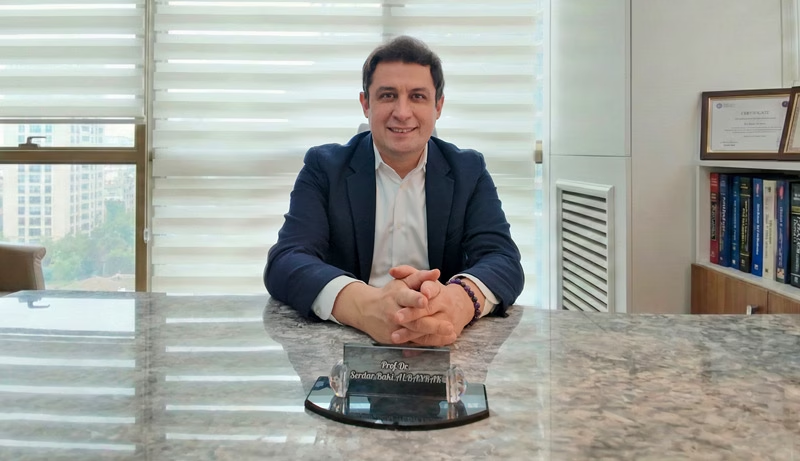
Prof. Dr. Serdar Baki Albayrak
Neurosurgeon · Full Professor of Neurosurgery
Prof. Albayrak plans each GPi target on MRI to the millimeter. He then checks every lead's position with imaging during surgery. In dystonia, he usually operates under general anesthesia.
He completed his neurosurgery training at Istanbul University in 2004. Clinical fellowships then followed at the University of Helsinki and at Harvard Medical School. Consultations take place in English or Turkish.
27+Years
5,000+Operations
64Countries
33Publications
Figures from Prof. Albayrak's professional profile, September 2026. See his full publication list.
Request an AppointmentFrequently Asked Questions
Can dystonia be cured?
Most dystonia has no cure, but treatment controls symptoms well in many people. However, dystonia from a medicine often settles once the medicine stops.
What is the success rate of dystonia surgery?
Results depend mostly on the type and cause of dystonia. Inherited, unexplained and cervical dystonia usually improve the most. Dystonia after brain injury improves less, so ask what to expect in your case.
How much does dystonia surgery cost in Turkey?
The cost depends on the device, the hospital and the nights you stay. Tests, your hotel and flights also add to it. So ask for the cost of your own plan at the consultation.
Which doctor treats dystonia?
A movement disorder neurologist diagnoses dystonia and usually gives the injections. When these stop helping, a neurosurgeon who performs DBS joins the team.
Prof. Albayrak's Published Research
None of Prof. Albayrak's 33 publications covers dystonia itself. His closest paper reviews MRI during surgery, which can confirm DBS lead position. Another covers peripheral nerve surgery, the field of selective denervation.
- Intra-operative magnetic resonance imaging in neurosurgery
- Management outcome of peroneal nerve injury at knee level: experience of a single military institution
Public health information
- National Institute of Neurological Disorders and Stroke. Dystonia.
- NHS. Dystonia.
- MedlinePlus Genetics, US National Library of Medicine. Early-onset isolated dystonia.
- MedlinePlus, US National Library of Medicine. Deep brain stimulation.
- National Institute for Health and Care Excellence (NICE). Deep brain stimulation for tremor and dystonia (excluding Parkinson's disease).
- National Eye Institute. Blepharospasm.
- MedlinePlus, US National Library of Medicine. Torticollis.
- UK Civil Aviation Authority. Surgical conditions: guidance for health professionals.
- US Centers for Disease Control and Prevention. Medical tourism.
- GOV.UK, Driver and Vehicle Licensing Agency. Neurological disorders: assessing fitness to drive.
This guide gives general medical information and does not replace a consultation. Diagnosis and treatment decisions need an examination by your own doctor.
Last updated: 1 October 2026. Website editor: Prof. Dr. Serdar Baki Albayrak's clinic, [email protected].
Plan Your Dystonia Surgery Consultation in Istanbul
Request an appointment with Prof. Dr. Serdar Baki Albayrak. The team then helps you plan your visit and your programming follow-up.
Request an Appointment