
Paid online consultations are available by appointment. For booking, please contact us via Whatsapp.

What Is Spondylolisthesis Surgery?
Spondylolisthesis surgery frees nerves pinched by a vertebra that has slipped forward. Often, it also joins that vertebra to the one below: a spinal fusion. As a result, the slip should not progress.
Spondylolisthesis itself means one vertebra has slid forward over the one below. Yet a mild slip often needs no operation at all.
At a Glance
- What slipsOne vertebra over the one below, usually at L4-L5 or L5-S1
- Adult typesDegenerative (wear) and isthmic (a stress crack)
- First stepPhysical therapy and activity changes
- Key testsStanding and bending X-rays, plus an MRI
- Usual operationDecompression with fusion; decompression alone if stable
- Flying homeAfter a check-up; no fixed UK figure for spine surgery
Where Are You in Your Decision?
First, pick the line closest to you. Each line then jumps to its answer.
- 01Back or leg pain that eases when you sitSigns of a slipped vertebra
- 02Your report says grade 1 or grade 2What the grade decides
- 03Months of therapy have not helpedWhen surgery makes sense
- 04Bending X-rays show the slip movesWhy movement means fusion
- 05Numbness between the legs or bladder changesEmergency signs
- 06Planning surgery from abroadStay, flights and follow-up
When Do You Need Spondylolisthesis Surgery?
Generally, surgery becomes a fair choice when symptoms limit daily life despite good treatment. It also comes up when nerves weaken or the slip keeps moving.
Back or leg pain that eases when you sit
Spondylolisthesis pain typically grows when you stand or walk. It then eases when you sit or bend forward, according to the NHS. For example, leaning on a shopping cart often helps.
Pain may also reach the buttocks and thighs, with tight hamstrings. A pinched nerve root can add sciatica down one leg, too.
A grade 1 or grade 2 slip on your report
The grade shows how far the vertebra has slid, from 1 to 5. Grades 1 and 2 count as low grade, so most settle without surgery.
However, the grade alone does not decide. Even a grade 2 slip can pinch a nerve hard. So Prof. Albayrak weighs your symptoms first.
Months of treatment without enough relief
First, physical therapy, activity changes and painkillers ease most flare-ups. They cannot, however, move the vertebra back.
Prof. Albayrak generally reviews surgery after a regular 3-6 month program without enough progress. A sharply shorter walking distance also brings the decision forward. Growing leg weakness, too, means he does not wait.
A slip that moves or grows
X-rays taken as you bend forward and back show whether the vertebra rocks. If it moves, doctors call the level unstable, and a fusion then usually follows. A slip that grows between check-ups also points toward surgery, especially in younger patients.
Questions at this stage
Does grade 2 spondylolisthesis require surgery?
Not usually. In fact, many with a grade 2 slip do well with therapy and activity changes. Surgery then comes up only if nerve symptoms persist, weakness grows or the slip moves.
Can spondylolisthesis heal on its own?
The slipped vertebra does not move back by itself. However, symptoms often settle with exercise and activity changes. So many people live well without surgery.
When to See a Doctor About Spondylolisthesis
Most slips worsen slowly, so there is time to plan. A few signs, however, need same-day help.
Book a specialist visit if you notice:
- Back or thigh pain that lasts beyond 3-4 weeks (NHS)
- A walking distance that keeps getting shorter
- Fever, night sweats or weight loss along with back pain
Get emergency care the same day for:
- Numbness around the genitals or the back passage
- Trouble passing urine, or loss of bladder or bowel control
- Fast-growing weakness in both legs
- A foot you suddenly cannot lift (foot drop)
These signs can mean cauda equina syndrome, which needs urgent surgery. So call 911 (US and Canada), 999 (UK) or 112 (Europe).
Fever or weight loss can also point to an infection or a spinal tumor.
Types and Grades of Spondylolisthesis
Doctors describe each slip by its cause, the type, and by its size, the grade. A standing side X-ray then measures the grade as a percentage.
| Grade (Meyerding) | How far it has slid | Group | Usual approach |
|---|---|---|---|
| Grade 1 | Up to 25% | Low grade | Treatment without surgery first |
| Grade 2 | 26-50% | Low grade | Symptoms and nerve findings decide |
| Grade 3 | 51-75% | High grade | Surgery often comes up |
| Grade 4 | 76-100% | High grade | Surgery usually advised |
| Grade 5 (spondyloptosis) | The vertebra has slipped off completely | Most severe | Extensive surgery |
Degenerative or Isthmic?
In adults, two types cause most slips. First, degenerative spondylolisthesis comes with age, as worn discs and facet joints loosen their hold. It mostly affects people over 50, and women more often than men (MedlinePlus).
Isthmic spondylolisthesis, in contrast, starts with a stress crack at the back of the vertebra. Young athletes and gymnasts get such cracks more often (NHS), especially from backward bending.
Less often, injury, bone disease, a tumor or earlier surgery causes the slip. It can also run in families.
Spondylolisthesis, Stenosis or a Herniated Disc?
A slip often narrows the spinal canal too (NIAMS), so the two can overlap. For narrowing without a slip, however, see spinal stenosis surgery.
In contrast, a herniated disc pushes its soft center onto a nerve; see herniated disc surgery.
Finally, a slip in the neck can press on the spinal cord itself. For clumsy hands and unsteady walking, see cervical myelopathy.
What is the difference between spondylolysis and spondylolisthesis?
Spondylolysis means a stress crack in the back of a vertebra, with no slip. Spondylolisthesis, in contrast, means the vertebra has slid forward. A crack can lead to a slip, but many never do.
Spondylolisthesis Treatment Options Compared
Surgery aims to free pinched nerves and hold the slipped level still. The table then compares each option.
| Option | Who it suits | What it involves | What to expect |
|---|---|---|---|
| Non-surgical care | Most low-grade slips; the first step | Core exercises, activity changes, painkillers, sometimes an injection | No downtime; the slip stays |
| Decompression alone | A stable slip with mainly leg pain | Removal of bone and ligament pressing on nerves; no screws | Shorter operation; the slip can progress |
| Posterior fusion (TLIF or PLIF) | An unstable or growing slip | Decompression, a cage with bone graft, then screws and rods | The bone fuses over months |
| Front or side fusion (ALIF, OLIF, XLIF) | Selected cases, such as restoring disc height | A cage through the belly or side, often with screws from behind | Less back-muscle strain; rare vessel or organ injury |
| Reduction and fixation | High-grade slips | Screws and rods partly realign the vertebra | A larger operation |
Does Every Slip Need a Fusion?
No. If the slip stays stable and leg pain dominates, decompression alone often suffices. The operation then runs shorter, and the level keeps its movement.
Bending X-rays that show movement, however, change the plan. Without a fusion, the freed level could slip faster and need a second operation. So Prof. Albayrak fuses an unstable level from the start. Our spinal fusion surgery guide explains the methods and recovery.
What Decides the Approach?
Age, bone quality, the grade and your spinal curve shape the plan. Earlier back operations matter too. Weak, osteoporotic bone, for example, holds screws less firmly and can collapse.
Before surgery, Prof. Albayrak therefore checks vitamin D and calcium levels and treats any shortfall. For bone that has already collapsed, also see spinal compression fractures and kyphoplasty.
What is the best surgery for spondylolisthesis?
No single operation suits every slip. For example, a stable slip with leg pain may need only decompression. An unstable or high-grade slip, in contrast, usually needs a fusion.
Risks and Results of Spondylolisthesis Surgery
Serious complications are uncommon, but every spine operation carries some risk. MedlinePlus and the NHS list these:
- Nerve root injury, with leg numbness or weakness
- A tear in the nerve sac, with a fluid leak and headaches
- Infection, bleeding or blood clots
- Bone that fails to fuse, or screws that loosen
- Extra wear at the levels next to the fusion
To lower these risks, Prof. Albayrak uses nerve monitoring throughout. Imaging during surgery also confirms each screw position. Quitting smoking at least four weeks beforehand helps the bone fuse, too.
However, not operating carries risks as well, since nerves under long pressure can stay weak.
What is the success rate of spondylolisthesis surgery?
Published figures vary, so ask what any quoted rate measures. MedlinePlus notes that results can be very successful, but a fusion rarely removes all pain. Leg pain also tends to improve more than back pain.
Spondylolisthesis Surgery Recovery Time
Most people walk with help within a day or two. Leg pain often eases early, too. The bones, however, need at least 3-4 months to heal well (MedlinePlus).
| When | What usually happens |
|---|---|
| Days 1-2 | Walking with help; rolling out of bed in one piece |
| Days 3-7 | Discharge to a nearby hotel; short walks several times a day |
| Weeks 2-6 | Longer walks; no bending, twisting or lifting over about 10 lb (4.5 kg) |
| Weeks 6-12 | Physical therapy builds the core; daily activities widen |
| Months 3-12 | Control X-rays track the fusion; limits lift step by step |
Back to Work and Sport
Generally, young, healthy people with light jobs return to work 4-6 weeks after a fusion. Older people after larger operations, however, may need up to 4-6 months (MedlinePlus).
First, walking and a stationary bike start early. Swimming then follows once the wound heals and your surgeon agrees. Finally, running, jumping and contact sports wait until the fusion becomes solid.
Coming to Istanbul from the US, Canada, the UK or Europe
A fusion takes 3-4 hours, then up to 3-4 days in hospital (MedlinePlus). For the whole trip, however, plan about two to three weeks in Istanbul.
When You Can Fly Home
Your surgeon sets the flight date after a final check. UK aviation guidance gives no separate figure for spine surgery. However, it advises older or anemic patients to delay flying for several days.
For major surgery, the US CDC also suggests delaying flights for 10-14 days. Long flights raise the risk of blood clots, especially after surgery (NHS). So book an aisle seat, walk hourly and drink water.
For flights, stays and visas, see our guide to surgery in Turkey.
Follow-Up at Home
Before you leave, first ask for your discharge summary, operation note and X-ray copies. Then book a check-up and physical therapy at home before you travel.
For insurance, see Medicare and US insurance for surgery in Turkey. For NHS rules, see treatment in Turkey from the UK. From Canada, check with your provincial health plan and private insurer before you book.
Your visit to Istanbul
Your Spondylolisthesis Treatment in Istanbul, Step by Step
The visit generally follows four steps.
STEP 01
Request an appointment
Use the form on this page, WhatsApp or call +90 532 308 97 72. A short message is enough: your symptoms, walking distance, country and travel dates.
You can write in English or Turkish. The team then contacts you to arrange the consultation. For the consultation, also bring your X-rays and MRI on a disc or USB drive.
STEP 02
Consultation and tests
At his clinic in Teşvikiye, Şişli, Prof. Albayrak first asks how far you can walk. He then checks your strength, reflexes and feeling in both legs. Next come the matching tests:
- Standing side X-ray: the true size of the slip, which lying down can hide
- Bending X-rays: whether the level moves
- MRI: which nerves the slip pinches
- CT scan: a stress crack in the bone
- EMG: nerve damage, if the exam leaves doubt
Does spondylolisthesis show on an MRI?
Often, yes, but an MRI taken lying down can make the slip look smaller. So standing X-rays, including bending views, measure it best.
STEP 03
Surgery: freeing the nerves and fixing the level
The operation takes place in a hospital in Istanbul, under general anesthesia. Prof. Albayrak names the hospital at the consultation. A typical fusion then follows these steps:
- You lie face down, and an X-ray confirms the level
- Under magnification, the surgeon frees the pinched nerves
- Screws go into the vertebrae, and imaging checks each position
- A cage with bone graft fills the disc space
- Finally, rods join the screws, and the wound closes in layers
What is TLIF surgery?
TLIF stands for transforaminal lumbar interbody fusion. First, the surgeon reaches the disc space from the back, on one side. A cage with bone graft goes in, and then screws and rods hold the level.
STEP 04
Recovery, flight and follow-up
After discharge, you rest at a nearby hotel, ideally with a companion. Before the flight, Prof. Albayrak checks the wound and your walking. Back home, your own doctor then takes over.
Get urgent help if any of these signs appear after surgery:
- A fever of 101°F (38.3°C) or higher
- A red, warm, swollen or leaking wound
- New numbness or weakness in the legs
- Trouble controlling urine or bowel movements
- Calf pain or swelling, chest pain or shortness of breath
Your Spondylolisthesis Surgeon in Istanbul
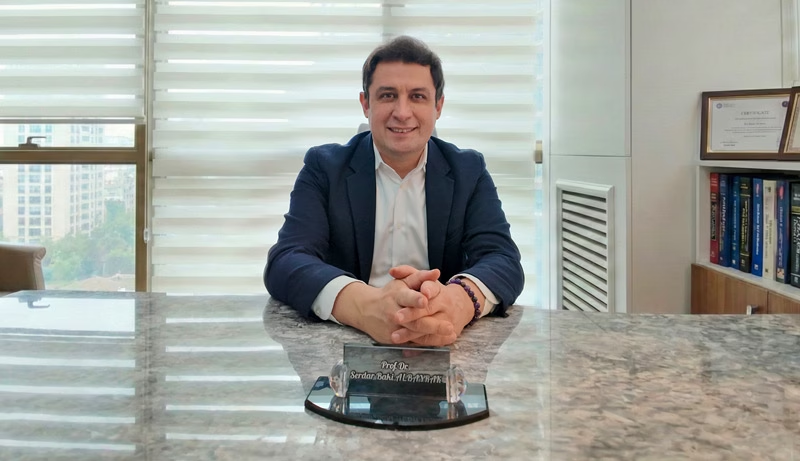
Prof. Dr. Serdar Baki Albayrak
Neurosurgeon · Full Professor of Neurosurgery
For spondylolisthesis, Prof. Albayrak plans each operation from standing and bending X-rays. During every fusion, he also uses nerve monitoring and checks screw positions with imaging.
He completed neurosurgery training at Istanbul University in 2004. He then took clinical fellowships at the University of Helsinki and Harvard Medical School.
At Harvard, he trained at Brigham and Women's Hospital. Consultations take place in English or Turkish.
27+Years
5,000+Operations
64Countries
33Publications
Figures from Prof. Albayrak's professional profile, September 2026. See his full publication list.
Request an AppointmentFrequently Asked Questions
Can spondylolisthesis come back after surgery?
A fused level should not slip again. Over the years, however, the levels next to it can wear faster (adjacent segment disease). So a healthy weight and regular exercise help protect them.
Which exercises should I avoid with spondylolisthesis?
Avoid moves that arch your lower back, such as bridges, heavy squats and backward stretches. High-impact jumping can also aggravate pain. In contrast, walking, swimming and core exercises with a neutral spine usually suit you.
How much does spondylolisthesis surgery cost in Turkey?
The cost depends on the operation, the number of levels and the hospital stay. A fusion also adds implants such as screws, rods and cages. So ask for your own plan's cost at the consultation.
Prof. Albayrak's Published Research
None of Prof. Albayrak's papers studies spondylolisthesis itself, so these cover the closest topics. His full list of 33 publications also appears on his profile.
- Topical application of tacrolimus prevents epidural fibrosis in a rat postlaminectomy model: histopathological and ultrastructural analysis
- Doxorubicin for prevention of epineurial fibrosis in a rat sciatic nerve model: outcome based on gross postsurgical, histopathological, and ultrastructural findings
- Spinal epidural abscess due to Brucella
Public health information
- NHS. Spondylolisthesis.
- MedlinePlus, US National Library of Medicine. Spondylolisthesis.
- MedlinePlus. Spinal fusion.
- MedlinePlus. Spine surgery: discharge.
- NHS. Lumbar decompression surgery.
- NIAMS, National Institutes of Health. Spinal stenosis: symptoms, causes and risk factors.
- NHS. DVT (deep vein thrombosis).
- UK Civil Aviation Authority. Surgical conditions: guidance for health professionals.
- US Centers for Disease Control and Prevention. Medical tourism.
This page gives general medical information and does not replace a consultation. So diagnosis and treatment decisions need an examination by your own doctor.
Last updated: 1 October 2026. Website editor: Prof. Dr. Serdar Baki Albayrak's clinic, [email protected].
Plan Your Spondylolisthesis Consultation in Istanbul
Request an appointment with Prof. Dr. Serdar Baki Albayrak. The team then helps you plan the dates of your visit.
Request an Appointment