
Paid online consultations are available by appointment. For booking, please contact us via Whatsapp.

What Is a Spinal Cord Tumor in a Child?
A pediatric spinal cord tumor is an abnormal growth in or around the spinal cord. Many start inside the cord itself and grow slowly over months. Still, the canal is narrow, so even a slow tumor can press on vital nerves.
These nerves control walking, feeling and the bladder. So early diagnosis and careful surgery protect skills your child needs for life. A growing spine also adds a second goal: a straight back.
Our guide to spinal cord and spine tumors covers adults. For other conditions in children, see pediatric neurosurgery.
At a Glance
- How commonRare in children; many grow slowly and are low grade
- Most common typeAstrocytoma inside the cord, then ependymoma
- First signsBack pain that wakes your child, a walking change or a new curve
- Key testMRI with contrast, often under sedation in young children
- Main treatmentMicrosurgery with live nerve monitoring
- After surgeryRehabilitation, MRI checks and spine checks until growth ends
Which Sign Brought You Here?
Pick the line closest to your child's story to open that part of this guide.
- 01Back or neck pain that wakes your childLasting pain, often worse at night
- 02Tripping, falls or a change in walkingToe walking, clumsy hands or lost walking skills
- 03A curve in the spine that growsScoliosis that hurts or worsens quickly
- 04Wetting again, or bladder and bowel troubleNew accidents or stubborn constipation
- 05An MRI report that names a tumorAstrocytoma, ependymoma and other types
- 06Planning surgery in IstanbulLength of stay, flights and care back home
Spinal Cord Tumor Symptoms in Children
Symptoms build up slowly, so parents often mistake them for growing pains. Pain tends to come first, and then nerve problems follow.
A neck tumor can affect both arms and legs. In contrast, a tumor low in the spine affects the legs and bladder early.
Back or neck pain
Pain is a common early sign, as NINDS notes. In children, it lasts for weeks, often gets worse at night and may wake them.
- A stiff neck, or a head that tilts to one side
- In toddlers: crying when lying down, or refusing to sit or play
Walking changes and clumsiness
Pressure on the cord, for example, makes the legs weak or stiff. As a result, your child may trip, fall or tire quickly on stairs.
- A limp, toe walking, or a toddler who goes back to crawling
- Clumsy hands in neck tumors, or numbness and tingling
A curve in the spine
Sometimes scoliosis, a sideways curve of the spine, is the first sign. NIAMS, for example, lists tumors among its possible causes.
Doctors look closer, however, when a curve hurts, grows fast or looks unusual. An MRI then checks the cord before any brace or curve surgery. For other nerve-related causes, see neuromuscular scoliosis in children.
Bladder and bowel changes
The lowest part of the cord also controls the bladder and bowel. So a child who stayed dry may start wetting again or become constipated.
Questions at this stage
Is my child's back pain a sign of a tumor?
Usually not, since most back pain in children comes from muscles or sport. However, pain that lasts for weeks or wakes your child calls for a check.
Can a spinal cord tumor cause scoliosis in a child?
Yes, it can, because a tumor can upset the muscles that keep the spine straight. So a curve that hurts or grows fast calls for an MRI.
When Should Parents Seek Help?
Most back pain in children is harmless and settles within weeks. Some patterns, however, call for a prompt visit, and a few need emergency care.
Book a visit with your pediatrician for:
- Back pain that lasts for weeks or wakes your child
- A new curve, or one that hurts or grows fast
- Tripping, toe walking or a change in walking
- Wetting again after toilet training
Seek emergency care the same day for:
- Sudden leg weakness, or a child who cannot stand
- Loss of bladder or bowel control
- Numbness between the legs or around the bottom
- Weakness that worsens over hours or days
These signs can mean sudden pressure on the cord. So go to the nearest hospital first, rather than waiting for a visit abroad.
Types of Spinal Cord Tumors in Children
Doctors group these tumors by location: inside the cord, beside it or around it. The location then points to the likely type and the operation.
| Where it grows | Typical tumors in children | How they usually behave | Usual first step |
|---|---|---|---|
| Inside the cord (intramedullary) | Low-grade astrocytoma, ependymoma, ganglioglioma | Mostly slow; may span several levels, sometimes with a cyst | Microsurgery with nerve monitoring |
| Beside the cord, inside its sac (intradural extramedullary) | Myxopapillary ependymoma; nerve sheath tumors in NF1 or NF2; dermoid cysts; spread from a brain tumor | Usually benign, except spread from the brain | Removal, or MRI checks for some NF tumors |
| In bone or tissue around the sac (extradural) | Neuroblastoma, Ewing sarcoma, lymphoma, benign bone tumors | From benign to fast-growing cancer | Often chemotherapy first; surgery for pressure or stability |
Astrocytoma
Astrocytoma is the most common tumor inside the spinal cord in children. Most are low grade, but they often lack a clear edge. So the surgeon removes as much as is safe.
A fluid-filled cavity, or syrinx, often sits beside it; see syringomyelia. The astrocytoma guide covers these tumors in the brain.
Ependymoma
Spinal ependymomas are rare in children; NCI notes most are myxopapillary, low in the spine. They often have a clearer border, so complete removal is more often possible. Radiotherapy sometimes follows, and MRI checks continue for years.
Other Tumors in Children
In children with NF1 or NF2, nerve sheath tumors can grow along the spine. Many, however, need only regular MRI checks. Prof. Albayrak's 2006 first-author report describes a malignant nerve tumor in an adult with NF1.
Some brain tumors, such as medulloblastoma, can seed the spine; see brain tumors in children. Lipomas and dermoid cysts, in contrast, form before birth; see tethered cord syndrome.
What is the most common spinal cord tumor in children?
Inside the cord, astrocytoma leads, and ependymoma comes next. Most of these tumors grow slowly.
Are spinal cord tumors in children cancerous?
Many are low grade, so they grow slowly and seldom spread. Some, however, are cancers, such as high-grade gliomas and neuroblastoma. Even a benign tumor can harm the cord, so it still calls for expert care.
How Doctors Diagnose a Spinal Cord Tumor
First, the neurosurgeon checks strength, reflexes, feeling, walking and the shape of the back. Then an MRI with contrast shows the tumor and its relation to the cord.
- MRI of the spine and brain: size, position and any spread
- Sedation or a short anesthetic: helps young children lie still
- CT scan and standing X-rays: bone changes and any curve
- Lumbar puncture: checks the spinal fluid for some tumors, such as ependymoma
Only tissue under the microscope, however, confirms the exact type and grade. Gene tests on the same tissue then guide further treatment.
Why does my child need an MRI of the brain as well?
Some tumors spread along the spinal fluid in both directions. So one complete scan maps the whole system before surgery.
Treatment Options for Spinal Cord Tumors in Children
For most tumors that press on the cord, surgery comes first. The pathology result then decides what follows, from MRI checks to chemotherapy or radiotherapy.
| Option | When doctors use it | Main goal | What it means for your child |
|---|---|---|---|
| Microsurgical removal | Most tumors that press on the cord | Remove as much as is safe; confirm the type | 48 hours in intensive care, then several days on the ward |
| Observation with MRI | Small tumors without symptoms, many NF1 tumors, fully removed low-grade tumors | Treat only if the tumor grows | Scans every few months at first |
| Chemotherapy | Low-grade gliomas that regrow or cannot come out; children under 3, to delay radiotherapy | Slow or shrink the tumor | Outpatient cycles over months |
| Targeted therapy | Tumors with certain gene changes, such as BRAF | Block the growth signal | Pills or drips that an oncologist plans |
| Radiotherapy | High-grade tumors, some ependymomas, tumors that keep growing | Control remaining tumor | Weekday sessions for several weeks; for ependymoma, not before age 1 (NCI) |
Does my child need chemotherapy or radiotherapy after surgery?
Often not, if the surgeon removes a low-grade tumor completely. NCI notes that close MRI checks may then be enough. High-grade tumors, or tumors that regrow, usually call for more treatment.
How Spinal Cord Tumor Surgery Works in a Child
Under general anesthesia, the surgeon opens the bony arches over the tumor from the back. Then, under the microscope, the tumor comes out piece by piece. Many surgeons then put the arches back (laminoplasty) to protect a growing spine.
Tools That Protect Your Child's Nerves
Prof. Albayrak combines these methods in each operation:
- Microsurgery: work under a microscope, millimeter by millimeter
- Neuromonitoring: live checks of motor (MEP) and sensory (SEP) signals
- Neuronavigation: a 3D map from the MRI, mainly in the neck and upper back
- Ultrasonic aspirator: gently breaks up and removes large tumors
How Much of the Tumor Can Come Out?
Ependymomas often separate from the cord, so complete removal is often possible. Astrocytomas, however, usually blend into it. Then the aim is to remove as much as is safe.
So if monitoring shows a warning, the team pauses or stops. Walking and bladder control come first.
Risks of Surgery
The most common risk is new numbness or weakness, which often improves over weeks. Others include a spinal fluid leak, infection, bladder changes and, later, a spine curve.
Can spinal cord tumor surgery cause paralysis?
It can, which is why nerve monitoring runs throughout the operation. Some weakness after surgery is common and often temporary. A tumor left untreated, however, can also cause lasting damage.
Keeping the Spine Straight After Surgery
In a growing child, the spine can slowly curve sideways (scoliosis) or round forward (kyphosis). So spine checks continue until growth ends, alongside the tumor scans.
The risk rises with younger age and with surgery over several levels. Radiotherapy adds to it, too; NCI lists both among its possible late effects.
How Surgeons Lower the Risk
Surgeons remove only the bone the tumor requires and often put the arches back. Screws and rods then steady the spine if a curve calls for it.
Follow-Up Checks After Treatment
| Check | Why it matters | Typical timing |
|---|---|---|
| MRI of the spine, and the brain when needed | Finds tumor that remains or returns | Low-grade tumors: often every 6 months. Ependymoma: every 3-4 months for 2-3 years, then less often (NCI) |
| Standing spine X-rays | Tracks any curve or forward rounding | At regular visits until growth ends |
Will my child need spinal fusion later?
Some children do, especially after surgery over many levels at a young age. Regular X-rays, however, catch a growing curve early.
Recovery and Rehabilitation
Children usually spend the first 48 hours after surgery in intensive care. Nurses also check movement and feeling around the clock. Physiotherapy then begins within the first few days.
A child's nervous system adapts well, so recovery often moves faster than in adults. Strength and feeling, however, can take weeks to months. Physiotherapy, occupational therapy and, if needed, a bladder program support each step.
Most children return to school step by step, once walking and energy allow. Contact sports wait until your surgeon agrees.
How long is recovery after spinal cord tumor surgery in a child?
The hospital stay usually lasts several days, including the first 48 hours in intensive care. Strength and feeling, however, can keep improving for many months.
A Practical Guide for Parents
A diagnosis like this turns family life upside down. Unless your child needs urgent surgery, though, you usually have time for questions.
Questions to Ask the Surgeon
- Where exactly is the tumor, and what type does it look like?
- How much can come out safely, and what if some remains?
- Which functions lie close to it, and how might surgery affect the spine?
- Which treatment follows at home, and which records should we take?
Talking to Your Child
Use simple, honest words that match your child's age. For example, explain that the doctor will take out a lump that presses on nerves. A favorite toy or blanket also helps in hospital.
Coming to Istanbul from the US, Canada, the UK or Europe
Many families come for the operation and continue further care at home. So plan the stay and the handover to your local team early.
How Long to Stay in Istanbul
Allow for the consultation, any new MRI, the operation and two days in intensive care. Several days on the ward and a wound check then follow. Overall, many families plan for about two weeks, then confirm the date with the team.
Flying Home With Your Child
After neurosurgery that may leave air in the skull, UK guidance advises about 7 days. For spine surgery, however, it gives no separate figure, so your surgeon decides.
The US CDC adds that flying soon after surgery raises the risk of blood clots. So book a flexible ticket.
Care Back Home
Before you leave, ask for the discharge summary, pathology report and scan copies. Then book visits with your local pediatric team.
For insurance and Medicare, see planning from the US. NHS rules and travel insurance appear under planning from the UK. From Canada, check with your provincial health plan and private insurer before you book.
Your child's treatment in Istanbul
From Your First Message to Flying Home
Treatment in Istanbul follows four clear steps.
STEP 01
Request an appointment
Use the form on this page, WhatsApp or call +90 532 308 97 72. A short message is enough: your child's diagnosis, age, country and travel dates. You can write in English or Turkish.
STEP 02
Consultation and tests in Istanbul
First, Prof. Albayrak examines your child at his clinic in Teşvikiye. Next, he goes through the MRI scans with you and explains each option.
What should we bring to the first appointment?
Bring all MRI scans on a disc or USB drive, with the written reports. Also bring a list of medicines, allergies and earlier operations.
STEP 03
Surgery and hospital stay
The operation takes place in an Istanbul hospital with pediatric intensive care. Prof. Albayrak then names the hospital at the consultation, along with the likely stay.
Can a parent stay with our child in hospital?
Usually, one parent can stay in the child's room on the ward. Intensive care units, however, have stricter visiting rules, so ask about them at the consultation.
STEP 04
Recovery, fitness to fly and follow-up
After discharge, your family rests near the hospital until the wound check. Your surgeon then confirms when your child can fly.
Back home, get urgent help for any of these signs:
- New weakness or numbness in the arms or legs
- Trouble passing urine, or new loss of bladder control
- Fever, redness or fluid leaking from the wound
- A severe headache or repeated vomiting
Your Child's Spinal Cord Surgeon in Istanbul
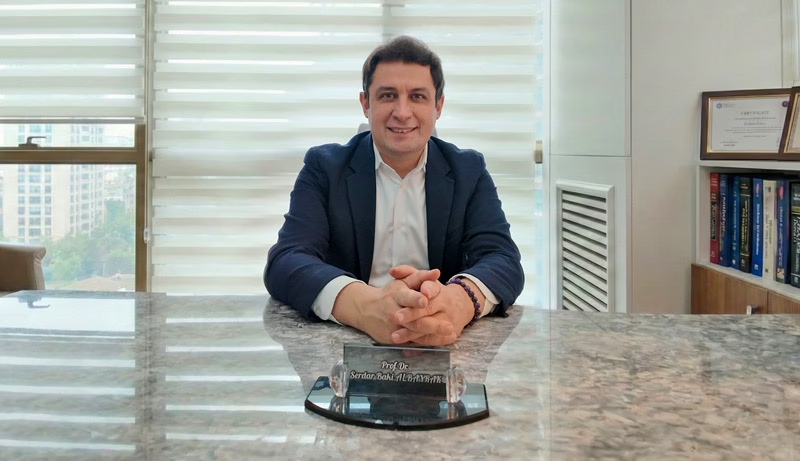
Prof. Dr. Serdar Baki Albayrak
Neurosurgeon · Full Professor of Neurosurgery
Prof. Albayrak operates on brain and spinal cord tumors in children as well as adults. Nerve monitoring and navigation also form a routine part of these operations.
27+Years
5,000+Operations
64Countries
33Publications
Figures from Prof. Albayrak's professional profile, September 2026. See his full publication list.
Request an AppointmentFrequently Asked Questions
Is a spinal cord tumor in a child curable?
Often, yes, especially when a low-grade tumor comes out completely. NCI notes a relatively favorable outlook in that case. For other tumors, the aim becomes long-term control.
Can a spinal cord tumor come back after surgery?
Yes, some can, especially when part of the tumor remains. Ependymomas, for example, can return many years later, NCI notes. For this reason, MRI checks continue for years.
How much does spinal cord tumor surgery cost in Turkey?
The cost depends on the operation, the hospital stay and the tests your child needs. Rehabilitation and your family's hotel also count. So ask for the cost of your own plan at the consultation, before you decide.
Prof. Albayrak's Published Research
None of Prof. Albayrak's papers focuses on spinal cord tumors in children alone. The closest cover NF1 nerve tumors, spread into the cord and childhood spinal surgery. His profile lists all 33 publications.
- A case of intra-dural malignant peripheral nerve sheath tumor in thoracic spine associated with neurofibromatosis type 1
- Cervical leptomeningeal and intramedullary metastasis of a cerebral PNET in an adult
- Tethered cord syndrome in childhood: special emphasis on the surgical technique and review of the literature with our experience
- Topical application of tacrolimus prevents epidural fibrosis in a rat postlaminectomy model: histopathological and ultrastructural analysis
Public health information
- National Cancer Institute. Childhood Ependymoma.
- National Cancer Institute. Childhood Glioma (Including Astrocytoma).
- National Cancer Institute. Late Effects of Treatment for Childhood Cancer (PDQ), patient version.
- National Institute of Neurological Disorders and Stroke. Brain and Spinal Cord Tumors.
- National Institute of Arthritis and Musculoskeletal and Skin Diseases. Scoliosis in Children and Teens.
- UK Civil Aviation Authority. Surgical conditions: guidance for health professionals.
- US Centers for Disease Control and Prevention. Medical tourism.
This guide gives general medical information and does not replace a consultation. So diagnosis and treatment decisions need an examination by your child's own doctor.
Last updated: 1 October 2026. Website editor: Prof. Dr. Serdar Baki Albayrak's clinic, [email protected].
Plan Your Child's Consultation in Istanbul
Request an appointment with Prof. Dr. Serdar Baki Albayrak. The team then helps your family plan the dates of the visit.
Request an Appointment