
Paid online consultations are available by appointment. For booking, please contact us via Whatsapp.

What Is Craniosynostosis?
Craniosynostosis means one or more seams (sutures) in a baby's skull close too early. The skull cannot grow along a closed seam, but the brain keeps growing. So the head grows in other directions and takes on an unusual shape.
Treatment for true craniosynostosis is usually surgery in the first year of life. It gives the brain room to grow and corrects the head shape. In the first months, a smaller endoscopic operation with a helmet afterward is often possible.
However, most odd head shapes in babies come from lying in one position. This flat head needs no surgery, so the first step is a careful exam. For other conditions in babies, see our pediatric neurosurgery guide.
Craniosynostosis at a Glance
- What closes earlyOne or more seams between the skull bones
- Most common typeSagittal, which makes the head long and narrow
- Flat head from lyingFar more common, and it needs no surgery
- Endoscopic surgerySmall cuts in the first months, then a helmet
- Open reshapingUsually from about 6 months, rarely with a helmet
- Flying homeUK guidance: about 7 days after neurosurgery
Where Are You in Your Decision?
First, pick the line that fits you. Each one then jumps to the matching part of this guide.
- 01You noticed an unusual head shapeA flat head from lying, or a closed seam?
- 02A doctor named a type of craniosynostosisSagittal, metopic, coronal, lambdoid or syndromic
- 03You worry about pressure on the brainSigns that need a doctor the same day
- 04You are weighing endoscopic or open surgeryTiming, the helmet and the main differences
- 05Your baby already has a surgery dateRecovery, helmet care and long-term follow-up
- 06You are planning treatment in IstanbulHospital stay, flying with a baby and care at home
Signs of Craniosynostosis in Babies
Parents usually notice an odd head shape in the first months, often in photos from above. The shape then depends on which seam closed early.
An unusual head shape
Each closed seam gives a typical shape, such as a long, narrow head. The shape also tends to become clearer as the brain grows.
A ridge, or a soft spot that closes early
You may feel a hard ridge along the closed seam. The soft spot on top (fontanelle) can also close early. Normally, it closes at about 7-19 months, MedlinePlus notes.
However, an early-closing soft spot alone does not prove craniosynostosis. The head shape and head growth tell doctors more.
Slow head growth
At each check-up, your pediatrician measures the head and plots it on a growth chart. A head that stops following its own curve then needs a closer look.
Changes in the face and eyes
When a seam near the face closes, one eye socket may sit higher. The forehead or one ear can also shift forward.
Questions at this stage
Can craniosynostosis happen after birth?
Most babies have it from birth, but the shape may take months to show. Mild cases may go unnoticed until later childhood, the NHS notes. Rarely, a seam closes early in an older child.
Can craniosynostosis correct itself?
No. A seam that has closed does not open again on its own. In contrast, a flat head from lying often improves as the baby grows.
Flat Head or Craniosynostosis? How Doctors Tell Them Apart
Most flat heads come from pressure on a soft skull, not from a closed seam. Doctors call this positional plagiocephaly, or flat head syndrome. It is common, and it usually improves without surgery.
From behind, the two can look alike. Seen from above, however, they differ in several ways.
| Feature | Flat head from lying (positional) | Lambdoid craniosynostosis |
|---|---|---|
| The seam | Stays open | Closes too early |
| Head seen from above | A parallelogram shape | A trapezoid shape |
| Ear on the flat side | Moves forward | Moves back and down |
| Forehead | Bulges forward on the flat side | Bulges on the opposite side, if at all |
| Bony ridge or bump | None | A ridge along the seam; a bump behind the ear on the flat side |
| Usual treatment | Position changes and tummy time; sometimes a helmet | Surgery |
What Helps a Flat Head
Keep your baby sleeping on the back, as that lowers the risk of sudden infant death. Then give plenty of tummy time during waking hours, and always stay close. Also switch sides when you feed or carry your baby.
Some babies always turn the head the same way, because one neck muscle is tight (torticollis). For them, a physiotherapist teaches gentle stretches. The NHS, however, does not provide helmets for flat head syndrome, since evidence for them is weak.
Does a helmet fix craniosynostosis?
No. A helmet cannot open a closed seam, so on its own it helps only a flat head. After endoscopic surgery, however, a helmet guides the growing skull into a better shape.
Types of Craniosynostosis
Doctors name each type after the seam that closed early. Each one, in turn, gives the head a typical shape.
| Seam that closes | Head shape (medical name) | What you may notice | How common |
|---|---|---|---|
| Sagittal (top of the head, front to back) | Scaphocephaly | A long, narrow head, often with a broad forehead | The most common type |
| Coronal, one side (ear to ear) | Anterior plagiocephaly | One side of the forehead looks flat; the eyebrow and eye socket sit higher | The next most common |
| Metopic (middle of the forehead) | Trigonocephaly | A pointed, triangular forehead; the eyes may sit close together | Less common |
| Coronal, both sides | Brachycephaly | A short, wide head that rises at the top | Often part of a syndrome |
| Lambdoid (back of the head) | Posterior plagiocephaly | Flattening at the back on one side | The rarest type |
Several Seams and Syndromic Craniosynostosis
Sometimes more than one seam closes early. In this complex form, pressure inside the skull rises more often.
In some babies, a gene change also affects the face, hands or feet. Examples include Crouzon, Apert, Pfeiffer and Saethre-Chotzen syndromes.
These children often need several operations over the years. So specialists in eyes, ears, breathing, teeth and genetics work as one team. Some also develop hydrocephalus or a Chiari malformation, which need separate checks.
Metopic Ridge or Metopic Craniosynostosis?
Some babies have a small bony ridge down the middle of the forehead. On its own, it is usually a cosmetic matter and often fades, MedlinePlus notes. In contrast, metopic craniosynostosis also narrows the forehead into a triangle.
Is craniosynostosis genetic?
Usually not. In most babies, doctors find no single cause, and it rarely runs in the family. In syndromic forms, however, a gene change plays a clear role, so ask about genetic counseling.
Does Craniosynostosis Affect the Brain?
Often not, especially when only one seam closes. Still, a closed seam can limit space for the growing brain. So doctors watch three things.
Pressure Inside the Skull
High pressure rarely follows one closed seam, but several seams make it more likely. If it lasts, it can harm vision and development. So the doctor also checks the eyes for a swollen optic nerve.
Speech, Learning, Hearing and Sight
Most children with one closed seam develop normally. However, some types can lead to speech delays or learning difficulties, the NHS notes. Syndromic forms can also affect hearing, sight and breathing.
For this reason, development checks continue into the school years.
Appearance and Confidence
Head shape matters for more than looks. A clearly uneven head or face can affect how a child feels later. Uneven eye sockets can also disturb how vision develops.
When to See a Doctor About Your Baby's Head
An unusual head shape needs a calm check, not an emergency visit. Signs of raised pressure, however, need care the same day.
See your pediatrician soon for:
- A head shape that looks more uneven over the weeks
- A hard ridge along the top or front of the head
- A head that falls off its curve on the growth chart
- A baby who always turns the head the same way
Get urgent care now for:
- Constant crying that nothing settles
- Repeated vomiting, or refusing feeds
- A tense or bulging soft spot
- Eyes that stay turned downward
- Unusual sleepiness, or a seizure
Call 911 in the US and Canada, 999 in the UK or 112 in Europe. Other causes can bring these signs, such as hydrocephalus or, rarely, a brain tumor in children.
A head that grows too fast points more toward hydrocephalus. Craniosynostosis, in contrast, mainly changes the shape.
How Doctors Diagnose Craniosynostosis
Diagnosis starts with an exam, and many babies need only that and one scan. The doctor looks at the head from all sides, feels the seams and measures it.
Which Scans Your Baby May Need
In young babies, an ultrasound can show the seams without radiation. A skull X-ray is another option.
A low-dose CT scan with 3D images, however, shows the closed seam most clearly. It also helps plan surgery.
An MRI looks at the brain itself when the doctor suspects another problem. An eye exam then checks for signs of high pressure. Genetic tests also help when the face, hands or feet look different.
Is a CT scan safe for my baby?
A CT scan uses radiation, so doctors order it only when it changes the plan. Low-dose settings then keep the dose small. For surgical planning, the 3D images usually outweigh that small risk.
Craniosynostosis Surgery: Endoscopic or Open?
Surgery is the main treatment for true craniosynostosis. It gives the brain room to grow and improves the head shape. Some mild cases, however, only need regular checks, the NHS notes.
Prof. Albayrak uses two main approaches: endoscopic surgery with a helmet, and open skull reshaping. He chooses by age, the closed seam and the degree of the shape change.
Timing: Why Age Matters
In the first months, the skull bones are thin and soft. The fast-growing brain then helps mold the new shape. So most babies have surgery in the first year of life.
The endoscopic approach works well mainly in about the first 3-4 months. Open reshaping usually takes place between about 6 months and 1 year. Older children can still have open surgery, although results then vary more.
Endoscopic Strip Craniectomy With a Helmet
The surgeon makes one or two small cuts in the scalp. Through them, a thin camera (endoscope) helps remove a strip of bone along the closed seam.
Afterward, the growing brain reshapes the skull, and a custom helmet guides that growth. So the helmet forms part of the treatment, not an extra. Blood loss also stays small, and many babies go home after 1-2 days.
Open Cranial Vault Remodeling
In open surgery, the cut usually runs across the top of the head, from ear to ear. The surgeon then removes the affected bones, reshapes them and fixes them back in place.
Dissolvable plates often hold the bones while they heal. A blood transfusion is more often necessary, and the hospital stay usually lasts 3-5 days. In return, the surgeon sets the new shape directly, so most children need no helmet.
For seams near the face, the forehead and brow may also move forward. A neurosurgeon often works with a plastic (craniofacial) surgeon on this operation.
Options for Complex Cases
Several closed seams or a syndrome may need surgery in stages. Other options then include a distraction device or springs that widen the skull over weeks.
Endoscopic and Open Surgery Compared
| Question | Endoscopic surgery with a helmet | Open cranial vault remodeling |
|---|---|---|
| Usual age | About the first 3-4 months | About 6-12 months, sometimes later |
| Incision | One or two small cuts | A zigzag cut from ear to ear |
| Operation time | Shorter | Several hours |
| Blood loss | Usually small | Larger; a transfusion is often necessary |
| Hospital stay | Usually 1-2 days | Usually 3-5 days |
| Helmet | Yes, worn daily for months | Usually not |
| How the shape changes | Gradually, as the brain grows | Mostly at the time of surgery |
At what age should a baby have craniosynostosis surgery?
For endoscopic surgery, the window is about the first 3-4 months. Open reshaping usually takes place between 6 months and 1 year. The exact timing then depends on the seam and your baby's health.
How long does craniosynostosis surgery take?
Endoscopic surgery takes much less time than open reshaping, which can last several hours. Anesthesia and waking up add more time. Your surgeon gives the expected time at the consultation.
Risks of Craniosynostosis Surgery
Every operation carries risks, and your surgeon explains which ones apply to your baby. Most relate to bleeding, infection and the shape over time.
- Bleeding: the main concern in open surgery
- Infection: uncommon, but the wound needs careful care
- Spinal fluid leak: possible if the thin membrane under the bone tears
- Low body temperature: small babies lose heat fast
- Return of the old shape: more likely if a seam closes again
- Gaps in the bone: most fill in over time; a few need a later repair
The helmet can also cause skin redness or sores. So check the skin each time you take it off.
Surgery works on the skull bone, not on the brain itself. Even so, the team watches your baby closely in intensive care after the operation.
Is craniosynostosis surgery dangerous?
It is a major operation, so it carries real risks, mainly bleeding and infection. Most children who have surgery, however, do well, MedlinePlus notes. So ask how the hospital's pediatric intensive care supports babies.
Recovery, Helmet Care and Long-Term Follow-Up
Babies often recover faster than parents expect. Swelling around the eyes, however, can look worrying in the first days.
Recovery Timeline
| When | What usually happens |
|---|---|
| First night | Close monitoring, often in intensive care |
| Days 1-3 | Swelling of the face and eyelids peaks; a mild fever is common; feeding returns |
| Going home | Often after 1-2 days with endoscopic surgery, or 3-5 days with open surgery |
| First 3 weeks | Head bruising eases within a week; eye swelling may come and go; no daycare yet; avoid knocks to the head |
| Months after endoscopic surgery | Daily helmet wear, with regular helmet checks and adjustments |
Living With the Helmet
After endoscopic surgery, the helmet usually stays on about 23 hours a day. MedlinePlus notes that babies often wear it for the first year. You take it off for bathing and skin checks.
As the head grows, an orthotist adjusts the helmet or makes a new one. So plan regular helmet visits for months, wherever you live.
Long-Term Follow-Up
Check-ups follow the head size, the shape and the eyes. They come every few weeks at first and then less often, the NHS notes.
Children with a syndrome or several closed seams need follow-up into their teens. Some may also need speech therapy, dental care or more surgery later.
Will my baby have a scar?
Yes, but hair usually hides it. Endoscopic cuts stay small, and the open cut often follows a zigzag line.
Will my child need a second operation?
Most children with one closed seam need only one operation. Complex and syndromic forms, however, often need further surgery as the child grows. Regular check-ups then catch that need early.
Coming to Istanbul from the US, Canada, the UK or Europe
The hospital stay is short, but the helmet phase lasts months. So plan the trip and the care at home together, before you book.
How Long to Stay
First come the consultation, the scan and checks before anesthesia. Then follow the operation and 1-5 days in hospital, depending on the approach. After that, you rest nearby until a check before the flight.
After endoscopic surgery, the helmet also needs a scan and a fitting. UK aviation guidance advises about 7 days between neurosurgery and flying. So plan around two weeks in Istanbul, and keep your return date flexible.
Flying With Your Baby
Your surgeon confirms the flight date at a final check. Ask the airline for a bassinet seat, and keep the helmet with you. Feeding during take-off and landing can also ease ear pressure.
Helmet Care and Follow-Up at Home
Before you travel, find a team at home to take over. This means a pediatrician and, after endoscopic surgery, an orthotist who can adjust the helmet.
Before you leave, ask for a discharge summary, copies of the scans and the helmet details. The CDC also advises taking copies of all new records home.
In England, the NHS runs four specialist craniosynostosis centers, so ask your GP about follow-up. In the US, insurers differ on helmet cover, so ask in writing. Canadian families should check with their provincial health plan and private insurer before booking.
For insurance, Medicare, the NHS and visas, see our guide to surgery in Turkey.
Can my baby fly after craniosynostosis surgery?
Usually, yes, once the wound heals well and your baby feeds normally. UK aviation guidance advises about 7 days after neurosurgery. Your surgeon then confirms the date at a final check.
Your baby's treatment in Istanbul
From Your First Message to Flying Home
Treatment follows four steps, and each step answers one practical question.
STEP 01
Request an appointment
Use the form on this page, WhatsApp or call +90 532 308 97 72. A short message is enough: your baby's age, your concern and your travel dates.
You can write in English or Turkish. The team then contacts you to arrange the consultation date.
STEP 02
Consultation and tests in Istanbul
Prof. Albayrak first looks at your baby's head from all sides and feels the seams. He also measures the head and asks about the pregnancy and the family.
Next, a scan shows which seam has closed, if any. He then explains whether your baby needs surgery, which approach suits and why.
The clinic lies in Teşvikiye, Şişli, on the European side of Istanbul. Get directions on Google Maps.
What should we bring to the consultation?
Bring any scans on a disc or USB drive, with the written reports. Head measurements from your baby's health record also help. Photos of the head from above, taken over recent weeks, show how the shape has changed.
STEP 03
Surgery and hospital stay
The operation takes place in a hospital in Istanbul, under general anesthesia. Prof. Albayrak names the hospital at the consultation, along with the likely stay.
Beforehand, an anesthesia specialist checks your baby, and blood tests prepare for a possible transfusion. Also ask whether a parent can stay with your baby on the ward.
STEP 04
Recovery, the flight home and follow-up
Before discharge, you learn how to care for the wound and, if needed, the helmet. Keep the wound dry until the surgeon says you can wash it, MedlinePlus advises.
You also receive a discharge summary for your doctor at home. Ask for copies of the scans, too.
Your Baby's Neurosurgeon in Istanbul
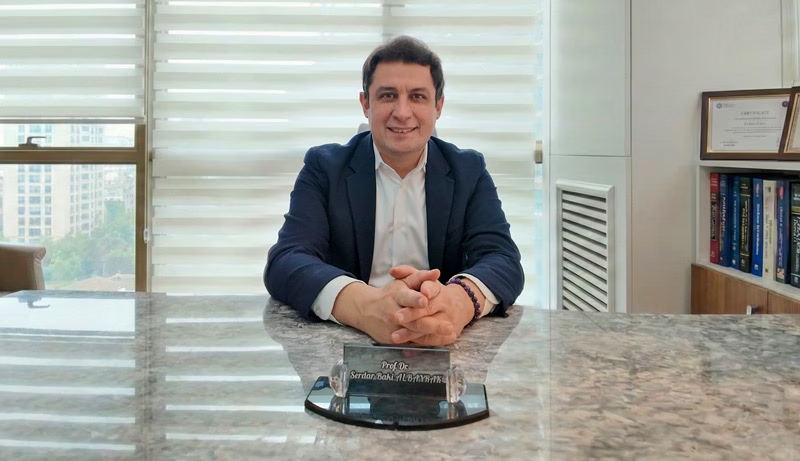
Prof. Dr. Serdar Baki Albayrak
Neurosurgeon · Craniosynostosis Surgery in Babies and Children
Prof. Albayrak treats craniosynostosis with endoscopic surgery and a helmet, or with open skull reshaping. He recommends either one only after examining the baby in person. His published work also includes a review of surgery for tethered cord syndrome in childhood.
He completed his neurosurgery training at Istanbul University in 2004. Clinical fellowships then followed at the University of Helsinki and Harvard Medical School. Consultations take place in English or Turkish.
27+Years
5,000+Operations
64Countries
33Publications
Figures from Prof. Albayrak's professional profile, September 2026. See his full publication list.
Request an AppointmentFrequently Asked Questions
How much does craniosynostosis surgery cost in Turkey?
The cost depends on the approach, the hospital stay, the scans and any helmet. Prices online often cover different things. So ask for the cost of your baby's plan at the consultation, before you decide.
Can a baby with craniosynostosis live a normal life?
Yes, most children do, especially with one closed seam and timely treatment. Children with a syndrome may need more care over the years. Even so, many of them also lead full lives.
Which doctor treats craniosynostosis?
A pediatric neurosurgeon, often together with a plastic (craniofacial) surgeon. Your pediatrician usually spots the head shape first and refers you. For syndromes, other specialists also join the team.
Prof. Albayrak's Published Research
These articles by Prof. Albayrak cover surgery in children, the skull bone and vision. None of them studies craniosynostosis directly. See his full list of 33 publications.
- Tethered cord syndrome in childhood: special emphasis on the surgical technique and review of the literature with our experience
- Giant intradiploic leptomeningeal cyst of the posterior fossa
- Persistent bilateral amaurosis in a child caused by damage to the calcarine cortex and the claustrum in contralateral hemispheres after a closed head injury
Public health information
- NHS. Craniosynostosis.
- NHS. Flat head syndrome (plagiocephaly and brachycephaly).
- MedlinePlus. Craniosynostosis.
- MedlinePlus. Craniosynostosis repair: discharge.
- MedlinePlus. Cranial sutures.
- MedlinePlus. Metopic ridge.
- UK Civil Aviation Authority. Surgical conditions: guidance for health professionals.
- US Centers for Disease Control and Prevention. Medical tourism.
This page gives general medical information and does not replace a consultation. Diagnosis and treatment decisions need an examination by your child's own doctor. Travel rules change, so check the official pages above before you book.
Last updated: 1 October 2026. Website editor: Prof. Dr. Serdar Baki Albayrak's clinic, [email protected].
Plan Your Baby's Craniosynostosis Treatment in Istanbul
Request an appointment with Prof. Dr. Serdar Baki Albayrak. The team then helps you plan the dates of your visit.
Request an Appointment