
Paid online consultations are available by appointment. For booking, please contact us via Whatsapp.

What Is Skull Augmentation Surgery?
Skull augmentation surgery adds a thin, custom implant on top of a healthy skull to change the shape of the head. It mostly treats a flat back of the head or a forehead that slopes far backward.
Some surgeons call it cranial augmentation or cosmetic skull reshaping. In short, the brain and the skull itself stay untouched, and only the outer contour changes.
Still, this is a real operation under general anesthesia. So it suits adults who have thought it through, not a quick cosmetic fix.
At a Glance
- Who it helpsAdults with a flat back of the head, a sloping forehead or a dent in the skull contour
- How it worksAn implant sits on the outer skull, under the scalp
- MaterialsCustom PEEK, ready-made or hand-shaped bone cement, or hydroxyapatite cement
- PlanningThin-slice CT scan and a 3D implant design you approve
- OperationGeneral anesthesia; usually one to three hours
- Main risksInfection, fluid under the scalp, a visible edge, numbness
Is part of your skull missing after surgery or an injury?
Then you need skull repair, not augmentation. Our guide to cranioplasty surgery covers stored bone, titanium and PEEK repair.
Is this about a baby's head shape?
Infants follow a different path, such as positioning or a helmet. See our guide to craniosynostosis instead.
Which Head Shape Concern Brought You Here?
Pick the line that sounds most like you. Each one then opens the matching part of this guide.
- 01The back of my head looks flatCauses in adults and how the surgery rounds it
- 02My forehead slopes too far backForehead augmentation for men and women
- 03Implant, bone cement or fillers?All options compared in one table
- 04How much change is possible?What the scalp allows
- 05Is it safe? What about the scar?Risks, warning signs and recovery
- 06I am planning surgery from abroadTwo visits, length of stay and flights
Before and After Illustration: How the Head Contour Changes
The drawing below shows the idea of the operation on one head profile. Drag the handle to compare the shape before surgery with a planned contour.
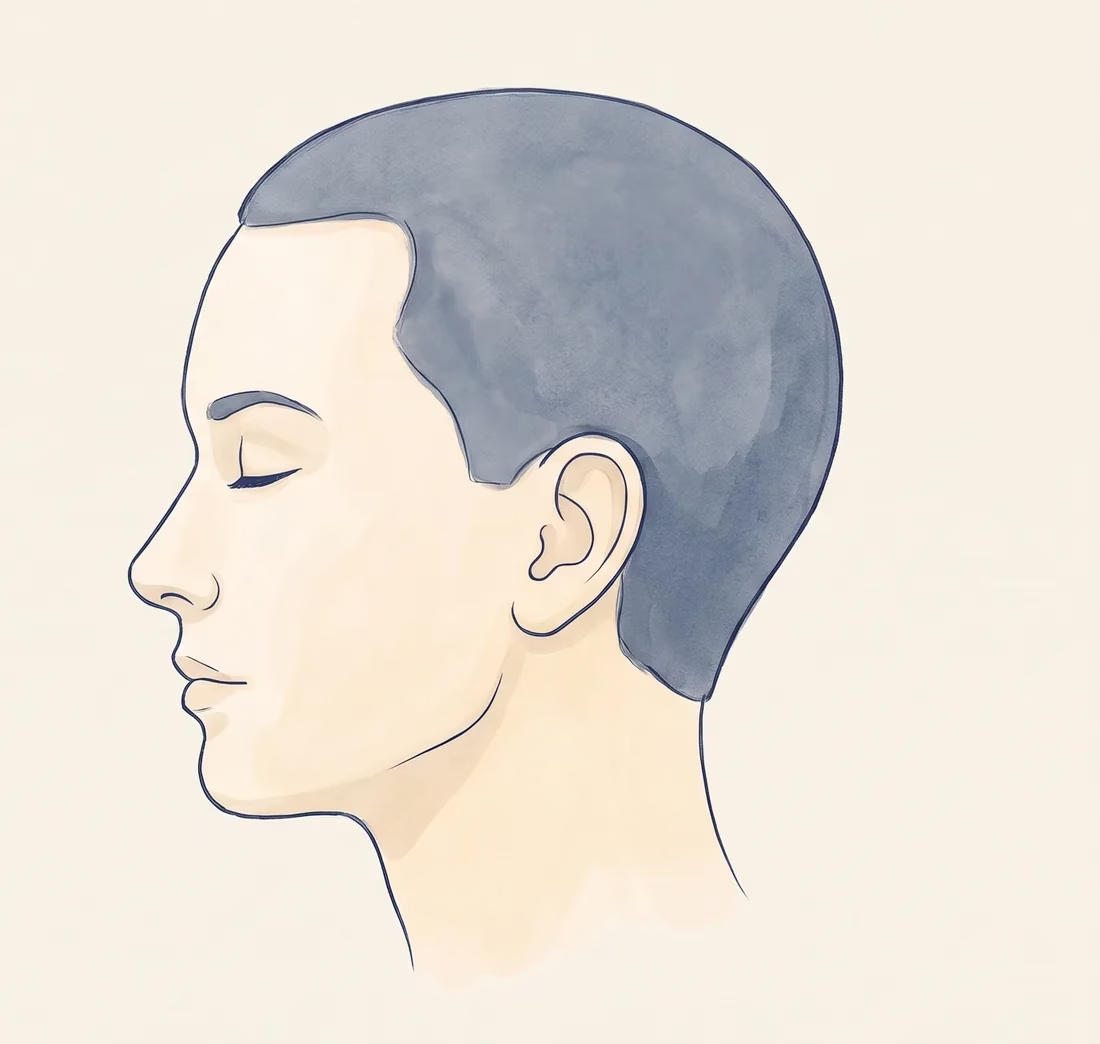
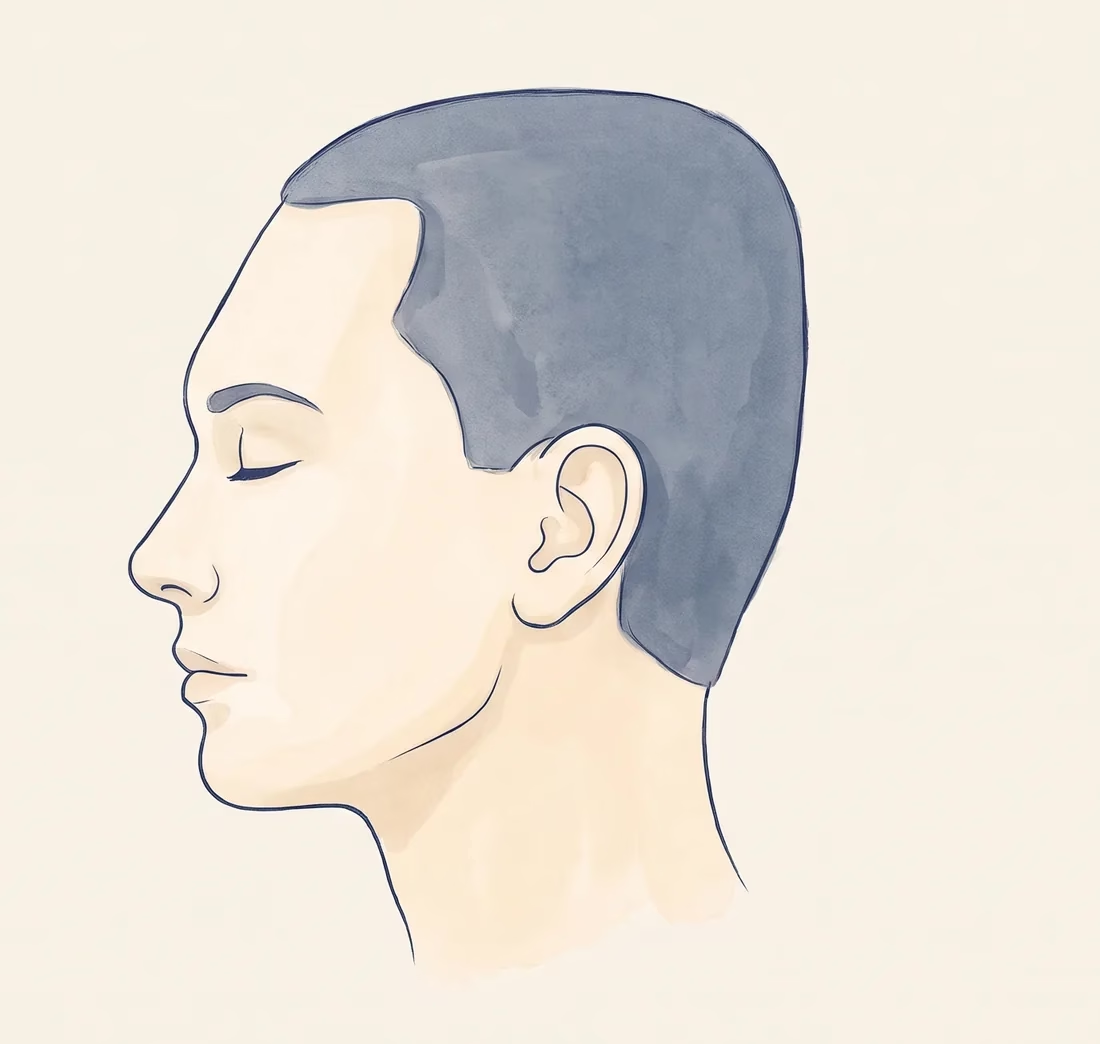
What the Drawing Shows
- Back of the head: an implant fills the flat area, so the curve continues smoothly down to the neck.
- Forehead: a thinner implant brings the upper forehead forward, so the slope looks softer.
- Everything else: the face, nose and jaw stay the same. Only the skull contour under the hair changes.
In reality, the change is usually more subtle than any drawing. So your surgeon shows you the planned shape on your own 3D model before you decide.
Flat Back of the Head in Adults
A flat back of the head in an adult usually comes from the bone itself. So pillows, exercises or a helmet cannot change it after childhood, while surgery can add the missing curve.
Why the Back of the Head Is Flat
Most often, the flat area began in infancy, for example from sleeping in one position. In other people, the skull simply grew short and wide, a shape doctors call brachycephaly.
Sometimes a suture in the skull also closed early in childhood. Either way, the shape stays fixed once the skull stops growing.
How Occipital Augmentation Works
The surgeon makes a cut across the back of the scalp, low and inside the hair. Next, the custom implant slides onto the bone and small screws or sutures hold it. The implant edges taper to nearly nothing, so the new curve blends into the neck.
Also, the scalp here is thick and firm. For this reason, it covers an implant well, but it also limits how far the back of the head can grow in one step.
Questions at this stage
Can you fix a flat back of the head as an adult?
Yes, with surgery. An adult skull no longer changes shape, so a helmet or exercises do not work. A custom implant over the flat area, however, can give the back of the head a rounder curve.
Will people see the implant with short hair?
Usually not, because the implant sits under thick scalp and its edges taper. With very short hair, however, the scar line may show, so ask your surgeon where the cut will run.
Sloping Forehead Augmentation
Forehead augmentation brings a backward sloping forehead forward with an implant over the frontal bone. As a result, the profile looks more upright, while the brows and eyes stay in place.
The cut usually runs behind the hairline, from one ear toward the other. Then the surgeon places a thin implant between the brow ridge and the top of the head.
Men and Women Need Different Shapes
A male forehead often keeps a slight slope and a defined brow ridge. A female forehead, by contrast, tends to look rounder and more upright. So the implant design follows your features, not one standard shape.
In addition, the forehead skin is thinner than the scalp at the back. Therefore the implant edges must taper very finely, or they may show in bright light.
Questions at this stage
Why do I have a sloped forehead?
Mostly because of the bone shape you inherited, which is normal anatomy and not a disease. However, a forehead shape that changes in adult life is different, and it needs a medical check first.
Can I have forehead and back of the head augmentation together?
Often yes, in one operation with two implants. Your surgeon, however, weighs the longer operation and the extra swelling before suggesting it.
Custom Implant, Bone Cement or Fillers?
Most skull augmentations use either a custom implant made before surgery or bone cement. Fillers and fat, by contrast, change the surface only a little and carry their own risks.
| Option | How it takes shape | Strengths | Limits |
|---|---|---|---|
| Custom PEEK implant | Designed on your CT scan and made before surgery | Exact fit, smooth edges, does not block scans | Takes weeks to make; needs a longer cut to fit in |
| Ready-made bone cement (PMMA) | Cast in a 3D-printed mold from your CT | Planned contour; can bend slightly to slide in | Production time; hard surface |
| Hand-shaped bone cement (PMMA) | Mixed and shaped on the skull during surgery | No production wait; one trip | Contour depends on the surgeon's hand; more touch-ups |
| Hydroxyapatite cement | Paste that sets on the bone | Bone-like mineral; good for small areas | Brittle; suits thin layers only |
| Fat or fillers | Injections under the skin | No implant, no long cut | Small, often temporary change; rare but serious vessel blockage |
Why Fillers Rarely Replace Surgery
On the forehead, fillers and fat can soften a small hollow. However, the US FDA warns that dermal fillers can block a blood vessel, which may harm the skin or vision. At the back of the head, moreover, the thick scalp hardly lets injections change the shape.
How a Custom Implant Takes Shape
First, a thin-slice CT scan of your skull becomes a 3D model. Next, the surgeon draws the new contour on the model and you review it together. A maker then produces the implant to that design.
In skull reconstruction, Prof. Albayrak already works with patient-specific implants designed from CT. So the same planning carries over to augmentation.
How long do skull implants last?
PEEK and bone cement do not dissolve, so the shape usually stays for many years. Still, nobody can promise a lifetime result. If a problem appears, a surgeon can remove or replace the implant.
Is bone cement an implant too?
Yes. Once it sets, bone cement stays on the skull as a permanent implant. The difference lies in timing: a custom implant takes shape before surgery, while hand-shaped cement takes shape during it.
How Much Can the Skull Be Built Up?
The scalp sets the limit. An implant can only grow as large as the skin over it can stretch and close without tension.
If the skin closes too tightly, the wound may open or the implant may show through over time. So your surgeon plans a change that the scalp can cover safely, even if you hoped for more.
When a Bigger Change Needs Two Stages
For a large correction, a surgeon may first place a small balloon, called a tissue expander, under the scalp. Over several weeks, it stretches the skin slowly. Then a second operation removes it and places the implant.
Also, an old scar, past radiotherapy or very thin skin change the plan. In these cases, a smaller implant is often the safer choice.
How Skull Augmentation Surgery Works
The operation takes place under general anesthesia and usually lasts one to three hours. The exact time depends on the area, the material and whether both regions get an implant.
- Marking the cut: the surgeon draws the line inside the hair and shaves only a narrow strip, if any.
- Lifting the scalp: the scalp lifts gently off the bone, and the brain lining stays closed.
- Fitting the implant: the implant sits on the bone, and its edges blend into the skull. Small screws or sutures then hold it.
- Placing a drain: a thin tube under the scalp often stops fluid from collecting for a day or two.
- Closing: the surgeon closes the scalp in layers and wraps the head in a soft dressing.
Where the Scar Goes
For the forehead, the cut usually runs across the top of the head, behind the hairline. For the back of the head, in contrast, it runs low across the scalp. As hair grows back, it hides the line in most people.
The skin near the cut may feel numb for weeks or months. This usually improves as small nerves recover.
How long does skull augmentation surgery take?
Usually one to three hours. One region with a ready-made implant tends to take less time, while two regions or hand-shaped cement take longer.
Do I need to shave my head?
Usually not. Most surgeons shave only a narrow strip along the cut, or none at all. Your hair then covers the line as it grows.
Risks of Skull Augmentation Surgery
Skull augmentation does not enter the brain, yet it still carries real surgical risks. Large studies of cosmetic skull surgery remain scarce, so honest planning matters more than any promise.
| Risk | What it means | How planning lowers it |
|---|---|---|
| Infection | The most serious problem; the implant may then come out | Healthy scalp, no smoking, careful wound care |
| Fluid or blood under the scalp | Swelling that may need draining | Drain, pressure dressing, rest |
| Wound opening | The scar parts, sometimes over the implant | An implant size the scalp can cover |
| Visible or palpable edge | A step you can feel or see, mostly on the forehead | Finely tapered edges in the design |
| Numbness or hair loss at the scar | Often temporary; a wider scar is possible | Careful cut and gentle closure |
| Asymmetry or an unwanted shape | A second operation may follow | 3D design you approve beforehand |
General anesthesia also carries its own small risks. The NHS explains them in its guide to general anaesthetic.
Tell your surgeon soon if you notice:
- Swelling that keeps growing after the first days
- A soft, fluid-filled bulge over the implant
- A new step or edge that you can see
- Numbness that spreads instead of shrinking
Go to the nearest emergency department (911, 999 or 112) for:
- Fever above 38 °C (100.4 °F) with chills
- Redness, warmth, discharge or a bad smell from the wound
- A wound that opens
- A severe or growing headache
Is skull reshaping surgery dangerous?
It carries real but manageable risks, and the brain itself stays untouched. Infection is the main concern, so your surgeon checks your scalp, health and habits first. Results also differ from person to person.
Can a skull implant come out if I do not like it?
Yes. A surgeon can remove or reshape a PEEK or cement implant in a second operation. That operation, however, carries its own risks, so careful planning beforehand matters most.
Skull Augmentation Recovery Time
Most people stay in hospital for one or two nights. Swelling peaks in the first days and then settles over several weeks.
| Stage | What happens | Your part |
|---|---|---|
| Days 1 to 3 | Pain relief, drain out, head dressing | Rest with the head raised; short walks |
| Week 1 | Swelling and bruising; after forehead surgery, puffy eyelids | Cool packs if allowed; no pressure on the area |
| Weeks 2 to 3 | Stitches or staples out; first hair wash | Gentle hair care; loose headwear only |
| Weeks 3 to 6 | Most swelling gone | No contact sport, heavy lifting or tight hats |
| Months 3 to 6 | Final contour; numbness eases | Follow-up visit; report any new bulge |
Desk work often resumes within one to two weeks. However, sports with a risk of a blow to the head wait until your surgeon agrees.
What is the recovery time after skull augmentation?
Most people return to light daily life within one to two weeks. Visible swelling fades over three to six weeks, and the final shape settles within a few months.
When can I wear a hat or headwear again?
Loose headwear is usually fine once the dressing comes off. Tight hats, bands or anything that presses on the scar, however, should wait until your surgeon checks the wound.
Who Is a Good Candidate for Skull Augmentation?
A good candidate is a healthy adult whose skull has stopped growing and whose concern comes from the bone shape. A CT scan confirms this before any plan.
- Healthy scalp: no active infection or open wound on the head.
- Non-smoker, or ready to stop: smoking slows wound healing and raises the risk of infection.
- Clear goal: you can describe the change you want, such as a rounder back of the head.
- Realistic hopes: the operation changes the skull contour, while the face itself stays the same.
An Honest First Conversation
At the first visit, your surgeon asks how the head shape affects your daily life. Sometimes worry about appearance becomes overwhelming, and the NHS describes this as body dysmorphic disorder. In that case, support may help more than surgery.
A new change in head shape is not a cosmetic issue
A bump, dent or swelling that appears in adult life needs a medical check first. Rarely, a growth in the bone or under it causes the change; see our guide to brain tumors.
Coming to Istanbul from Abroad for Skull Augmentation
Because a custom implant takes time to make, many people plan two trips. Others choose a single trip with hand-shaped cement or a ready-made implant.
Two Visits or One
On the first visit, you meet Prof. Albayrak, have an exam and get a thin-slice CT scan in Istanbul. Then the implant takes shape over several weeks while you are home. On the second visit, the operation and early recovery follow.
With hand-shaped cement, however, consultation and surgery can fit into one stay. Your surgeon explains which route suits your goal.
How Long to Stay and When to Fly
For the surgery visit, plan about ten to fourteen days, so the stitches come out before you leave. The UK CAA guidance on fitness to fly leaves the date to your doctor. So your surgeon confirms it at the last check.
The NHS also gives practical advice on cosmetic surgery abroad. For costs, insurance and the trip itself, see our guide to surgery in Turkey.
Hair Transplant and Family Plans
Many visitors to Istanbul also plan a hair transplant. The back of the head, however, serves as the usual donor area, so tell your surgeon early and plan the order together.
A family member can join you at the consultation, too. Then everyone hears the plan, the risks and the recovery rules together.
Can I combine skull augmentation with a hair transplant?
Not on the same day, as a rule. Both procedures use the back of the scalp, so your surgeon decides the order and the gap between them.
Your treatment in Istanbul
From Your First Message to Flying Home
Skull augmentation in Istanbul follows four clear steps. Each one answers a practical question about your trip.
STEP 01
Request an appointment
Use the form on this page, WhatsApp or call +90 532 308 97 72. Then tell us which area concerns you and your travel dates. You can write in English or Turkish.
STEP 02
Consultation, CT scan and design
First, Prof. Albayrak examines your head shape and scalp at his clinic in Teşvikiye. Next, a thin-slice CT scan follows in Istanbul, and the implant design starts from it.
Questions worth asking include:
- Which material suits my goal and my scalp?
- How much change can my scalp safely cover?
- Where will the scar run?
What should I bring to the consultation?
Bring any earlier CT or MRI images with their reports, a list of your medicines and notes on past head surgery. Photos of the shape you hope for can also help the conversation.
STEP 03
Surgery and hospital stay
If you choose surgery, the operation takes place in a hospital in Istanbul. Prof. Albayrak names the hospital at the consultation, along with the likely stay. A relative or companion can usually stay with you, too.
STEP 04
Recovery, fitness to fly and follow-up
After discharge, you rest at a nearby hotel and keep the wound dry. Then, before the flight, your surgeon removes the stitches and confirms that you can fly.
Back home, seek urgent help for fever, wound discharge or a swelling that grows fast.
Can someone travel with me?
Yes, and it helps. A companion can carry bags and help with hair care in the first days. They can also watch for warning signs.
Your Skull Augmentation Surgeon in Istanbul
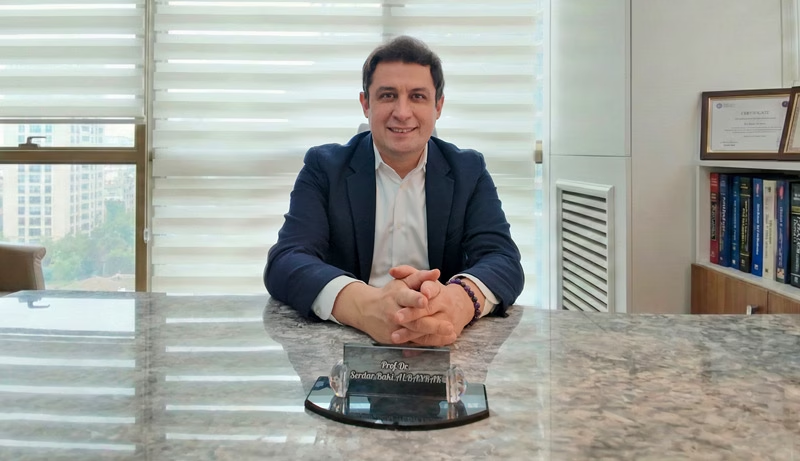
Prof. Dr. Serdar Baki Albayrak
Neurosurgeon · Full Professor of Neurosurgery
Prof. Albayrak plans and performs skull augmentation in Istanbul, alongside skull repair after craniectomy. He designs each implant from a CT scan and talks through the limits with you first.
After medical school at Marmara University, he trained in neurosurgery at Istanbul University. Clinical fellowships at the University of Helsinki and Harvard Medical School followed.
27+Years
5,000+Operations
64Countries
33Publications
Figures from Prof. Albayrak's professional profile, September 2026. See his full publication list.
Request an AppointmentFrequently Asked Questions
What is the difference between skull augmentation and cranioplasty?
Skull augmentation adds volume over a complete, healthy skull to change its shape. Cranioplasty, by contrast, closes a gap where bone is missing, for example after a craniectomy. Read more in our cranioplasty guide.
Does skull augmentation affect the brain?
No. The implant sits on the outside of the skull, and the bone stays closed. So the surgery does not change how the brain works.
Can women have skull augmentation?
Yes. Long hair also hides the scar well. The design simply follows a softer, rounder female contour.
How much does skull augmentation cost in Turkey?
The cost depends mostly on the material, the number of areas and the length of stay. So ask for the cost of your own plan at the consultation, and see our guide to costs.
Prof. Albayrak's Published Research
Prof. Albayrak has no paper on cosmetic skull surgery itself. Instead, the first paper describes a cyst inside the bone at the back of the skull, the same region an occipital implant covers. The second, in turn, studies an infection after surgery, the main risk of any implant.
Each link opens PubMed; his profile lists all 33 publications.
- Giant intradiploic leptomeningeal cyst of the posterior fossa
- Postoperative cerebral abscess formation caused by Toxocara canis in a meningioma cavity
Public health information
- MedlinePlus, US National Library of Medicine. Plastic and Cosmetic Surgery.
- MedlinePlus. General anesthesia.
- NHS. Cosmetic procedures.
- NHS. Cosmetic surgery abroad.
- NHS. Body dysmorphic disorder (BDD).
- NHS. General anaesthetic.
- US Food and Drug Administration. Dermal Fillers (Soft Tissue Fillers).
- US Centers for Disease Control and Prevention. Medical tourism.
- UK Civil Aviation Authority. Assessing fitness to fly.
This guide gives general medical information and does not replace a consultation. The drawings on this page are illustrations, not patient photographs, and results differ from person to person.
Last updated: 18 November 2026. Website editor: Prof. Dr. Serdar Baki Albayrak's clinic, [email protected].
Plan Your Skull Augmentation Consultation in Istanbul
Request an appointment with Prof. Dr. Serdar Baki Albayrak. The team then helps you plan the consultation, the CT scan and your stay.
Request an Appointment