
Paid online consultations are available by appointment. For booking, please contact us via Whatsapp.

Is Surgery or Radiation Better for an Acoustic Neuroma?
Neither option suits everyone. Surgery removes the tumor and suits large tumors that press on the brainstem. Radiosurgery, such as Gamma Knife, aims to stop growth without an incision, so it mainly suits small to medium tumors under about 3 cm.
An acoustic neuroma (vestibular schwannoma) grows slowly on the hearing and balance nerve. So most people have time to compare both paths calmly. Monitoring with MRI also remains a third option for many small tumors (NIDCD).
This article compares only surgery and radiation. For symptoms, surgical routes and recovery, see our acoustic neuroma surgery page.
At a Glance
- SurgeryTakes the tumor out, completely in most cases
- RadiosurgeryStops growth; the tumor stays in place
- Size landmarkAbout 3 cm, and pressure on the brainstem
- HearingNot certain with either option
- ScansRegular MRI checks after both
- RecoveryWeeks after surgery, often days after radiosurgery
Where Are You in Your Decision?
First, pick the question closest to yours. Each line then takes you to the matching part of this article.
- 01Is my tumor too big for radiation?How size and brainstem contact steer the choice
- 02Which option protects my hearing?What each path means for the ear
- 03I worry about my faceFacial nerve risk with each option
- 04Show me both side by sideTen points in one table
- 05What happens after Gamma Knife?Swelling, scans and surgery later
- 06I want an opinion in IstanbulHow each path changes the trip
What Size Acoustic Neuroma Needs Surgery?
Around 3 cm works as the main landmark. Below it, radiosurgery often works well. Above it, or when the tumor presses on the brainstem, surgery usually comes first, because radiation can swell a large tumor.
In Prof. Albayrak's practice, radiosurgery mostly suits tumors under 3 cm. By contrast, he usually advises surgery for a tumor that keeps growing or has passed 3 cm. Doctors also grade size from 1 to 4, often called the Koos grade.
| Tumor on MRI | Usual first choice | Why |
|---|---|---|
| Small, inside the hearing canal | Monitoring, then radiosurgery or surgery if it grows | Many small tumors grow very slowly |
| Medium, up to about 2.5 to 3 cm, no pressure on the brainstem | Radiosurgery or surgery | Both control the tumor well at this size |
| Large, touching or pushing the brainstem | Surgery | Radiation does not relieve pressure, and swelling adds risk |
| Tumor with fluid-filled cysts | Often surgery | Cysts can enlarge quickly after radiation |
| Blocked fluid flow (hydrocephalus) | Surgery, sometimes with fluid drainage | The pressure needs relief now, not over months |
Why Age and Health Also Count
A younger person has many decades for a tumor to grow back. So many younger people prefer removal, also because radiation effects need lifelong scans. For older adults or people with heart or lung disease, however, radiosurgery often carries less risk (NIDCD).
Can Gamma Knife treat a large acoustic neuroma?
Usually not as a first step. Above about 3 cm, radiation can swell the tumor and press harder on the brainstem. Surgery then removes most of it, and radiosurgery can later treat a small leftover piece.
Which Option Protects Hearing Better?
Neither option promises to save hearing. Your hearing before treatment and the tumor's size matter most. Hearing already lost rarely returns, whichever path you choose (MedlinePlus).
Hearing After Surgery
With a small tumor and good hearing, a surgeon may choose a route that aims to keep it. Yet the tiny artery of the hearing nerve can go into spasm, so hearing may still fall. With a large tumor, the chance of keeping useful hearing drops further.
Hearing After Radiosurgery
Hearing often stays close to its level at first. However, it can decline slowly over the following years. So the ear needs regular hearing tests, not just MRI scans.
Then, if hearing on that side fades, hearing aids or an implant may help. Your team can also plan these for the other ear if needed.
Does radiation save hearing better than surgery?
For small tumors, the difference often stays modest. Radiation tends to keep hearing in the short term, but slow loss can follow over years. For larger tumors, both options carry a real risk to hearing on that side.
Facial Nerve Risk: Surgery vs Radiation
With small tumors, lasting facial weakness stays uncommon after either option. With large tumors, surgery carries a higher risk, because the nerve stretches thin over the tumor. NHS guidance notes that both treatments can sometimes cause facial numbness or weakness.
During surgery, small electrodes track the facial nerve all the time. Prof. Albayrak also may leave a thin piece on the nerve when it sticks firmly. Radiosurgery can later control that piece, so facial movement comes first.
After radiation, nerve effects tend to appear later, often after some months. In contrast, weakness after surgery shows at once and often improves over weeks. Our facial paralysis guide explains the treatments if weakness lasts.
Can Gamma Knife cause facial numbness?
Yes, sometimes. The facial nerve and the nerve for facial feeling lie close to the tumor. Numbness or twitching can appear months later, and it often eases with time.
Acoustic Neuroma Surgery vs Gamma Knife Compared
The table puts both paths next to each other. Bring it to your consultation, so you can ask about each line for your own tumor.
| Point | Microsurgery | Radiosurgery (Gamma Knife, CyberKnife) |
|---|---|---|
| Aim | Removes the tumor | Stops growth; the tumor may shrink slowly |
| Incision | Yes, usually behind the ear | None |
| Best size | Any size; the main choice above about 3 cm | Generally under about 3 cm |
| Hospital stay | Usually 4 to 5 days | Usually home the same day |
| Back to normal life | Several weeks; balance settles gradually | Often the next day (MedlinePlus) |
| Effect timing | Pressure relief at once | Weeks to months, sometimes longer |
| Hearing | Risk depends on size and route | Often kept at first; may fade over years |
| Facial nerve | Higher risk with large tumors | Lower risk; effects may appear later |
| Tissue diagnosis | Yes, the lab confirms the tumor type | No tissue; diagnosis rests on MRI |
| Scans afterward | Regular MRI; regrowth stays uncommon | Lifelong MRI follow-up |
Both paths also share one fact: regular MRI scans continue after treatment (NHS). So choose a plan that you can follow for years, close to home.
What Happens After Gamma Knife for Acoustic Neuroma?
Most people go home the same day, and the tumor then changes slowly. Its effects may take weeks or months to show (MedlinePlus). So the first scans mainly confirm that growth has stopped.
Temporary Swelling
Local swelling can appear months after the treatment, with headache or nausea. It usually settles without further treatment (MedlinePlus). Some tumors also look larger on a scan for a while, so one scan alone rarely means failure.
If the Tumor Keeps Growing
A small share of tumors keep growing after radiation. Surgery then remains possible, but scar tissue can make the nerves stick to the tumor. For this reason, careful planning matters even more in that operation.
Very rarely, radiation can also trigger a new tumor many years later. This risk counts more for younger people, so ask about it openly.
Can you have surgery after Gamma Knife?
Yes. Surgery can still remove a tumor that grows after radiosurgery. However, scar tissue often makes it harder to free the nerves, so a skull base surgeon should plan it.
Which Symptoms Each Option Can Ease
Both options mainly aim to control the tumor, not to cure every symptom. Even with treatment, hearing loss and tinnitus can persist (NHS). Yet the two paths differ for pressure symptoms.
- Imbalance and unsteadiness: often improve over weeks after surgery, once the brain adapts to one balance nerve
- Facial pain or numbness from pressure: surgery can relieve it sooner, because it removes the pressure
- Headache from blocked fluid: needs prompt relief, often with surgery; see our page on hydrocephalus treatment
- Tinnitus: may ease, stay the same or change with either option
Tell your doctor which symptom troubles you most. That answer often shapes the choice as much as the scan.
When Monitoring Still Makes Sense
A small tumor without growth may need neither treatment yet. In Prof. Albayrak's practice, monitoring suits very small tumors, older adults, people with serious heart or lung disease, and people whose hearing still works well. He then repeats the MRI every 6 months.
If the scans stay the same, monitoring simply continues. Then, once growth appears, the choice between surgery and radiation opens again. Our treatment page explains what to do with a small tumor found on a scan.
Book a visit with your doctor if:
- A follow-up MRI shows growth
- Hearing in one ear keeps falling
- Unsteadiness or facial numbness appears
- Headaches change in pattern
Go to the nearest emergency department if you have:
- A sudden, severe headache with vomiting
- New drowsiness or confusion
- Sudden weakness of the face or limbs
- Trouble swallowing or speaking
Questions to Ask Before You Choose
Good questions turn two options into one clear plan. So bring these to your consultation, together with every MRI and hearing test on disc.
- How large is my tumor, and does it touch the brainstem?
- Does my tumor have cysts, or signs of fast growth?
- What chance of keeping hearing do I have with each option?
- What facial nerve risk applies to my tumor size?
- If I choose radiation, what happens if the tumor keeps growing?
- How often will I need MRI scans, and for how long?
Comparing the answers side by side often makes the right path clear. A second opinion also helps, and it rarely delays anything that matters for a slow tumor. Similar logic applies to deciding when a meningioma needs surgery, the other common tumor in this area.
Coming to Istanbul From the US, Canada, the UK or Europe
A consultation comes first, before any decision. Bring every MRI on disc, your hearing tests and the written reports. Prof. Albayrak then examines you and explains which path fits your tumor.
If You Choose Surgery
Plan about a month in Istanbul, plus a few days for tests. Prof. Albayrak advises against flying in the first month after this operation. Our article on flying after brain surgery explains how the travel date works.
If Radiosurgery Fits Better
If radiosurgery suits your tumor better, Prof. Albayrak tells you so at the consultation. Since you usually go home the same day, the trip itself stays short. Afterwards, MRI checks can continue with your local doctor.
Our guide covers planning from the US, planning from the UK and a full travel checklist. From Canada, check with your provincial health plan and private insurer before you book.
Your care in Istanbul
From Your First Message to a Clear Plan
Your care in Istanbul follows four clear steps. The consultation comes first, so nothing commits you to surgery in advance.
STEP 01
Request an appointment
Use the form on this page, WhatsApp or call +90 532 308 97 72. A short message is enough: your diagnosis, your country and your travel dates.
You can write in English or Turkish, so use whichever feels easier. The team then agrees the consultation date with you.
STEP 02
Consultation in Istanbul
First, Prof. Albayrak examines you at his clinic in Teşvikiye and goes through your scans with you. He then explains whether monitoring, surgery or radiosurgery fits your tumor. Bring these to the visit:
- Every earlier MRI on disc, with the dates
- Your hearing tests (audiograms)
- A list of your symptoms and when each began
STEP 03
Treatment, if you need it
If you choose surgery, the operation takes place in a hospital in Istanbul. Prof. Albayrak names the hospital at the consultation, and also tells you how long you may stay there.
STEP 04
Scans and hearing tests at home
After treatment, you receive a written plan with the next MRI and hearing test dates. Then your local doctor can arrange those checks close to home.
Who follows me after I go home?
Your local doctor usually takes over day-to-day care, using the written plan and your scan copies. So arrange this visit before you travel, and keep the team's number with you.
Your Neurosurgeon in Istanbul
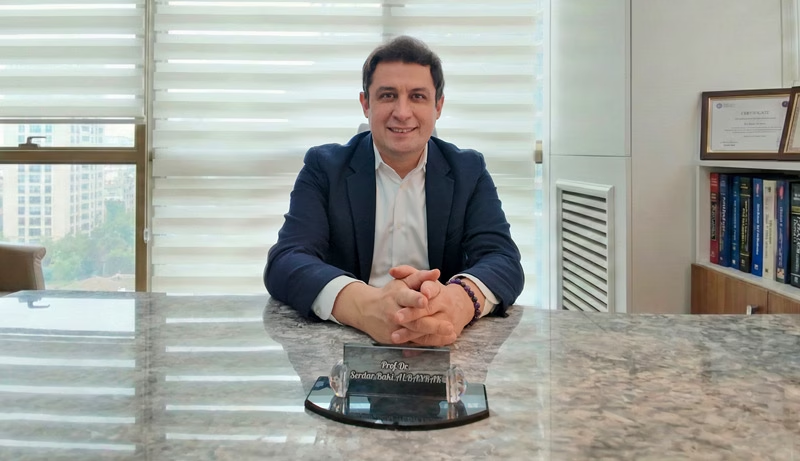
Prof. Dr. Serdar Baki Albayrak
Neurosurgeon · Full Professor of Neurosurgery
Prof. Albayrak removes acoustic neuromas through the principles of skull base surgery, under the microscope and with facial nerve monitoring. Just as openly, he tells patients when monitoring or radiosurgery suits their tumor better.
He completed his neurosurgery training at Istanbul University in 2004. He then took clinical fellowships at the University of Helsinki and Harvard Medical School. At Harvard, he trained at Brigham and Women's Hospital.
27+Years
5,000+Operations
64Countries
33Publications
Figures from Prof. Albayrak's professional profile, September 2026. See his full publication list.
Request an AppointmentFrequently Asked Questions
Does Gamma Knife shrink an acoustic neuroma?
Its main aim lies in stopping growth. Some tumors shrink slowly over the years, while others stay the same size. A stable tumor on follow-up scans counts as a good result.
Which option has the faster recovery?
Radiosurgery, in most cases. Many people resume normal activities the next day. After surgery, by contrast, balance and energy usually take several weeks to settle.
Can I choose radiation if my tumor is large?
Usually not as the first treatment. A large tumor that presses on the brainstem needs removal, and radiation can follow for any leftover piece. Your scans decide where your tumor falls.
Prof. Albayrak's Published Research
None of his papers studies acoustic neuroma directly, so these two cover the closest ground. The review covers surgery in the same corner behind the ear. The case report describes a nerve sheath tumor, from the family that includes schwannomas.
Each link opens PubMed. His full list of 33 publications is also on his profile.
- Microvascular decompression as a surgical management for trigeminal neuralgia: a critical review of the literature
- A case of intra-dural malignant peripheral nerve sheath tumor in thoracic spine associated with neurofibromatosis type 1
Public health information
- National Institute on Deafness and Other Communication Disorders. Vestibular Schwannoma (Acoustic Neuroma) and Neurofibromatosis.
- NHS. Acoustic neuroma (vestibular schwannoma).
- MedlinePlus. Acoustic neuroma.
- MedlinePlus. Stereotactic radiosurgery: Gamma Knife.
This article gives general medical information and does not replace a consultation. So decisions on monitoring, surgery or radiation need an examination by your own doctor.
Last updated: 14 November 2026. Website editor: Prof. Dr. Serdar Baki Albayrak's clinic, [email protected].
Unsure Between Surgery and Radiation?
Request an appointment with Prof. Dr. Serdar Baki Albayrak. Bring your scans and hearing tests to the consultation, and leave with a clear plan.
Request an Appointment