
Paid online consultations are available by appointment. For booking, please contact us via Whatsapp.

What Is 5-ALA in Brain Tumor Surgery?
5-ALA (5-aminolevulinic acid) is a drink you take a few hours before the operation. Fast-growing tumor cells turn it into a substance that glows pink under the blue light of the surgical microscope, while healthy brain stays dark. So the surgeon can see tumor edges that look like normal brain in white light.
Doctors also call this fluorescence-guided surgery. Its main use lies in high-grade gliomas such as glioblastoma, where the tumor grows into the brain like roots (NICE).
This article explains only the technique. For symptoms, tumor types and the full range of operations, see our guide to brain cancer surgery.
At a Glance
- How you take itA drink, about 2 to 4 hours before anesthesia
- What it showsTumor tissue glows pink under blue light
- Best suited toHigh-grade glioma, especially glioblastoma
- Main benefitMore complete removal of the visible tumor
- Main side effectSkin sensitive to strong light for about a day or two
- RadiationNone; it works with light only
What Would You Like to Know?
First, pick the question closest to yours. Each line then takes you to the matching part of this article.
- 01How does the dye make a tumor glow?From the drink to the pink light
- 02Will it work for my tumor?Tumor types, in one table
- 03What happens on the day?Hour by hour, from drink to dim room
- 04Does it really help?What studies show, and what they do not
- 05Is it safe for me?Side effects, light rules and who should not take it
- 06I am planning surgery in IstanbulWhat to ask before you travel
How Does 5-ALA Make a Brain Tumor Glow?
The glow comes from the tumor cells themselves. 5-ALA is a natural building block that every cell uses, but fast-growing tumor cells process it differently and store the result.
- The drink: you take the dose dissolved in water, matched to your body weight
- The barrier: a high-grade tumor damages the blood-brain barrier, so the substance reaches tumor cells far more than healthy brain
- The change: inside tumor cells, 5-ALA turns into protoporphyrin IX, a pigment that the cells cannot clear quickly
- The light: the surgeon switches the microscope to blue light, and the pigment answers with a pink to red glow
Prof. Albayrak describes the moment in plain terms: the field turns blue, the tumor glows, and he follows that glow while healthy tissue stays dark. The technique uses light only, so it adds no radiation to your body.
Is 5-ALA a contrast dye like the one used for MRI?
No. MRI contrast goes into a vein and shows the tumor on the scan. 5-ALA is a drink, and its glow only appears under the special blue light of the surgical microscope during the operation.
Which Brain Tumors Glow With 5-ALA?
The glow is strongest in fast-growing gliomas. NICE recommends 5-ALA for adults with a suspected high-grade glioma that shows enhancement on MRI, when the surgeon aims to remove all of that enhancing part. Other tumors glow less predictably.
| Tumor | Does it usually glow? | What it means for surgery |
|---|---|---|
| Glioblastoma and other grade 4 gliomas | Yes, strongly in most cases | The main use; it helps find the root-like edges |
| Grade 3 astrocytoma or oligodendroglioma | Often, at least in parts | Glowing spots can point to the most active area |
| Low-grade glioma (grade 2) | Often little or no visible glow | Navigation and brain mapping matter more |
| Brain metastasis | Variable | Can help at the edge of some deep tumors |
| Meningioma | Often | Used in selected cases, for example where the tumor meets bone |
| Regrowth after radiation | Yes, but treated tissue can glow too | The surgeon reads the glow together with scans |
Prof. Albayrak uses the technique mostly in glioblastoma. He also uses it in metastases and in some meningiomas. Each tumor type has its own page: astrocytoma, oligodendroglioma, brain metastases and meningioma.
Can 5-ALA be used in children?
Yes, in selected cases. The dose then follows the child's weight closely. In many countries this counts as use outside the adult label, so the team explains it to the family first.
What Happens on the Day of 5-ALA Surgery?
The drink adds only two small steps to a normal brain tumor operation: a timed dose before anesthesia, and dim light for a short time afterwards.
- About 2 to 4 hours before anesthesia: a nurse gives you the drink. It tastes close to water, and you then rest while the substance reaches the tumor
- In the operating room: the surgeon opens the skull in white light and removes the main tumor with the microscope and navigation
- Near the edges: the room lights go down, the microscope switches to blue light, and glowing tissue guides the last part of the removal
- The first 24 to 48 hours: you recover in a dim room with the curtains closed, because your skin reacts to strong light for a while
The rest of the operation and recovery follow the usual path. Our article on recovery after brain tumor surgery covers the weeks that follow.
Together With Awake Surgery and Navigation
5-ALA shows where the tumor is, but not where important brain function sits. So, near speech or movement areas, the surgeon combines it with nerve monitoring or awake craniotomy. Function then comes first, even if some tissue still glows.
Does 5-ALA make the operation longer?
Usually only a little. Switching to blue light takes seconds, and the surgeon moves between both lights as needed. The main extra step for you is drinking the dose at the right time.
Does 5-ALA Improve Brain Tumor Surgery Results?
It helps surgeons remove the visible tumor more completely. A large randomized European trial in high-grade glioma found complete removal of the enhancing tumor in about 65% of patients with 5-ALA, against about 36% with white light alone.
More complete removal matters, because it gives radiotherapy and chemotherapy less tumor to treat. In that trial, more patients also went six months without the tumor growing again.
Even so, the study did not prove longer overall survival. Later reviews also judged the overall quality of evidence as low.
So 5-ALA counts as a useful tool, not a cure. It does not change the tumor's biology, and treatment after surgery still decides much of the outlook. If the tumor returns, our page on repeat glioblastoma surgery explains when another operation makes sense.
Why Not Every Glowing Area Is Removed
Glow tells the surgeon where tumor cells are likely, not whether removal is safe. Tumor that glows inside a speech or movement area may stay, because losing function would harm you more than leaving a thin layer.
- Function first: glowing tissue in a vital area may be left on purpose
- False glow: inflamed or radiation-treated tissue can glow without active tumor
- Missed cells: single tumor cells spread beyond any visible glow
- Weak glow: low-grade tumors may not light up at all
For these reasons, European drug safety material warns against using the glow alone to diagnose a tumor. The lab report on the removed tissue gives the diagnosis.
5-ALA Compared With Other Surgical Guides
No single tool shows everything. So surgeons often combine two or three of them in the same operation.
| Tool | What it shows | Main limit |
|---|---|---|
| 5-ALA | Tumor cells glow pink, live, under blue light | Weak in low-grade tumors; treated tissue can glow |
| Sodium fluorescein | Yellow-green glow where the blood-brain barrier is damaged | Marks leaky tissue, not tumor cells as such |
| Neuronavigation | Your exact position on the MRI, like GPS | The brain shifts as the tumor comes out |
| MRI during surgery | A fresh scan before the skull is closed | Needs a special operating room; adds time |
| Awake mapping and monitoring | Where speech and movement sit | Shows function, not tumor |
Sodium fluorescein goes into a vein, and Prof. Albayrak chooses between the two dyes by tumor type. Prof. Albayrak also wrote an early paper on MRI during surgery, listed in the sources below.
5-ALA Side Effects and Light Rules
Most people notice nothing except the dim room. The main effect is skin sensitivity to strong light, which fades as the body clears the substance within about two days.
Possible Side Effects
- Redness or a sunburn-like rash if strong light reaches the skin too early
- Short-lived changes in liver blood tests, which usually settle within weeks
- Nausea or low blood pressure around surgery
- Changes in blood counts, checked with routine tests
Who Should Not Take It
People with porphyria, an allergy to the substance, or a pregnancy usually do not receive it. Tell the team about every medicine and herbal product as well. Some antibiotics and St John's wort, for example, also raise light sensitivity.
For the first 24 to 48 hours:
- Keep curtains closed and lights low
- Avoid direct sun and bright lamps
- Ask before any test with strong light
- Normal room light later is fine
Go to the nearest emergency department if, after you go home, you have:
- A sudden, severe headache or vomiting
- New drowsiness or confusion
- A seizure or new weakness
- Fever with fluid from the wound
Questions to Ask Your Surgeon About 5-ALA
Good questions show how the technique fits your own tumor. So bring these to your consultation, together with every MRI on disc.
- Does my scan suggest a tumor that is likely to glow?
- Will you combine 5-ALA with navigation, monitoring or awake surgery?
- What will you do if glowing tissue sits in a vital area?
- Which of my medicines should I stop or report before the drink?
- How long should I stay out of strong light afterwards?
- When will the lab report on the tumor be ready?
Comparing the answers helps you judge any plan calmly. A second opinion also fits here, as long as it does not delay surgery for a fast-growing tumor.
Planning 5-ALA Surgery in Istanbul From Abroad
A consultation comes first, before any decision. Bring every MRI on disc and the written reports. Prof. Albayrak then examines you and explains whether surgery fits and how he plans to use fluorescence.
The drink itself changes little about the trip. Yet the dim-light rule means you should not plan any outdoor sightseeing for the first two days. Plan the stay around the operation and the lab result instead.
Our guide covers planning from the US, planning from the UK and a full travel checklist. For the flight home, read our article on flying after brain surgery.
Your care in Istanbul
From Your First Message to a Clear Plan
Your care in Istanbul follows four clear steps. The consultation comes first, so nothing commits you to surgery in advance.
STEP 01
Request an appointment
Use the form on this page, WhatsApp or call +90 532 308 97 72. A short message is enough: your diagnosis, your country and your travel dates.
You can write in English or Turkish, so use whichever feels easier. The team then agrees the consultation date with you.
STEP 02
Consultation in Istanbul
First, Prof. Albayrak examines you at his clinic in Teşvikiye and goes through your scans with you. He then explains whether surgery fits your tumor and which tools he plans to use. Bring these to the visit:
- Every MRI on disc, with the dates
- Any biopsy or earlier surgery report
- A list of your medicines, including herbal products
STEP 03
Surgery, if you need it
If you choose surgery, the operation takes place in a hospital in Istanbul. Prof. Albayrak names the hospital at the consultation, and also tells you how long you may stay there.
STEP 04
Lab result and next steps
After surgery, you receive the lab report and a written plan for the next MRI and any further treatment. Then your oncology team at home can continue from there.
Who continues my treatment after I go home?
Your local oncology team usually plans radiotherapy or chemotherapy, using the lab report and the written plan. So arrange that first visit before you travel, and keep the team's number with you.
Your Neurosurgeon in Istanbul
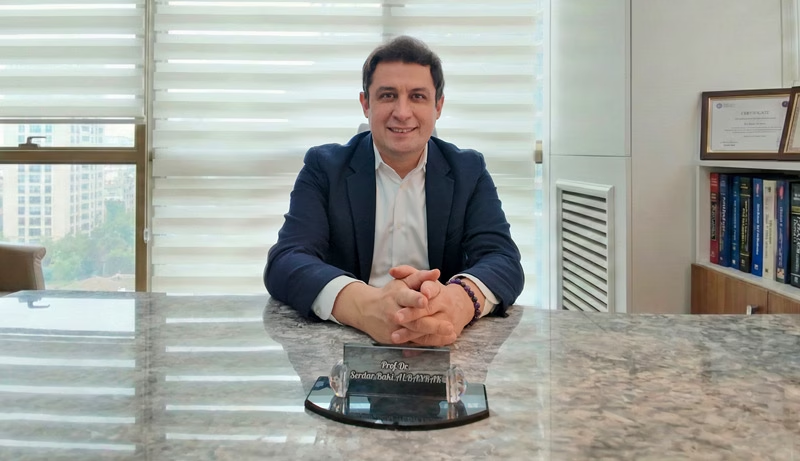
Prof. Dr. Serdar Baki Albayrak
Neurosurgeon · Full Professor of Neurosurgery
Prof. Albayrak removes brain tumors under the microscope, with navigation, monitoring and fluorescence where the tumor type suits it. He aims for the largest removal that keeps your speech, movement and daily life safe.
He completed his neurosurgery training at Istanbul University in 2004. He then took clinical fellowships at the University of Helsinki and Harvard Medical School. At Harvard, he trained at Brigham and Women's Hospital.
27+Years
5,000+Operations
64Countries
33Publications
Figures from Prof. Albayrak's professional profile, September 2026. See his full publication list.
Request an AppointmentFrequently Asked Questions
Is 5-ALA available in every hospital?
No. It needs a surgical microscope with a special blue light filter, and a team used to reading the glow. Centers that focus on brain tumor surgery usually have it.
Does 5-ALA affect my eyesight?
No, the drink does not harm vision. The room simply stays dim for a day or two. Any change in sight after surgery relates to the tumor's location, not to the dye.
Does 5-ALA mean the whole tumor is removed?
Not always. It helps remove more of the visible tumor, but tissue in vital areas may stay, and single cells lie beyond any glow. Your scan after surgery shows how much was removed.
Can 5-ALA be used again in a second operation?
Yes. It can guide repeat surgery as well. After radiation, however, treated tissue may also glow, so the surgeon reads the light together with the newest scans.
Prof. Albayrak's Published Research
None of his papers studies 5-ALA itself, so these three cover the closest ground. The first covers MRI during surgery, another tool for complete glioma removal. The second studies human glioblastoma cells, and the third a metastasis that looked like a glioma.
Each link opens PubMed. His full list of 33 publications is also on his profile.
- Intra-operative magnetic resonance imaging in neurosurgery
- The effects of tibolone on the human primary glioblastoma multiforme cell culture and the rat C6 glioma model
- Cerebral metastasis of small-cell lung carcinoma mimicking a supratentorial cystic astrocytoma
Public health information
- National Institute for Health and Care Excellence. Brain tumours (primary) and brain metastases in over 16s, quality statement 3: 5-aminolevulinic acid-guided resection.
- National Cancer Institute. Adult Central Nervous System Tumors Treatment (PDQ), patient version.
- NHS. Treatment for a malignant brain tumour.
This article gives general medical information and does not replace a consultation. So decisions on surgery and on the use of 5-ALA need an examination by your own doctor.
Last updated: 15 November 2026. Website editor: Prof. Dr. Serdar Baki Albayrak's clinic, [email protected].
Facing Surgery for a Glioma?
Request an appointment with Prof. Dr. Serdar Baki Albayrak. Bring your MRI scans to the consultation, and leave with a clear plan for your operation.
Request an Appointment