
Paid online consultations are available by appointment. For booking, please contact us via Whatsapp.

What Is Acoustic Neuroma Surgery?
Acoustic neuroma surgery removes a benign tumor from the nerve of balance and hearing. A surgeon reaches it through a small skull opening behind or above the ear. The aim is to remove the tumor while protecting facial movement and, where possible, hearing.
Doctors also call the tumor a vestibular schwannoma. It belongs to the skull base tumors, a group that also includes pituitary tumors. It does not spread like cancer, yet it can press on nearby nerves.
As it grows, it can therefore affect hearing, balance and the face. However, not every tumor needs surgery: MRI monitoring and radiosurgery are the other options (NHS). For tumors that grow or press on the brainstem, Prof. Albayrak performs microsurgery in Istanbul.
At a Glance
- The tumorBenign and usually slow-growing, on the nerve of balance and hearing
- First signsHearing loss, ringing or unsteadiness, mostly on one side
- Three optionsMRI monitoring, radiosurgery or microsurgery
- Surgical priorityProtect facial movement, and save hearing where the tumor allows
- Hospital stayUsually 4-5 days in Prof. Albayrak's practice, the first night in intensive care
- Flying homeNot in the first month, on Prof. Albayrak's advice; he confirms the date
Where Are You in Your Decision?
First, pick the line that matches you. Each link then explains what it means for treatment.
- 01Hearing loss or ringing in one earWhy one-sided symptoms lead to an MRI scan
- 02A scan found a small tumorWhen watching with MRI is the safest first step
- 03The tumor is growing or already largeWhen microsurgery becomes the better choice
- 04Weighing radiosurgery against surgeryWhat focused radiation can and cannot do
- 05Worried about your hearing or your faceHow surgery protects facial movement and hearing
- 06Planning surgery from abroadHospital stay, flights home and follow-up
Which Acoustic Neuroma Treatment Fits Your Tumor?
Overall, four things shape the plan: tumor size, age, hearing and general health. Growth on repeat scans matters too, so the right choice differs from person to person.
Hearing loss or ringing in one ear
In fact, hearing loss in one ear is usually the first sign. Many people notice it on the phone first, or in noisy rooms.
- Hearing loss that affects one ear more than the other
- Ringing or buzzing in that ear (tinnitus)
- Unsteadiness, especially when walking in the dark
- Later, numbness or weakness on that side of the face
These symptoms often have common causes, such as Ménière's disease. Even so, UK guidance supports an MRI scan for one-sided hearing loss or tinnitus (NICE).
Facial numbness or pain can also have other causes; see facial nerve pain.
A small tumor found on a scan
Many acoustic neuromas grow very slowly, and some never grow at all (NHS). For a small tumor with mild symptoms, MRI monitoring is often the safest first step.
In Prof. Albayrak's practice, monitoring especially suits people with:
- A very small tumor
- Older age
- Serious heart or lung disease
- No hearing loss so far
Monitoring then means an MRI scan every 6 months. If the tumor stays the same, monitoring simply continues; if it grows, treatment comes next.
A tumor that grows or presses on the brainstem
Microsurgery removes the tumor itself, so it suits growing or large tumors. Left alone, a very large tumor can then press on the brainstem (NIDCD). In addition, it can cause a dangerous build-up of brain fluid, called hydrocephalus (NHS).
In Prof. Albayrak's practice, surgery therefore becomes the better choice when:
- The tumor keeps growing on MRI
- It measures more than about 3 cm
- It presses on the brainstem
- Balance problems disrupt daily life
- You are young, with many years ahead in which the tumor could grow
Considering radiosurgery instead
Stereotactic radiosurgery, in contrast, focuses many thin beams of radiation on the tumor (MedlinePlus). Despite its name, it involves no cutting, so most people go home the same day.
Radiation does not remove the tumor. Instead, it aims to stop its growth, and the tumor may then shrink over time. Radiosurgery generally suits tumors smaller than about 3 cm, because larger ones risk brain swelling.
Doctors may also prefer it for older or frail people (NIDCD). This also applies to tumors in both ears, or on the only hearing ear. Its effects on hearing or the face may appear later, not at once (MedlinePlus).
If radiosurgery suits your tumor better, Prof. Albayrak tells you so at the consultation.
Worried about your hearing or your face
First, protecting facial movement guides every step, since the facial nerve lies beside the tumor. Second, whether hearing survives depends on tumor size, the route and your hearing beforehand.
However, hearing already lost before treatment rarely comes back. Most people with small tumors have no lasting facial weakness (MedlinePlus). Large tumors, however, carry a higher risk of lasting weakness.
If facial weakness lasts, physiotherapy and nerve transfer surgery can then help movement return. Our guide to facial paralysis also explains these options.
Tumors on both sides: NF2
Most acoustic neuromas occur by chance and affect one ear only. Tumors in both ears, however, usually point to neurofibromatosis type 2, or NF2 (NIDCD).
Doctors now also call it NF2-related schwannomatosis. Symptoms usually start in the late teens or early twenties (NHS). Each child of an affected parent has a 1 in 2 chance of inheriting it.
In NF2, the plan must also consider other tumors and hearing in both ears (NIDCD). Relatives may also benefit from genetic testing and advice.
Acoustic neuroma or meningioma?
A meningioma can also grow in this corner behind the ear, the cerebellopontine angle. An MRI usually tells the two apart, so each gets its own plan. For details, see the meningioma guide.
Could it be Ménière's disease?
Ménière's disease also causes hearing loss, ringing and vertigo (NHS). Its symptoms, however, come in attacks, while an acoustic neuroma usually causes gradual change. Hearing tests and an MRI scan therefore help doctors separate them.
Questions at this stage
Is an acoustic neuroma a brain tumor?
Yes, the NHS calls it a benign brain tumor. However, it grows on a nerve, not in the brain tissue itself.
What size acoustic neuroma needs surgery?
In Prof. Albayrak's practice, tumors over about 3 cm usually need microsurgery. So do tumors that press on the brainstem. Smaller ones, in contrast, often suit monitoring or radiosurgery.
Is an acoustic neuroma cancer?
No. It is a benign tumor, so it does not spread through the body (MedlinePlus). Yet it can still damage nearby nerves as it grows.
When to See a Doctor
Most hearing loss and ringing in the ears have common causes. One-sided symptoms, however, deserve a check, and a few need help the same day.
Book a doctor's visit if you notice:
- Hearing loss that affects one ear more than the other
- Ringing in one ear that does not go away
- Dizziness that keeps coming back
- New numbness or tingling on one side of the face
Seek urgent care the same day for:
- Sudden hearing loss that came on over 3 days or less
- Hearing loss with a drooping face or numbness on the same side
- A severe headache with vomiting, blurred vision or trouble walking
- Sudden weakness of the face or a limb
UK guidance says a specialist should see sudden hearing loss within 24 hours (NICE). With a large tumor, headache, vomiting and blurred vision can also signal fluid build-up (NHS).
Acoustic Neuroma Treatment Options Compared
Overall, doctors have three main options: monitoring with MRI, radiosurgery and microsurgery (NIDCD). Each suits a different tumor and a different stage of life.
| Option | Best suited for | What it does | Recovery | Main trade-off |
|---|---|---|---|---|
| Monitoring with MRI (wait and scan) | Small tumors, mild symptoms, older age or serious illness | Checks growth with regular scans; treatment only if needed | None | Hearing can still worsen while you wait |
| Stereotactic radiosurgery | Small to medium tumors, generally under about 3 cm | Focused radiation to stop growth; the tumor stays in place | Usually home the same day; normal activities the next day | Long-term MRI checks; effects on nerves may appear later |
| Microsurgery (removal) | Growing or large tumors, pressure on the brainstem, younger patients | Removes the tumor, completely in most cases | Usually 4-5 days in hospital; desk work after about a month | Risks to hearing and facial movement, higher with large tumors |
Tumors in both ears, or on the only hearing ear, also change these trade-offs (NIDCD). So in every case, Prof. Albayrak goes through each option with you before you decide.
Is surgery or radiosurgery better for an acoustic neuroma?
Neither is better for everyone. Surgery removes the tumor, but radiosurgery only controls its growth, without an incision. So your tumor size, age, hearing and general health decide which fits you.
How Surgeons Remove an Acoustic Neuroma
Surgeons reach the tumor by one of three routes around the ear. The choice then depends on the tumor's size, its position and whether useful hearing remains.
| Route | Where the opening is | Hearing | Typical use |
|---|---|---|---|
| Retrosigmoid (behind the ear) | A small skull opening behind the ear | Can be kept in suitable cases | The most widely used route; suits tumors of any size |
| Translabyrinthine (through the inner ear) | Bone behind the ear and the inner ear structures | Lost on that side | When hearing on that side has already gone; often with an ear surgeon |
| Middle fossa (above the ear) | A small opening above the ear | The main aim is to keep it | Only small tumors inside the hearing canal |
Neurosurgeons also use the same retrosigmoid route for microvascular decompression in trigeminal neuralgia.
How Prof. Albayrak performs the operation
Prof. Albayrak follows the principles of skull base surgery and works under a high-powered microscope. First, he hollows out the tumor from inside, so it shrinks to a thin shell. Then he peels that shell gently off the nerves.
He also spares the tiny vessels that feed each nerve. Without them, in fact, a nerve can stop working.
Throughout, small electrodes on the facial muscles also track the facial nerve. A monitor sounds a warning when he comes close, so he changes direction.
How long does acoustic neuroma surgery take?
In Prof. Albayrak's practice, the operation usually takes about 4 to 8 hours. Larger tumors take longer, especially when the nerves need freeing millimeter by millimeter.
When a thin piece stays on the nerve
Sometimes a thin piece of tumor sticks firmly to the facial nerve. He may then leave it in place to protect facial movement. Afterward, regular MRI watches that piece, and radiosurgery can treat it if it grows (NHS).
What Are the Risks of Acoustic Neuroma Surgery?
Every operation near the brainstem carries risks, and they rise with tumor size (MedlinePlus). So ask which ones apply to your tumor before you decide.
- Hearing loss on the operated side, even when the nerve stays intact, because its small blood vessel can go into spasm
- Facial weakness, often temporary; physiotherapy helps it recover
- Spinal fluid leak from the wound or, sometimes, through the nose; extra stitches or a drain in the lower back usually stop it
- Headache around the wound in the first weeks; medicines control it
- Dizziness in the first days, while the brain adapts to losing one balance nerve
- Infection, such as meningitis, which is rare; antibiotics treat it
How the team lowers these risks
Facial nerve monitoring, for example, lowers the risk of facial weakness. If the eyelid does not close fully, eye drops then keep the eye moist.
Bleeding or stroke can follow any brain operation, although both are rare. Your surgeon should therefore explain every risk before you agree to surgery.
Is acoustic neuroma surgery dangerous?
It is major brain surgery, so it carries real risks. The main risks affect hearing, facial movement and spinal fluid. They rise with tumor size, so small tumors carry a lower risk.
Acoustic Neuroma Surgery Recovery: What to Expect
Most people walk with help within a day or two. They then usually leave hospital after 4-5 days. Balance and energy, however, take weeks to settle.
Week by week
The timeline below reflects Prof. Albayrak's usual practice, but your own course may differ.
| When | What usually happens |
|---|---|
| Day of surgery | A night in intensive care, with close checks and a control CT scan |
| Days 1-5 | Ward care; a physiotherapist helps you walk; some dizziness on the first walks is normal |
| Days 4-5 | Discharge, once you walk and eat well |
| Around day 10 | Stitches out |
| Weeks 2-4 | Daily walks; no heavy lifting or straining; balance usually settles within about a month |
| About 1 month | Return to desk work |
| About 2 months | Return to physically demanding work, once balance feels steady |
Tiredness and headaches can last for weeks, sometimes months (MedlinePlus). It also advises no lifting over 9 kg (20 pounds) for 2 months.
How long does it take to recover from acoustic neuroma surgery?
Desk work usually resumes after about a month, and physical work after about two. However, tiredness, balance and facial movement can keep improving for months.
Coming to Istanbul from the US, Canada, the UK or Europe
Surgery takes hours, but recovery before the flight home takes weeks. So plan acoustic neuroma surgery in Turkey around that flight, which comes after a check-up.
How long to stay in Istanbul
First come the consultation and tests, then about 4-5 days in hospital. Stitches come out around day 10. Recovery nearby then continues until your surgeon clears you to fly.
How long should I stay in Istanbul for acoustic neuroma surgery?
Plan for about a month after surgery, plus a few days for the tests. Prof. Albayrak advises against flying in the first month, so keep your return date flexible.
When you can fly home
UK aviation guidance advises no flights for about 7 days after neurosurgery (CAA). Air left inside the skull can expand at altitude, so flying too early carries risk.
After this operation, however, Prof. Albayrak advises against flying in the first month. Cabin pressure changes can cause problems in that period.
So keep your return ticket flexible, and travel with a companion if you can. On a long flight, also ask how to lower your risk of blood clots.
Can you fly after acoustic neuroma surgery?
Yes, once your surgeon confirms it is safe. UK aviation guidance sets about 7 days as a minimum after neurosurgery. After this operation, however, Prof. Albayrak advises against flying in the first month.
Follow-up after you return home
- Hearing: a hearing test once you have healed; hearing aids or an implant can help if that ear no longer hears
- Facial nerve: checks of facial movement, physiotherapy if needed, and eye care if the eyelid does not close fully
- MRI scans: regular checks, because about 1 in 20 people have regrowth after removal (NHS)
- Balance: daily walks and balance exercises, ideally with a physiotherapist
- Records: your discharge summary, operation note, scan copies and tissue report for your local doctor
Driving, insurance and visas
Driving rules also differ by country. In the UK, for example, drivers must tell the DVLA about sudden, disabling dizziness (GOV.UK). In the US and Canada, however, ask your doctor about local rules.
Insurance, Medicare, NHS cover and visas work the same way for every operation. So our planning guide to brain surgery in Turkey explains them in one place. From Canada, also check with your provincial health plan and private insurer before you book.
Your treatment in Istanbul
From Your First Message to Your Flight Home
The journey follows four steps, and each step answers one practical question.
STEP 01
Request an appointment
First, use the form on this page, WhatsApp or call +90 532 308 97 72. A short message is enough: your diagnosis, your country and your travel dates.
You can write in English or Turkish. The team then contacts you to arrange the consultation.
What should I bring to the consultation?
Bring your MRI scans on a disc or USB drive, together with the written reports. Also bring any hearing test results and a list of your medicines.
STEP 02
Consultation and tests in Istanbul
Prof. Albayrak examines you at his clinic in Teşvikiye, Şişli. He checks your hearing, balance and facial nerves, then goes through your scans with you.
Two tests guide the plan: an MRI with contrast and a hearing test (audiogram). The MRI shows the tumor's size and its contact with the nerves. Meanwhile, the audiogram shows how much hearing remains.
He then explains each option, its risks and the recovery. If monitoring or radiosurgery suits you better, he tells you so.
Do I need a new MRI before surgery?
Often, yes. Surgeons plan this operation on a recent MRI with contrast. An older scan may therefore need repeating in Istanbul.
STEP 03
Surgery day
The operation takes place in a hospital in Istanbul, under general anesthesia. Prof. Albayrak also names the hospital at the consultation.
- The team places small electrodes on your facial muscles for nerve monitoring
- The surgeon opens a small window in the skull, usually behind the ear
- Under the microscope, he hollows out the tumor and peels its shell off the nerves
- Finally, he closes the brain's covering watertight and repairs the opening
Will I have a visible scar?
The cut sits behind the ear, within the hairline. So once the hair grows back, the scar is hard to see.
STEP 04
Recovery and the check before your flight
After a night in intensive care, you move to the ward. Next, a physiotherapist helps you start walking. Most patients leave hospital on day 4 or 5, then rest at a nearby hotel.
Before you fly, Prof. Albayrak checks the wound, your balance and your facial movement. Finally, you leave with a discharge summary, copies of your scans and, later, the tissue report.
Back home, get urgent help for any of these signs:
- Clear fluid from the wound or nose, or dripping into the throat
- Fever, or redness or discharge at the wound
- A severe headache that medicines do not relieve
- New weakness, new balance problems, confusion or a seizure
Who looks after me once I am back home?
Your local doctor takes over routine care, using your discharge summary. For anything urgent, contact local emergency services first.
Your Acoustic Neuroma Surgeon in Istanbul
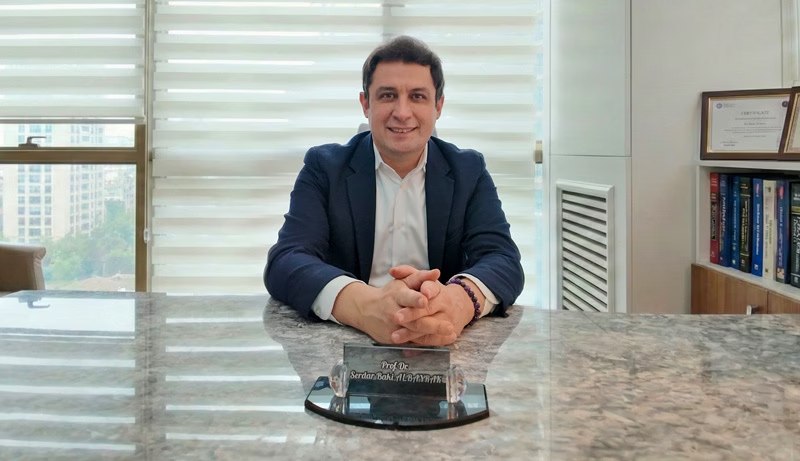
Prof. Dr. Serdar Baki Albayrak
Neurosurgeon · Acoustic Neuroma and Skull Base Surgery
Acoustic neuroma surgery means working millimeters from the facial, hearing and balance nerves. Prof. Albayrak therefore operates under the microscope with continuous facial nerve monitoring.
He trained in neurosurgery at Istanbul University. He then took clinical fellowships at the University of Helsinki and Harvard Medical School. At Harvard, he trained at Brigham and Women's Hospital.
Consultations take place in English or Turkish at Terrace Fulya Center, Teşvikiye, Şişli.
27+Years
5,000+Operations
64Countries
Figures from Prof. Albayrak's professional profile, September 2026. See his full publication list.
Request an AppointmentFrequently Asked Questions
Can an acoustic neuroma come back after surgery?
Sometimes: the NHS puts it at about 1 in 20 people after surgical removal. If a thin piece stayed on the facial nerve, regular MRI also watches it. Radiosurgery can then treat any growth.
Is an acoustic neuroma life-threatening?
Rarely. A very large tumor can, for example, press on the brainstem or block brain fluid. However, doctors find and treat most tumors well before that stage (NHS).
Do mobile phones cause acoustic neuromas?
Large studies have found no clear link between mobile phones and these tumors (NCI). Research continues, but most acoustic neuromas have no known cause.
How much does acoustic neuroma surgery cost in Turkey?
The cost depends on the hospital, your nights in hospital and the tests you need. So ask for a personal estimate at the consultation, and check what it includes.
Prof. Albayrak's Published Research
None of his papers studies acoustic neuroma directly, so these three cover the closest ground. For example, the review covers surgery in the same corner behind the ear. The chapter covers meningioma, the main look-alike tumor there.
Finally, the case report describes a nerve sheath tumor, from the tumor family that includes schwannomas. Each link opens PubMed or the publisher. His full list of 33 publications is also on his profile.
- Microvascular decompression as a surgical management for trigeminal neuralgia: a critical review of the literature
- The Origin of Meningiomas
- A case of intra-dural malignant peripheral nerve sheath tumor in thoracic spine associated with neurofibromatosis type 1
Public health information
- National Institute on Deafness and Other Communication Disorders. Vestibular Schwannoma (Acoustic Neuroma) and Neurofibromatosis.
- NHS. Acoustic neuroma (vestibular schwannoma).
- MedlinePlus. Acoustic neuroma.
- MedlinePlus. Stereotactic radiosurgery: Gamma Knife.
- MedlinePlus. Brain surgery: discharge.
- NHS. Neurofibromatosis type 2 (NF2).
- NHS. Hydrocephalus.
- NHS. Ménière's disease.
- National Institute for Health and Care Excellence. Hearing loss in adults: assessment and management (NG98).
- National Institute for Health and Care Excellence. Tinnitus: assessment and management (NG155).
- National Cancer Institute. Cell Phones and Cancer Risk.
- UK Civil Aviation Authority. Surgical conditions: guidance for health professionals.
- GOV.UK. Acoustic neuroma and driving.
This page gives general medical information and does not replace a consultation. Diagnosis and treatment decisions need an examination by your own doctor.
Last updated: 1 October 2026. Website editor: Prof. Dr. Serdar Baki Albayrak's clinic, [email protected].
Plan Your Acoustic Neuroma Treatment
Request an appointment with Prof. Dr. Serdar Baki Albayrak in Istanbul. The team then helps you plan the dates of your visit.
Request an Appointment